
For affluent families, executives, physicians, and business owners, annual gifting remains one of the simplest ways to transfer wealth efficiently. The 2026 annual gift tax exclusion allows individuals to move assets out of their taxable estate each year without reducing their lifetime exemption.
While the annual amounts may seem modest, consistent gifting can create meaningful long-term estate tax benefits, particularly for Illinois families facing a much lower state estate tax threshold.
As part of a broader advanced tax planning strategy, annual gifting can help preserve family wealth while supporting future generations.
Premium Tax Planners helps clients evaluate gifting opportunities within the context of their overall estate and tax strategy.
Understanding the annual gift tax exclusion rules for 2026 is the first step toward determining whether this strategy belongs in your long-term wealth-transfer plan.
| Key Takeaways The 2026 annual gift tax exclusion allows individuals to give up to $19,000 per recipient without reducing their lifetime estate and gift tax exemption.Married couples can use gift splitting to transfer up to $38,000 per recipient annually, creating significant long-term wealth-transfer opportunities.Consistent annual gifting can gradually reduce a taxable estate while shifting future asset appreciation to heirs.Certain payments, including direct tuition and medical expenses, generally do not count against annual gifting limits.For Illinois families, annual gifting can help reduce exposure to the state’s $4 million estate tax exemption, even when federal estate taxes are not a concern. |
The 2026 Annual Gift Tax Exclusion: $19,000 Per Recipient
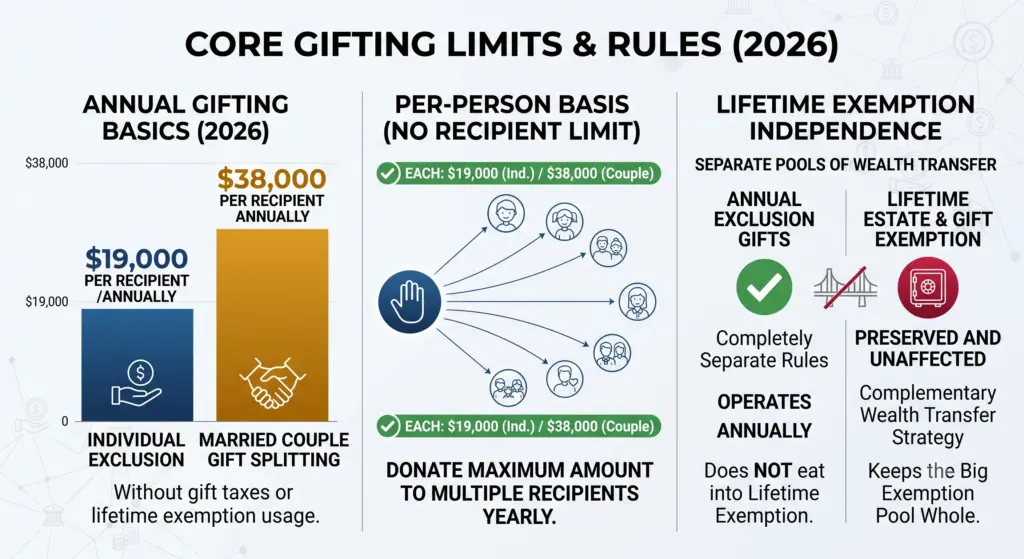
The IRS allows individuals to give a specified amount to any number of recipients each year without triggering gift tax consequences or reducing their lifetime exemption.
For 2026, the annual gift tax exclusion 2026 amount is $19,000 per recipient.
The rule applies on a per-person basis, which creates more flexibility than many taxpayers realize.
For example, a parent with three children could transfer $19,000 to each child during the year. A grandparent with six grandchildren could do the same for each grandchild. The exclusion is calculated separately for every recipient rather than being limited to a single annual amount.
This structure makes annual gifting one of the most accessible wealth-transfer strategies available under current tax law.
The 2026 gift limit may appear relatively modest compared to larger estate planning strategies, but its long-term impact can be substantial when gifts are made consistently over many years.
Why This Is Separate From Your $15 Million Lifetime Exemption
One of the most common misconceptions about gifting involves the relationship between annual gifts and the lifetime exemption.
Many taxpayers assume every gift reduces their federal estate and gift tax exemption. In reality, annual exclusion gifts operate under a separate set of rules.
As long as a gift qualifies under the annual exclusion limits, it generally does not reduce the donor’s lifetime exemption amount.
That distinction is important.
The federal estate and gift tax exemption now stands at historically high levels, allowing many affluent families to transfer substantial wealth before federal transfer taxes become a concern. At the same time, the annual gift tax exclusion 2026 provides an additional opportunity to move assets out of an estate without affecting those lifetime exemption amounts.
This is what makes annual exclusion gifting such an attractive planning tool.
Rather than choosing between annual gifts and lifetime exemption planning, families can often use both strategies together as part of a broader wealth-preservation approach.
For households focused on long-term estate planning, annual gifting effectively becomes a separate transfer mechanism that can be used year after year without consuming exemption capacity.
Gift Splitting: $38,000 Per Recipient for Married Couples
Married couples have an additional planning opportunity available through gift splitting.
Under federal tax rules, spouses can elect to treat a gift as if it were made equally by both spouses, even if only one spouse actually provided the funds.
This allows a married couple to effectively double the annual exclusion amount.
In 2026, that means a couple may transfer up to $38,000 to a single recipient while remaining within annual exclusion limits.
The flexibility becomes more apparent when multiple beneficiaries are involved.
A married couple with three adult children could transfer up to $114,000 during the year through annual exclusion gifts alone. Families with children and grandchildren may be able to move significantly larger amounts outside their estate over time.
The planning opportunity created by gift-splitting married couple elections is often underestimated because each individual transfer appears relatively small. However, when applied consistently across multiple recipients and multiple years, the cumulative effect can become meaningful.
For affluent families pursuing multigenerational wealth-transfer goals, gift-splitting strategies for married couples can serve as an efficient complement to trusts, lifetime gifting programs, and other estate-planning techniques.
The key is viewing annual gifting as an ongoing process rather than a one-time transaction.
When implemented consistently, annual exclusion gifting can gradually reduce the size of a taxable estate while shifting future appreciation to younger generations. Over time, that compounding effect often becomes far more valuable than the annual transfer amount itself.
How Annual Gifting Shrinks a Taxable Estate Over Time
The real value of annual gifting is not found in a single year’s transfer.
It comes from consistency.
Many affluent families focus on the amount they can give today and overlook what happens when the strategy is repeated year after year. Over time, annual gifts can gradually remove assets from an estate while also shifting future appreciation to the next generation.
That combination often creates a much larger impact than the original gift amount alone.
For families seeking to reduce taxable estate gifting exposure, the long-term effect is what makes the strategy so powerful.
The Compounding Effect of Gifting to Multiple Recipients
Consider a married couple with three adult children and four grandchildren.
Using annual exclusion gifts and gift splitting, they could transfer significant wealth each year without reducing their lifetime exemption. More importantly, any future appreciation on those gifted assets would generally occur outside the couple’s estate.
This distinction matters.
When appreciated assets remain inside an estate, future growth increases the estate’s potential tax exposure. When assets are gifted, future growth generally belongs to the recipient instead.
Over years or decades, the cumulative impact can be substantial.
This is why annual exclusion gifting is often viewed as more than a gifting strategy. It is a long-term wealth-transfer strategy that gradually shifts both assets and future appreciation out of the taxable estate.
For high-net-worth families, consistent gifting can be one of the simplest ways to reduce taxable estate-gifting exposure without implementing more complex planning structures.
Gifts That Don’t Count Against the Limit
The annual exclusion rules are valuable, but they are not the only way to transfer wealth tax-efficiently.
Certain transfers are exempt from gift tax rules altogether and generally do not count against the annual exclusion amount.
These exceptions can create additional planning opportunities for families supporting children, grandchildren, or other loved ones.
Direct Tuition and Medical Payments
One of the most useful exceptions involves educational and medical expenses.
Under federal tax law, payments made directly to an educational institution for tuition generally do not count against the annual exclusion amount. The same principle applies to qualifying medical expenses paid directly to a healthcare provider.
This creates opportunities that extend beyond the 2026 gift limit.
For example, a grandparent could make a qualifying tuition payment directly to a university while also making an annual exclusion gift to the same beneficiary during the year.
The two transfers are generally treated separately.
For families helping to fund education or healthcare costs, these exceptions can support larger wealth-transfer goals without affecting the annual gift tax exclusion amount for 2026.
Gifts to a Spouse and to Charity
Additional exceptions apply to gifts made to a spouse or to qualifying charitable organizations.
In general, transfers between spouses who qualify for the unlimited marital deduction are not subject to the annual exclusion limits. Similarly, gifts made to qualifying charitable organizations are generally governed by separate tax rules.
These provisions are often incorporated into broader estate planning strategies because they allow families to support personal, philanthropic, and wealth-transfer objectives simultaneously.
When coordinated effectively, annual gifting, charitable planning, and spousal transfers can work together as part of a comprehensive advanced tax planning strategy.
Why Annual Gifting Matters More in Illinois
Many affluent families focus primarily on federal estate tax rules.
For Illinois residents, state law can be just as important.
While the federal estate tax exemption increased significantly, Illinois continues to maintain a much lower estate tax threshold. As a result, families with no federal estate tax exposure may still face state-level estate tax concerns.
This is one reason annual gifting remains highly relevant even in a higher-exemption environment.
Reducing Exposure to the $4 Million Illinois Estate Tax
Illinois currently provides a state estate tax exemption that is significantly lower than the federal exemption.
As a result, many successful professionals, executives, physicians, and business owners may eventually face Illinois estate tax exposure long before federal estate taxes become an issue.
Annual gifting can help address that challenge.
By systematically moving assets out of an estate over time, families may reduce the value of assets subject to future Illinois estate tax calculations.
The strategy is particularly effective when implemented years before wealth-transfer concerns become urgent. Earlier gifting generally creates more opportunities for future appreciation to occur outside the taxable estate.
For affluent households pursuing comprehensive North Shore tax planning, annual gifting often serves as a foundational estate planning tool because of its simplicity, flexibility, and long-term impact.
When You Need to File a Gift Tax Return (Form 709)
One reason some taxpayers hesitate to make gifts is concern about filing requirements.
Fortunately, annual exclusion gifts are often simpler than people expect.
In many situations, gifts that fall entirely within annual exclusion limits do not create a gift tax liability. However, there are circumstances where additional reporting may still be required.
Gift Splitting, Larger Gifts, and Dipping Into the Lifetime Exemption
A Form 709 gift tax return may be required in several situations.
One common example involves gift splitting. Even when a married couple’s gifts qualify for annual exclusion treatment, a Form 709 gift tax return is generally required to properly report the election.
Filing requirements can also arise when gifts exceed annual exclusion limits.
Importantly, filing a return does not necessarily mean tax is owed.
In many cases, amounts exceeding the annual exclusion simply reduce the taxpayer’s available lifetime exemption. The return serves as a reporting mechanism that tracks how much of that exemption has been used.
Because gifting rules often interact with broader estate planning objectives, families frequently benefit from reviewing these decisions alongside professional estate and trust tax services rather than treating them as isolated transactions.
An Advisor’s Take: Making Gifting a Repeatable Annual Plan
The most effective gifting strategies are rarely built around a single year.
They are built around repetition.
Families that view annual gifting as a recurring part of their wealth-transfer strategy often achieve stronger long-term results than those who make sporadic gifts based on short-term circumstances.
A structured gifting plan can help families transfer wealth gradually, support future generations, and manage estate tax exposure without disrupting broader financial goals.
The simplicity of the strategy is part of its appeal. Once a framework is established, annual gifting can become a predictable component of a family’s overall tax planning and advisory approach.
Small Annual Gifts Can Create Significant Long-Term Results
The annual gift tax exclusion 2026 provides one of the simplest opportunities available to families seeking to transfer wealth efficiently.
While a single year’s gift may seem modest, consistent gifting can gradually remove assets and future appreciation from a taxable estate. For Illinois families, the strategy may also help address state-level estate tax concerns that remain relevant despite the higher federal exemption.
For executives, physicians, business owners, and high-net-worth families, annual gifting often works best when coordinated with broader estate and tax planning objectives.
Premium Tax Planners helps clients integrate gifting strategies, estate planning considerations, and long-term wealth preservation into a cohesive plan.
Whether your goal is to support future generations, preserve family wealth, or reduce estate tax exposure, thoughtful planning today can create meaningful benefits for years to come.
Review your gifting strategy with Premium Tax Planners.
FAQs
The annual gift tax exclusion amount for 2026 is $19,000 per recipient. Individuals may generally give up to that amount to any number of recipients during the year without using their lifetime exemption.
Generally, no. Gifts that qualify under the annual exclusion rules typically do not trigger gift tax or reduce the donor’s lifetime exemption.
Through gift splitting, a married couple can generally transfer up to $38,000 per recipient in 2026 while remaining within annual exclusion limits.
A Form 709 gift tax return may be required for certain transactions, including gift-splitting elections and gifts that exceed the annual exclusion limits.
It can. By moving assets out of an estate over time, reducing taxable gifts may help lower future Illinois estate tax exposure.