
A business can be doing well and still have the wrong business structure for its current level of profit. For many owners, that question comes up when self-employment tax starts taking a larger bite out of the earnings.
The S-corp vs sole proprietor decision is often presented as an easy tax-saving move. In reality, the math depends on your profit, the salary you would need to pay yourself, payroll costs, tax-return fees, the qualified business income deduction, and state taxes.
For Illinois business owners, there is another number to include: the state’s 1.5% replacement tax on S-corporations.
This guide breaks down sole proprietor vs. S-corp taxes for 2026, explains when to elect S-corp status, and shows why the S-corp election income threshold is better viewed as a break-even calculation than a fixed IRS number.
Key Takeaways
- Sole proprietors generally pay self-employment tax on net earnings from the business, while an S-corp can divide owner compensation between W-2 salary and distributions.
- The main S-corp self-employment tax savings come from distributions that are not subject to Social Security and Medicare employment taxes.
- You must pay yourself reasonable compensation for the work you perform before treating remaining amounts as distributions.
- A practical break-even range may be around $50,000 to $80,000 of net business profit, but there is no official IRS income threshold for making an S election.
- Illinois S-corporations also need to account for the 1.5% Personal Property Replacement Tax.
How a Sole Proprietor Gets Taxed Today: S-Corp vs Sole Proprietor
A sole proprietor generally reports business income and expenses on Schedule C. Net earnings from self-employment can then be subject to self-employment tax. When working through tax planning and advisory, consider this tax separately from regular federal income tax.
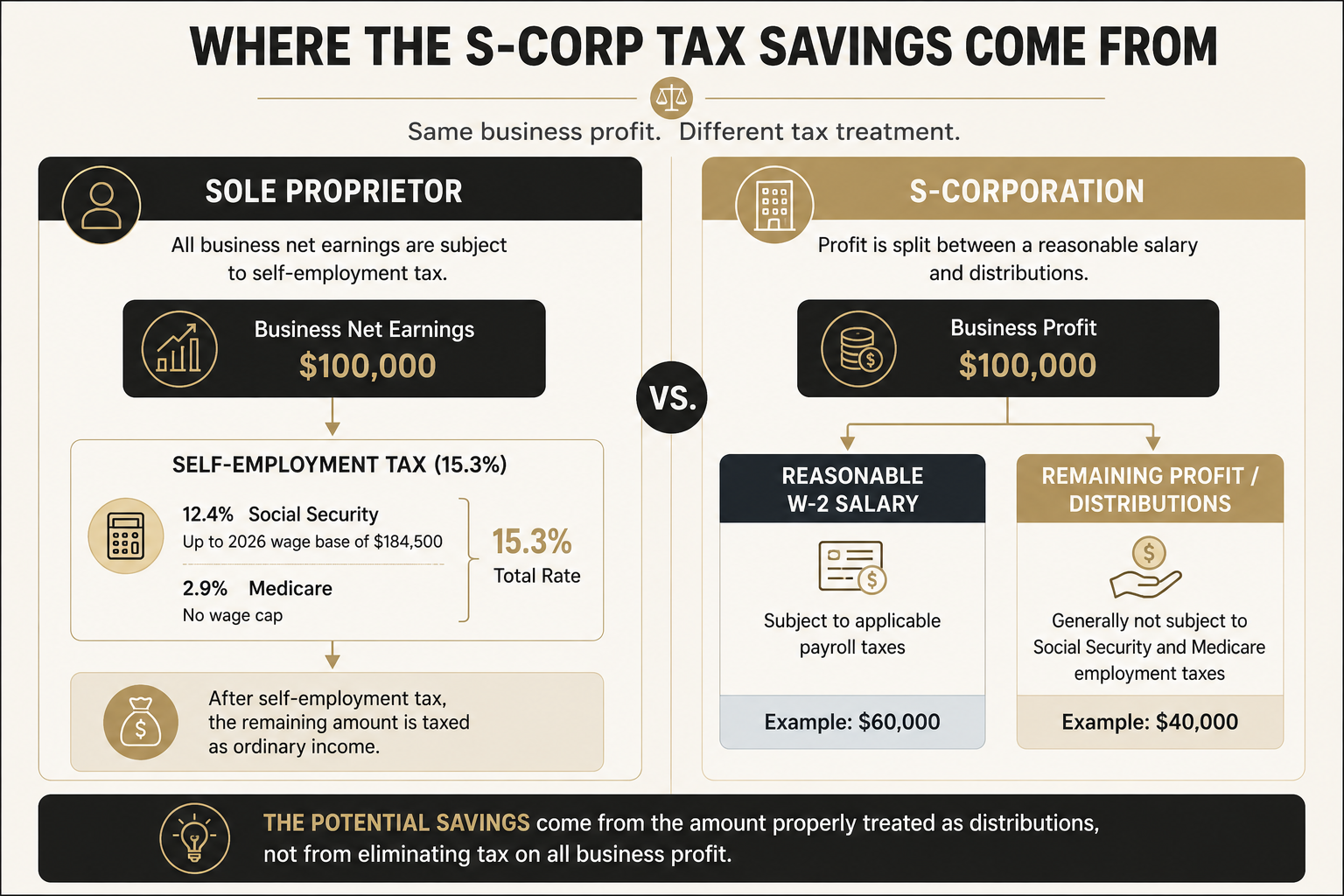
Why Every Dollar of Profit Faces 15.3% Self-Employment Tax
The self-employment tax rate is 15.3%, consisting of 12.4% for Social Security and 2.9% for Medicare. However, the actual calculation is more detailed than applying 15.3% directly to your Schedule C profit.
Generally, 92.35% of net self-employment earnings enters the basic calculation, and the Social Security portion is subject to the annual wage base. You can also generally deduct the employer-equivalent portion of self-employment tax when calculating adjusted gross income.
For sole proprietor vs. S-corp taxes, the full calculation should be used when estimating potential savings.
The 2026 Social Security Wage Base and the Medicare Piece
For 2026, the Social Security wage base is $184,500. Social Security tax generally applies at a combined 12.4% rate up to the applicable wage base when wages and self-employment earnings are considered together.
Medicare works differently. The basic Medicare portion is 2.9% and has no wage base limit.
A separate 0.9% Additional Medicare Tax may apply when combined Medicare wages, compensation, and self-employment income exceed these thresholds:
- Single and most other non-joint filers: $200,000
- Married filing jointly: $250,000
- Married filing separately: $125,000
Read More: Bonus Depreciation Is Back to 100% – What You Can Write Off Now
What an S-Corp Election Actually Changes
An S-corporation is generally a pass-through entity for federal income-tax purposes. The business files its own Form 1120-S, but its income, deductions, losses, and credits generally pass through to its shareholders.
The important difference in the S-corp vs sole proprietor calculation concerns employment taxes.
Splitting Income Into a Reasonable Salary and Distributions
If you work for your S-corporation, you generally become a shareholder-employee and receive W-2 wages for your services. Those wages are subject to applicable payroll taxes.
For example, if the business can support a $60,000 reasonable salary and leave $30,000 for distribution, the salary is subject to employment taxes while the distribution generally is not. This difference creates the potential S-corp self-employment tax savings.
Why Distributions Escape Self-Employment Tax
S-corp distributions are generally not subject to Social Security and Medicare employment taxes. However, this does not make the income tax-free. S-corporation income can still be subject to federal and state income tax, and the tax treatment of distributions can depend on stock basis and other rules.
The ‘Reasonable Salary’ Rule You Can’t Ignore
The potential tax benefit only works if the salary is defensible. You cannot simply choose a tiny salary and take nearly all business earnings as distributions.
The IRS can reclassify shareholder payments as wages when the facts show they were really compensation for services.
The Nine Factors the IRS Uses to Test Your Salary
IRS guidance lists factors that courts have considered when deciding whether shareholder compensation is reasonable:
- Training and experience
- Duties and responsibilities
- Time and effort devoted to the business
- Dividend history
- Payments to non-shareholder employees
- Timing and manner of paying bonuses to key people
- What comparable businesses pay for similar services
- Compensation agreements
- Use of a formula to determine compensation
There is no IRS table saying an owner earning a certain amount of profit must take a specific percentage as salary.
Your role matters. If most of the company’s revenue comes directly from your personal services, a larger portion of the money you receive may need to be treated as wages. If revenue comes from other employees, equipment, or capital, the analysis may look different.
Why Too Low a Salary Is the Top S-Corp Audit Trigger
Aggressively reducing salary can make an S-Corp look more attractive on paper because it increases the amount left for distributions. It can also create a compensation problem.
The IRS specifically has authority to reclassify non-wage payments as wages when shareholder-employees have been underpaid for their services. Reclassification can result in employment-tax consequences.
Determine reasonable compensation before estimating S-corp self-employment tax savings.
| Quick Tip Keep support for your salary calculation. Job duties, hours worked, industry compensation data, experience, and the way the business earns revenue can help explain why the salary is reasonable |
The Break-Even Math: When an S-Corp Pays Off
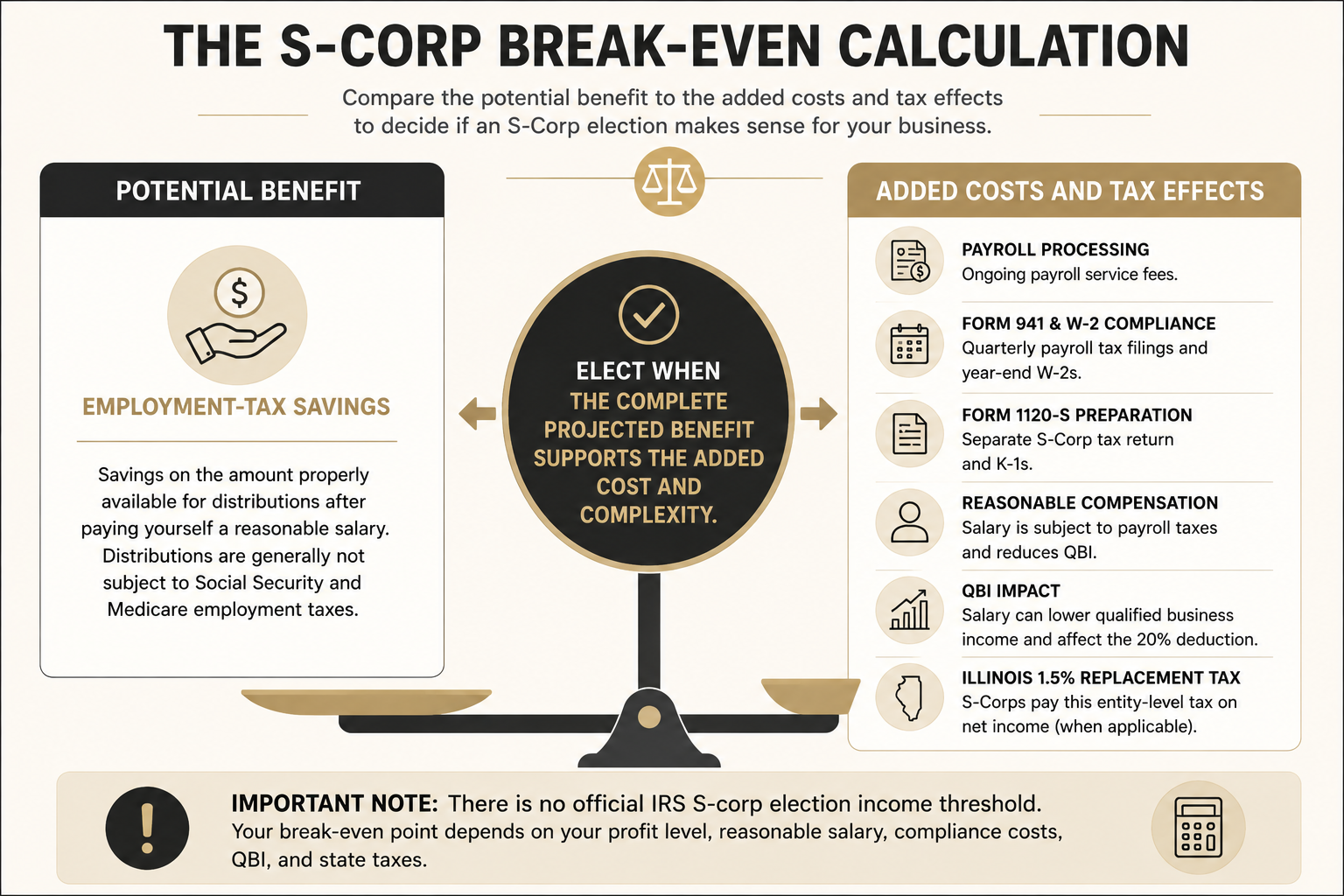
There is no statutory S-corp election income threshold that says you should elect S status once profit reaches a particular dollar amount.
Instead, there is a financial break-even point. Your potential payroll-tax savings need to exceed the additional cost and tax consequences created by operating an S-corporation.
The Income Level Where the Savings Beat the Extra Costs
A practical planning range is approximately $50,000 to $80,000 in net profit, although this is not an IRS rule. The real break-even point depends on how much profit remains after paying a reasonable salary.
For example, an $80,000 profit may produce limited savings if most of it needs to be paid as salary. This is why when to elect S-corp status should be based on profit, reasonable compensation, and added costs rather than revenue alone.
| Factor | Sole Proprietor | S-Corp |
| Separate federal business return | Generally no | Yes, Form 1120-S |
| Owner W-2 payroll | No | Generally yes for working shareholder |
| Self-employment/employment tax | Applies to net SE earnings | Applies to W-2 wages; qualifying distributions generally escape employment tax |
| Payroll filings | Generally no owner payroll | Required when paying wages |
| Reasonable salary requirement | No | Yes for shareholder-employees performing services |
| Additional administration | Lower | Higher |
Payroll, a Separate Return, and the Yearly Compliance Bill
An S-corporation can create roughly $2,000 to $4,000 in additional annual compliance costs in some situations, depending on the business and service providers used.
Costs may include:
- Payroll processing
- Quarterly Form 941 filings
- W-2 preparation
- State payroll requirements
- Bookkeeping adjustments
- Preparation of Form 1120-S and Schedule K-1
- Additional tax-planning and compliance work
If your estimated annual tax savings are $2,500 but S-corp administration costs $3,000, the election has not improved your financial position based on those numbers alone.
For owners considering advanced tax planning, the better comparison is annual after-tax savings minus recurring compliance costs and any additional state taxes.
How the S-Corp Choice Interacts With the QBI Deduction
The qualified business income, or QBI, deduction under Section 199A adds another layer to S-Corp vs sole proprietor math.
For eligible owners, QBI can generally produce a deduction of up to 20% of qualified business income, subject to applicable limits. The deduction is permanent under current law.
Why Your Salary Both Helps and Hurts the 20% Deduction
Reasonable compensation paid by an S-corporation to a shareholder is not QBI.
Your salary can affect the QBI deduction in several ways:
- Higher salary can reduce QBI: Reasonable compensation paid to an S-corp shareholder is excluded from QBI.
- Sole proprietors may start with more QBI: A sole proprietor does not pay themselves W-2 wages, which can leave a larger starting amount of QBI when other factors are equal.
- W-2 wages can matter at higher incomes: Above the applicable taxable-income thresholds, wages can become relevant to the Section 199A wage limitation.
- The 2026 thresholds are: $201,750 for most non-joint returns, $201,775 for married filing separately, and $403,500 for joint returns.
This interaction is one reason the S-corp election income threshold cannot be based on payroll taxes alone. Salary can reduce QBI while also affecting the wage limitation for higher-income taxpayers.
Read More: Oil & Gas vs. Solar: Which Cuts a High Earner’s Taxes More in 2026
The Illinois Catch: The 1.5% Replacement Tax
For Illinois owners, the federal sole proprietor vs S-corp taxes comparison leaves out an important state-level cost.
Illinois S-corporations are subject to the state’s Personal Property Replacement Tax. The current rate for S-corporations is 1.5% of applicable net Illinois income.
Why Illinois S-Corps Owe a Tax Sole Proprietors Don’t
A sole proprietor does not pay the 1.5% replacement tax simply for operating as a sole proprietorship. An Illinois S-corporation, however, generally files Form IL-1120-ST and pays the tax at the entity level.
This additional tax can reduce the federal savings from an S election, so it should be included when comparing the two structures. North Shore tax planning can help Illinois business owners account for both federal and state tax effects.
This is much tighter, while retaining the 1.5% distinction, Form IL-1120-ST, the impact on S-corp savings, and the anchor text.
When the State Pass-Through Entity Tax Election Helps
Illinois also permits eligible S-corps and partnerships to make an annual pass-through entity tax, or PTET, election.
The Illinois PTE tax rate is 4.95% of the entity’s applicable net income. Shareholders generally receive a corresponding Illinois credit based on their distributive share under the state’s rules.
The election can function as a federal SALT-cap planning strategy in appropriate situations because the entity pays the state tax. However, PTET is separate from the 1.5% replacement tax and should be evaluated using the owner’s full federal and Illinois tax picture.
An Advisor’s Take: Running the Numbers Before You Elect
The decision should start with projected profit rather than a rule such as “elect once you make $50,000.” A useful S-corp analysis should:
- Estimate sustainable business profit.
- Determine a supportable reasonable salary based on the work you actually perform.
- Calculate the potential employment-tax savings on the amount remaining after salary.
- Subtract added costs, including payroll, tax-return preparation, state taxes, and other compliance expenses.
- Model the QBI impact and other tax provisions affected by compensation or entity structure.
This process gives you a much more useful answer to when to elect S-corp status than relying on a generic income number.
Premium Tax Planners works with business owners whose business and personal taxes need to be reviewed together. For an owner considering an entity change, tax planning and advisory can compare both structures before the election affects payroll, distributions, and future filings.
Timing the Election and the Form 2553 Deadline for 2026
An eligible business generally elects S-corporation tax treatment by filing Form 2553.
For a 2026 election, keep these points in mind:
- January 1, 2026 effective date: For a calendar-year business seeking S-corp treatment from the start of 2026, the normal Form 2553 deadline was March 15, 2026.
- General filing rule: Form 2553 generally must be filed no later than two months and 15 days after the beginning of the tax year the election is intended to cover. It can also be filed during the preceding tax year.
- Eligible business structure: The business must have a legal and tax structure eligible to make the election, such as a corporation or eligible LLC. Certain LLCs can make the S election without separately filing Form 8832.
- Missed deadline: IRS procedures may provide late-election relief when the requirements are satisfied, so missing the regular deadline does not automatically mean waiting until the following year.
| Important Note Entity choice and S-corporation taxation can affect payroll, QBI, retirement planning, state taxes, and other parts of your return. Tax rules can also apply differently based on your circumstances. Consider reviewing the complete calculation with a qualified tax professional before making an election. |
Conclusion
The S-corp vs sole proprietor choice depends on more than the 15.3% self-employment tax rate. An S-corporation may create S-corp self-employment tax savings when the business earns enough to pay a reasonable salary and still leave profit for distributions. However, payroll costs, QBI, tax-return fees, and state taxes can reduce the benefit.
Before making an election, compare both structures using your projected profit, reasonable salary, compliance costs, QBI, and Illinois taxes. Premium Tax Planners can help you evaluate the numbers through business tax planning.
Schedule a consultation with Premium Tax Planners to determine whether an S-corp election makes financial sense for your business.
FAQs
At What Income Does an S-Corp Start Saving Money?
There is no official IRS S-corp election income threshold. A practical break-even range may be around $50,000 to $80,000 in net profit, depending on your reasonable salary, compliance costs, QBI, and state taxes.
How Much Salary Do I Have to Pay Myself?
There is no fixed IRS percentage. Your salary must be reasonable based on factors such as your duties, experience, hours worked, and what comparable businesses pay for similar work.
What Does It Cost to Run an S-Corp Each Year?
Additional compliance costs may be roughly $2,000 to $4,000 per year. These can include payroll, Form 941 filings, W-2 preparation, bookkeeping, and a separate Form 1120-S return.
Do Illinois S-Corps Pay Extra State Tax?
Yes. Illinois S-corporations generally pay a 1.5% Personal Property Replacement Tax on applicable net Illinois income. The state’s elective 4.95% PTET is separate from this tax.
When Is the Deadline to Elect S-Corp Status for 2026?
For a calendar-year business seeking S-corp treatment effective January 1, 2026, the normal Form 2553 deadline was March 15, 2026. Late-election relief may be available if you meet IRS requirements.