
Federal home office rules changed sharply for employees after 2017, yet the deduction remains available to some owners. A sole proprietor may deduct a qualifying workspace. An S-corporation owner can receive reimbursement for eligible costs when the arrangement is documented correctly.
The wrong route may cost you the deduction, create taxable wages, or cause you to claim a cost twice. A home office deduction approach starts with tax status, room use, and records.
This guide explains who qualifies, how both methods work, why an S-corporation shareholder generally needs an accountable plan, and how depreciation affects a home sale.
Key Takeaways
• Self-employed owners may deduct a qualifying home office directly.
• S-corporation owners generally need an accountable reimbursement plan.
• The workspace must usually receive regular and exclusive business use.
• Simplified and regular methods can produce different tax results.
• Regular-method depreciation can create taxable gain when the home is sold.
Why Most People Can No Longer Deduct a Home Office: Home Office Deduction S Corp Rules
The home office deduction begins with a basic distinction. A W-2 employee generally cannot claim unreimbursed home office costs as a federal itemized deduction. A self-employed person may qualify for a direct deduction, while an S-corporation shareholder-employee normally uses a company reimbursement process. Good tax planning and advisory start by identifying which role applies to you.
The Employee Deduction the TCJA Eliminated – and OBBBA Made Permanent
Before 2018, some employees could deduct qualifying unreimbursed business expenses as miscellaneous itemized deductions, subject to limits. The Tax Cuts and Jobs Act suspended those deductions for tax years 2018 through 2025. OBBBA made the elimination permanent for tax years beginning after December 31, 2025.
As a result, most W-2 employees cannot deduct unreimbursed home office expenses on their federal returns, even when their employers require them to work remotely.
The 2025 federal law commonly called OBBBA made the elimination of most miscellaneous itemized deductions permanent. A regular remote employee therefore generally cannot deduct the room, utilities, internet allocation, or similar unreimbursed costs on a federal return. Limited exceptions apply to certain workers under separate rules.
This result applies even when the employer requires remote work. Employer convenience does not restore the old deduction. The employer may instead reimburse qualifying costs under a compliant plan.
Read More: The Augusta Rule: Rent Your Home to Your Business, Tax-Free
Who Can Still Claim It: The Self-Employed and Business Owners
Self-employed Schedule C filers generally use Form 8829 for the regular method. Taxpayers choosing the simplified method calculate the deduction using the Simplified Method Worksheet in the Schedule C instructions and report the result on Schedule C.
Entity choice changes the path. A working S-corporation shareholder is an employee of a separate taxpayer and generally should not place the corporation’s home office costs on Schedule C.
The home office deduction for business owners therefore has more than one route:
- A sole proprietor may deduct qualifying costs directly against business income.
- A partner may have a different route when the partnership agreement requires the partner to pay unreimbursed expenses.
- An S-corporation shareholder-employee may request reimbursement through the corporation.
- A W-2 employee without an ownership role generally depends on the employer’s reimbursement policy.
A single-member LLC may be taxed as a sole proprietorship or may elect S-corporation status. Confirm its federal classification first.
The Rules Every Home Office Has to Pass
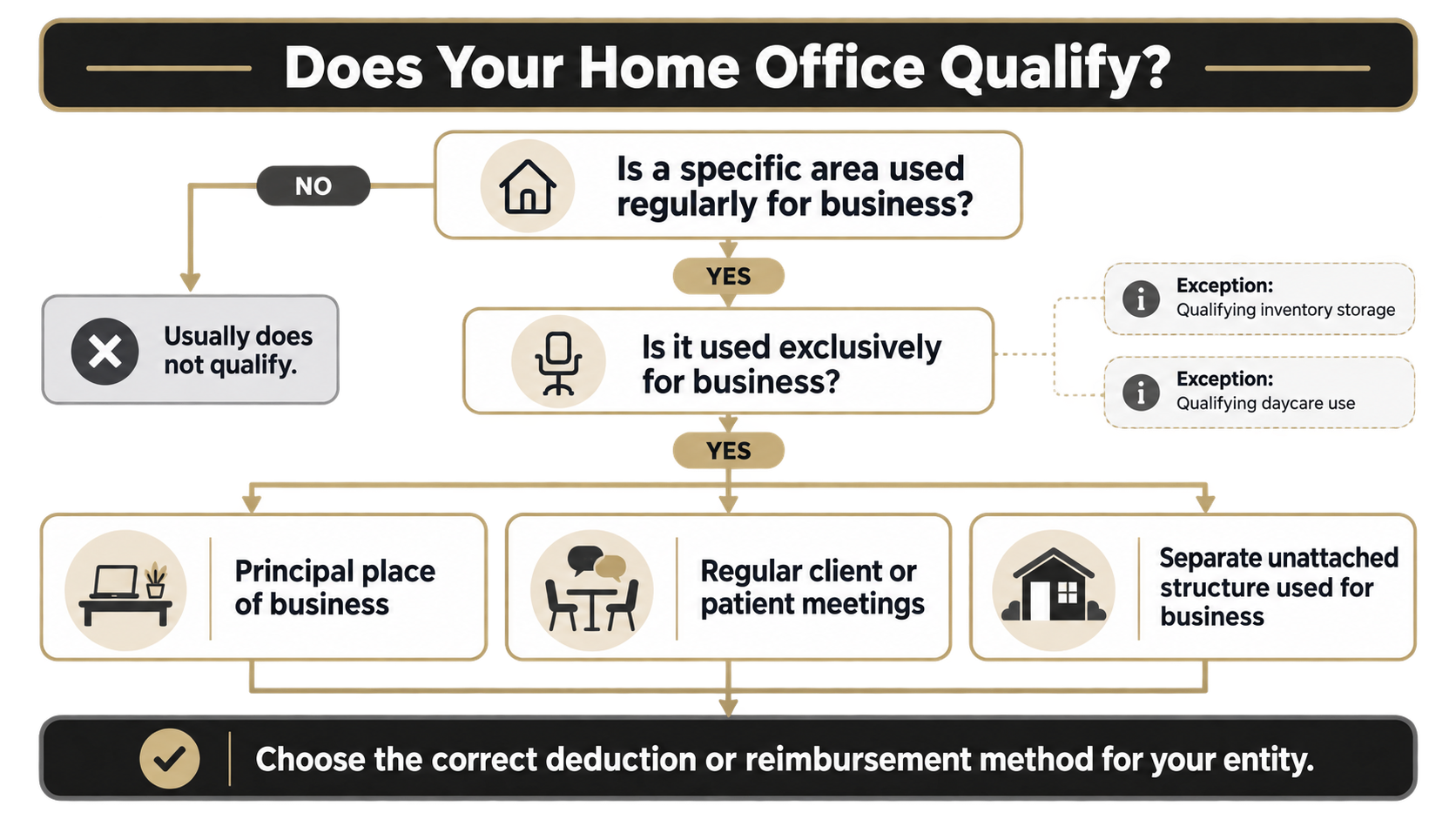
A payment method cannot rescue a workspace that fails the basic eligibility tests. Under IRS Publication 587, a qualifying workspace generally must receive regular and exclusive business use and satisfy a qualifying business-purpose test under Section 280A.
The ‘Regular and Exclusive Use’ Test – and Where People Fail It
Regular use means the business activity happens consistently, rather than once in a while. A room used for bookkeeping every workday may satisfy this test. A dining room used for one annual planning meeting usually will not qualify as a regular home office.
Exclusive use means the identified area is used only for the trade or business. A spare bedroom that doubles as a guest room usually fails, as may a family-room desk shared for personal activities. The office can occupy part of a room when its business area is clearly identifiable and free from personal use.
Two exceptions can ease this requirement. Certain inventory storage may qualify when the home is the only fixed location of a retail or wholesale business. A licensed daycare may use a time-and-space calculation. Both exceptions have detailed rules.
| Quick Tip Take dated photographs of the work area and keep a simple floor plan showing its dimensions. These records can support the home office deduction for business owners if the IRS later asks how the business percentage was calculated. |
The Principal-Place-of-Business Test Under Section 280A
The Section 280A home office standard allows a qualifying area used as the principal place of business. A home can meet that test when you conduct administrative or management work there and have no other fixed location where you perform substantial administrative or management activities for that same business.
For example, a contractor may work at customer sites while handling estimates, scheduling, billing, and records from a dedicated home office. The home may qualify for administrative purposes. Document activities performed at every fixed location.
A detached structure may qualify when used regularly and exclusively for business, even when it is not the principal place of business. Space used regularly for normal patient, client, or customer meetings may also qualify.
If You’re Self-Employed: Two Ways to Deduct
Once the space qualifies, a self-employed taxpayer usually chooses between the simplified and regular methods. You make the election year by year. Comparing both methods can be part of advanced tax planning, especially when housing costs are high or a future sale is possible.
The Simplified Method – $5 Per Square Foot, Up to $1,500
The simplified method uses $5 for each allowable square foot, capped at 300 square feet. The maximum is $1,500 for a full year of qualified use. Part-year use or area changes require a monthly calculation.
Suppose a consultant uses a 180-square-foot room exclusively and regularly for business throughout the year. The simplified deduction would be $900, subject to the gross-income limit. Under this method, the owner does not separately deduct the business share of utilities, insurance, repairs, rent, or home depreciation.
The simplified method reduces paperwork and sets home depreciation at zero. An unused simplified deduction cannot be carried forward. Prior actual-expense carryovers may remain available in a later regular-method year, subject to the rules.
The Regular Method – Actual Costs by Business-Use Percentage
The regular method uses actual expenses. Direct costs for the office, such as painting only the qualifying room, may be fully allocable to business. Indirect costs for the entire home are generally multiplied by the business-use percentage.
A common percentage compares office square footage with total home square footage. A room-count method may be reasonable when rooms are similar in size. Use a fair, consistent method.
Indirect expenses may include a business share of rent, utilities, insurance, eligible repairs, mortgage interest, real estate taxes, and depreciation. Treatment differs by expense, and limits can postpone some costs. Schedule C filers generally use Form 8829 for this method.
| Method | Basic calculation | Main tradeoff |
|---|---|---|
| Simplified | $5 × allowable square feet, up to 300 square feet | Easier records, maximum $1,500, no home depreciation deduction |
| Regular | Eligible actual costs × business-use percentage | More records and possible depreciation consequences |
The best home office deduction for business owners is not automatically the method with the larger current-year number. Consider substantiation, income limits, carryovers, and the effect of depreciation when you sell the home.
Read More: Tax-Loss Harvesting for High Earners: Rules, Wash Sales, and Limits
If You Own an S-Corp: The Accountable Plan
An S-corporation changes both the taxpayer and the payment route. A well-run s corp home office reimbursement arrangement lets the corporation pay the shareholder-employee for eligible expenses tied to corporate work. The owner receives the payment outside taxable wages when the plan satisfies the accountable-plan rules.
Why an S-Corp Owner Can’t Deduct the Home Office Directly
An S-corporation shareholder-employee cannot claim the corporation’s home office expenses as a personal home office deduction. The corporation also cannot directly depreciate or deduct expenses for a home it does not own or rent.
The standard compliant approach is for the corporation to reimburse the shareholder-employee for substantiated qualifying costs under an accountable plan. The corporation generally deducts the reimbursement, and the owner receives it without it being included in taxable wages.
The corporation should confirm that the workspace qualifies and the expenses have a corporate business connection. It can reimburse the documented amount under its written policy.
How an Accountable Plan Reimburses You Tax-Free
An accountable plan allows tax-free reimbursements if it meets three IRS requirements: a clear business connection, timely documentation of expenses, and the return of any excess funds. If a plan fails these rules, reimbursements are treated as taxable wages subject to income and payroll taxes.
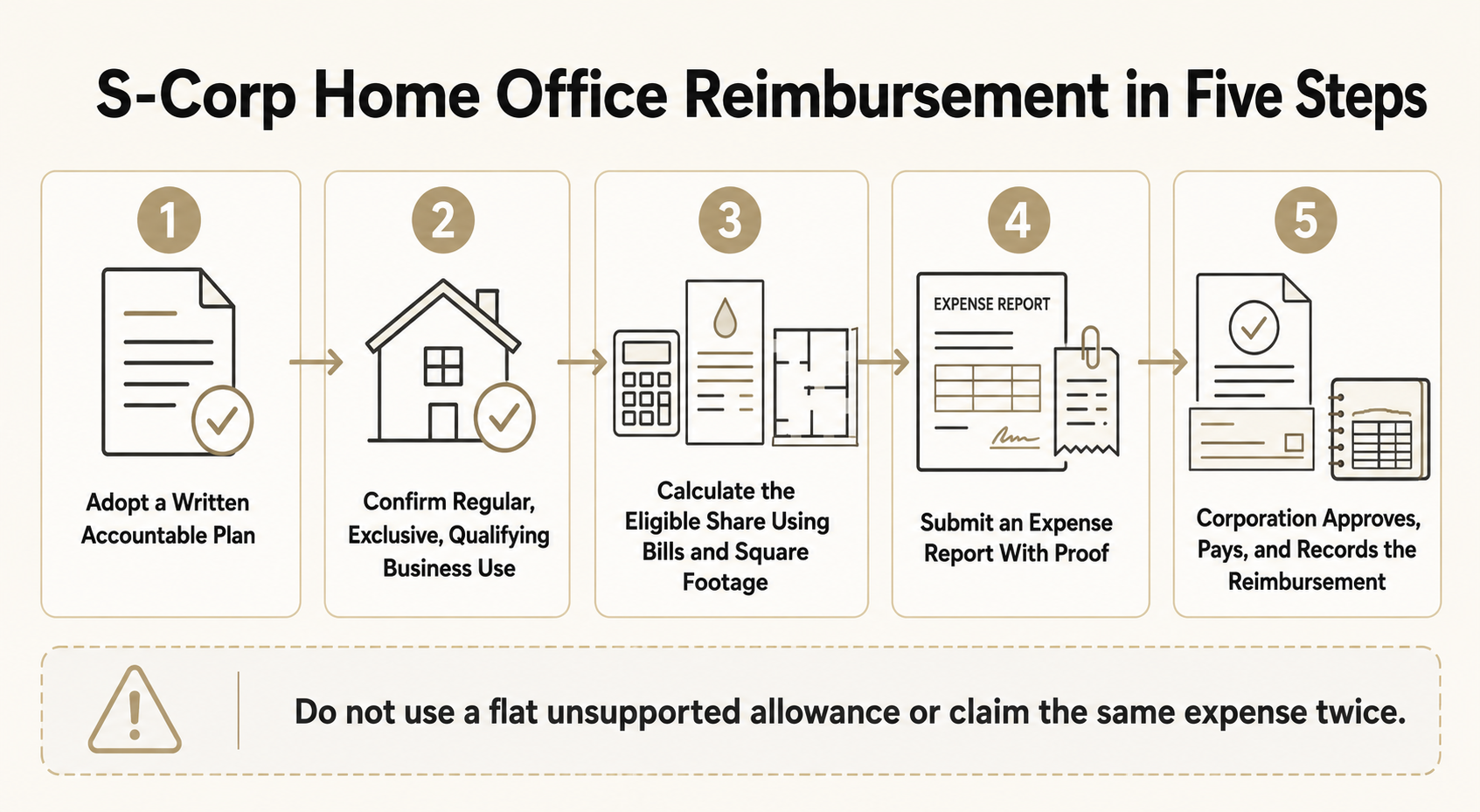
Five Steps for S-Corp Reimbursement:
- Adopt a written accountable plan through corporate action.
- Verify the home office meets IRS eligibility tests.
- Calculate the business share using bills and square footage.
- Submit an expense report with supporting proof.
- The corporation approves and records the tax-free payment.
Keep reimbursement separate from reasonable compensation. A dollar-for-dollar salary replacement may fail the business-connection requirement.
What the Plan Must Document to Satisfy the IRS
The written policy should identify covered employees and expenses, business purpose, deadlines, reimbursement process, and the obligation to return excess amounts. A corporate consent can document adoption.
Each claim should include evidence of the underlying expense and the business allocation. Useful records include:
A floor plan, measurements, and the total finished area used in the percentage
- Photographs showing regular and exclusive corporate use
- Mortgage, property tax, rent, insurance, utility, internet, repair, or maintenance records as relevant
- A worksheet separating direct and indirect expenses
- A signed employee expense report with the reimbursement period
- Proof that the corporation paid the approved amount
- Proof that any excess advance was returned
An accountable plan home office claim must avoid duplication. You can’t claim reimbursed electricity elsewhere. Exclude personal costs and unrelated improvements.
The Depreciation Trap When You Sell Your Home
Depreciation can make the regular method look attractive because it adds a current deduction. It can also create taxable gain later. This issue deserves attention before choosing the actual-expense method for a home office deduction S-corp calculation, or a direct self-employed deduction.
Why Home Office Depreciation Is Recaptured Even After the Home-Sale Exclusion
Homeowners can typically exclude up to $250,000 ($500,000 for married couples filing jointly) of gain on the sale of a principal residence under Section 121. However, this exclusion doesn’t apply to gain attributable to depreciation allowed or allowable for business use after May 6, 1997. This amount is taxed as unrecaptured Section 1250 gain at a maximum federal rate of 25%, making it essential to keep accurate depreciation records until the home is sold.
To simplify recordkeeping and reduce future tax issues, some S-corp owners choose not to include home depreciation in their accountable plan reimbursements. Discuss this strategy with your tax professional. For an office inside the home, depreciation-related gain is taxable but generally doesn’t require a separate gain allocation; conversely, a detached business structure may require separate treatment. Remember, while the simplified method avoids home depreciation entirely, you can switch methods year-to-year if needed.
An Advisor’s Take: Getting the Write-Off Without the Audit Risk
Claiming a home office does not automatically trigger an audit. Risk rises when the facts, amounts, and tax reporting do not agree. The most defensible home office deduction s corp file tells one consistent story from the room’s use through the corporate payment and tax return.
The Records That Make a Home Office Deduction Defensible
- Document the Space: Maintain measurements, a floor plan, and dated photographs of the office area.
- Establish Regular Use: Keep a calendar or log that demonstrates consistent business use of the space.
- Define Business Purpose: If the home is your administrative base, clearly note your activities and verify that no other fixed location exists for those tasks.
- Track Expenses: Retain all bills, categorize costs as direct or indirect, calculate your business-use percentage, and document any unusual allocations.
- Reconcile Records: Match S-corp reimbursements directly to corporate records and payment proof.
- Monitor Eligibility: Review the file periodically during the year; changes like moving the office, introducing personal use, or opening a commercial location can impact your eligibility.
- Be Consistent: Apply your written accountable plan policy consistently throughout the tax year.
Use this review list before the return is prepared:
- Confirm the taxpayer’s federal entity classification.
- Recheck regular and exclusive use for the full reimbursement or deduction period.
- Verify the principal-place, client-meeting, or separate-structure route.
- Compare the simplified and actual methods when a direct deduction is available.
- Match each reimbursed amount to a report and source document.
- Remove personal costs, duplicate claims, and unsupported estimates.
- Preserve depreciation and adjusted-basis records for a later home sale.
| Important Notice Tax rules can change and may apply differently based on your circumstances. Consider speaking with a qualified tax professional before making a tax decision. |
Takeaway
The home office write-off is still available to many owners, although the correct path depends on how the business is taxed. A sole proprietor may use a direct deduction after meeting the home office tests. An S-corporation shareholder-employee generally relies on a substantiated S-corp home office reimbursement through the company.
The strongest home office deduction strategy begins before year-end.
Premium Tax Planners helps business owners connect entity structure, payroll, reimbursements, and personal tax reporting through advanced tax planning. Schedule a consultation to review whether your workspace qualifies and build a documented process that fits your business.
FAQs
Can I Deduct a Home Office If I’m a W-2 Employee?
Usually, no. W-2 employees generally cannot deduct unreimbursed home office expenses on their federal returns, even when remote work is required. However, an S-corporation shareholder-employee may receive reimbursement through an accountable plan home office arrangement when the workspace and expenses qualify.
How Does an S-Corp Owner Claim Home Office Expenses?
An S-corporation owner generally submits documented expenses to the corporation under an accountable plan. The corporation reimburses the qualifying S-Corp home office expenses and records the payment as a business expense. The owner should not deduct the same costs personally.
What Is an Accountable Plan and Why Do I Need One?
An accountable plan allows an employer to reimburse qualifying business expenses without treating the payment as wages. It requires a business connection, timely proof, and the return of any excess reimbursement. Without these requirements, the payment may be treated as taxable wages. Proper documentation also supports effective business tax planning.
Does Claiming a Home Office Increase My Audit Risk?
A home office claim does not automatically trigger an audit. Problems may arise from personal use, unsupported estimates, excessive business percentages, or duplicate expenses. Keep a floor plan, bills, expense reports, and payment records showing that the Section 280A home office requirements were satisfied.
What Happens to the Deduction When I Sell My House?
The home-sale exclusion generally does not protect gain equal to depreciation allowed or allowable for business use after May 6, 1997. The simplified method does not include home office depreciation, while the regular method does.