
Many executives and high-income professionals assume the taxes on their Restricted Stock Units (RSUs) are largely handled by their employer. After all, shares are often withheld automatically when the RSUs vest, and the income appears on the employee’s W-2.
Then tax season arrives.
What catches many people off guard is that employer withholding and actual tax liability are often two very different numbers. A substantial RSU vesting event can push a taxpayer into a higher marginal bracket, trigger additional payroll taxes, and create a tax bill that wasn’t fully covered throughout the year.
The surprise is rarely caused by the RSUs themselves. It is usually caused by withholding that fails to keep pace with the taxpayer’s actual tax rate.
For executives receiving significant equity compensation, understanding the tax impact before shares vest can be just as important as understanding the compensation itself. As part of a broader individual tax planning strategy, evaluating vesting schedules, projected income, and withholding obligations can help reduce unexpected tax liabilities and improve year-end planning outcomes.
Premium Tax Planners helps high-income professionals evaluate RSU vesting events, project tax liability, and identify potential withholding gaps before they become costly surprises.
Key Takeaways
- RSUs are generally taxed as ordinary W-2 income when they vest, not when they are sold.
- The fair market value at vesting becomes both taxable compensation and the cost basis for future capital gains calculations.
- Employer withholding is often based on a 22% supplemental wage rate, which may be significantly lower than a high earner’s actual tax rate.
- Large RSU vesting events can trigger additional Medicare taxes and create substantial tax-payment shortfalls.
- Proactive planning before vesting can help executives address withholding gaps, manage estimated taxes, and coordinate equity compensation with broader financial goals.
How RSUs Are Taxed at Vesting
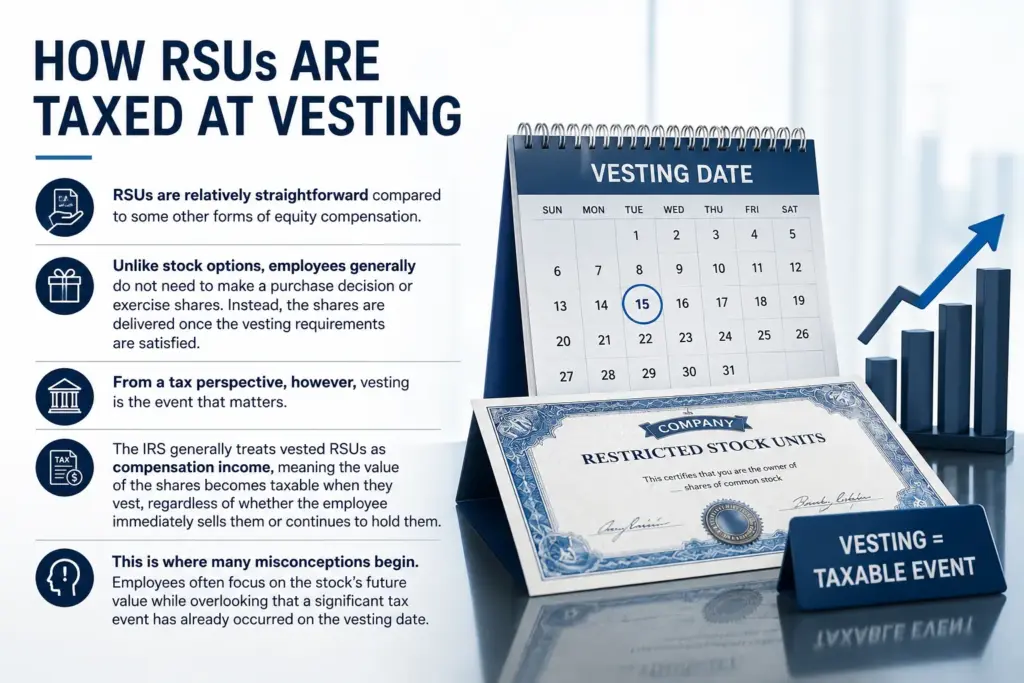
RSUs are relatively straightforward compared to some other forms of equity compensation.
Unlike stock options, employees generally do not need to make a purchase decision or exercise shares. Instead, the shares are delivered once the vesting requirements are satisfied.
From a tax perspective, however, vesting is the event that matters.
The IRS generally treats vested RSUs as compensation income, meaning the value of the shares becomes taxable when they vest, regardless of whether the employee immediately sells them or continues to hold them.
This is where many misconceptions begin.
Employees often focus on the stock’s future value while overlooking that a significant tax event has already occurred on the vesting date.
Fair Market Value at Vest Becomes Ordinary W-2 Income
When RSUs vest, the fair market value of the shares on that date is treated as ordinary compensation income.
That income is reported on the employee’s W-2 and taxed in much the same way as salary, bonuses, or other employment compensation.
For example, assume an executive receives 1,000 shares that vest when the company’s stock is trading at $100 per share. The fair market value at vesting is $100,000.
That $100,000 generally becomes taxable wage income for the year.
This is the core principle behind the tax treatment of RSU vesting. The IRS does not wait until the shares are sold. The taxable event occurs when the employee gains ownership of the vested shares.
For high earners, a large vesting event can significantly increase annual taxable income and affect both marginal tax rates and overall tax planning and advisory considerations.
Why Your Vest-Date Value Is Also Your Cost Basis
The vesting date creates a second tax concept that becomes important later: cost basis.
The same fair market value that is taxed as W-2 income generally becomes the employee’s tax basis in the shares.
Using the previous example, the employee recognises $100,000 of compensation income when the shares vest. That same $100,000 becomes the cost basis for future gain or loss calculations.
This distinction helps answer one of the most common questions executives ask: are RSUs taxed twice?
In most cases, the answer is no.
The vesting event creates ordinary income. Future appreciation or depreciation after vesting is generally treated separately under capital gains rules when the shares are sold.
Confusion often arises because taxpayers see both W-2 income and a future stock sale reported on their tax return. In reality, those are typically two different tax calculations applied to different portions of the stock’s value.
Understanding this distinction helps avoid mistakes when calculating gains and losses after a sale.
The 22% Withholding Gap That Catches High Earners
The taxation of RSUs is often not what surprises executives.
The withholding is.
Many employees assume that because taxes were withheld when the shares vested, their tax obligations have largely been satisfied. In practice, employer withholding frequently falls short of the employee’s actual tax rate.
This disconnect is the reason so many high earners find themselves writing an unexpected check to the IRS each April.
The problem becomes even more pronounced when multiple vesting events occur throughout the year or when RSUs are combined with bonuses, commissions, or other forms of compensation.
Why Employers Withhold 22% When Your Rate Is 32%-37%
Most employers apply the federal supplemental wage withholding rules when RSUs vest.
For many taxpayers, that means withholding is based on the RSU supplemental tax rate of 22%.
The challenge is that many executives and high-income professionals are not actually taxed at 22%.
Depending on income levels, federal marginal rates may be 32%, 35%, or 37%. State income taxes can further widen the gap.
As a result, withholding may cover only a portion of the eventual tax liability.
This mismatch is the foundation of the RSU withholding gap.
A taxpayer whose effective marginal rate significantly exceeds the withholding rate may accumulate a growing tax shortfall throughout the year without realizing it.
The larger the vesting event, the larger the potential gap.
This is one reason proactive individual tax planning becomes increasingly important for professionals receiving substantial equity compensation.
A Quick Example of the April Shortfall
Consider an executive whose RSUs generate $200,000 of additional taxable income during the year.
The employer withholds federal taxes based on the applicable RSU supplemental tax rate, resulting in approximately $44,000 of federal withholding.
However, assume the executive’s actual marginal federal rate is 35%.
The federal tax attributable to that income may be closer to $70,000 before considering other factors.
That creates a potential shortfall of roughly $26,000.
Add state taxes, Medicare taxes, and other income sources, and the gap can grow even larger.
This example illustrates why RSU tax withholding and actual tax liability are often very different numbers. The issue is not that the company made a mistake. The issue is that withholding rules were never designed to perfectly match every employee’s final tax situation.
For high-income households, understanding the RSU withholding gap before year-end can be the difference between a manageable tax strategy and an unpleasant surprise when filing a return.
FICA, NIIT, and the Other Taxes RSUs Trigger
Federal income tax is only part of the equation when RSUs vest.
Many executives focus on withholding on the shares and overlook additional payroll and investment-related taxes that may also affect their overall liability. Depending on income levels, those taxes can significantly increase the amount ultimately owed.
This is one reason why our RSUs are taxed is not always a straightforward question. The answer often extends beyond ordinary income tax and into several overlapping tax rules.
Social Security Wage Base, Medicare, and the 0.9% Surtax
Because vested RSUs are generally treated as compensation income, they are typically subject to payroll taxes as well.
This includes:
- Social Security tax, up to the applicable wage base
- Medicare tax
- The Additional Medicare Tax of 0.9% for higher-income taxpayers
For executives whose salary already exceeds the Social Security wage base, vested RSUs may not create additional Social Security tax exposure. Medicare taxes, however, generally continue to apply regardless of income level.
The Additional Medicare Tax often catches taxpayers by surprise because it applies once earnings exceed certain thresholds. Large vesting events can push compensation well above those limits, creating tax obligations that were not anticipated earlier in the year.
Another area of confusion involves the Net Investment Income Tax (NIIT).
RSUs themselves do not trigger NIIT when they vest because vesting income is compensation income rather than investment income. However, if the shares are held after vesting and later generate dividends or investment gains, NIIT may become relevant depending on the taxpayer’s overall income level.
For many high-income professionals, understanding the interaction between RSU vesting tax treatment and other federal taxes is just as important as understanding the income tax rules themselves.
How to Close the Withholding Gap Before April
The good news is that the withholding gap can often be managed before it becomes a problem.
Many taxpayers discover the shortfall only after their return is prepared. By then, the tax year is over, and planning opportunities are limited. A proactive approach during the year generally produces better outcomes.
The goal is not necessarily to eliminate every dollar of tax due. The goal is to ensure that withholding and estimated payments remain aligned with actual tax liability.
Adjusting Your W-4, Quarterly Estimates, and Sell-to-Cover
Several strategies can help address an emerging RSU withholding gap.
One option is increasing withholding through Form W-4. Additional withholding from regular paychecks can help offset taxes generated by RSU vesting events throughout the year.
Another approach involves making quarterly estimated tax payments. This can be particularly effective for executives who receive large equity awards, bonuses, or other variable compensation.
Some employees also choose a sell-to-cover approach, where enough shares are sold at vesting to satisfy withholding obligations.
While this helps generate liquidity for taxes, it does not necessarily eliminate a future shortfall if the taxpayer’s actual marginal rate exceeds the withholding rate applied by the employer.
The right strategy depends on the size of the equity award, other income sources, and the taxpayer’s overall financial situation. This is often where advanced tax planning can help executives coordinate compensation, investments, and estimated tax obligations more effectively.
After Vesting: Holding, Selling, and Capital Gains

Once RSUs vest, the tax treatment changes.
The vesting event has already created compensation income. Future tax consequences depend largely on what happens next.
At that point, the shares function much like any other investment asset. If the stock price increases after vesting, future appreciation may qualify for capital gains treatment when the shares are sold.
This is where long-term tax planning can create meaningful opportunities.
When Holding 12+ Months Actually Pays Off
Many employees immediately sell vested shares to diversify risk or generate liquidity.
Others choose to hold the stock.
Neither approach is inherently right or wrong. The decision should be based on overall financial objectives, portfolio concentration, and tax considerations.
If shares are sold within one year of vesting, any gain above the vest-date value is generally taxed at short-term capital gains rates.
If shares are held for more than one year, qualifying gains may be eligible for long-term capital gains treatment, which often results in lower federal tax rates.
This distinction becomes particularly important when employees expect meaningful future appreciation.
It is also another reason people ask whether are RSUs taxed twice.
The answer remains no. The value at vesting is taxed as compensation income. Any subsequent increase in value is taxed separately as a capital gain. These are two different tax events applied to two different portions of the stock’s value.
Understanding where one tax calculation ends and another begins is critical when evaluating whether to hold or sell vested shares.
An Advisor’s Take: Coordinating RSUs With the Rest of Your Return
RSUs rarely exist in isolation.
For many executives, equity compensation arrives alongside annual bonuses, deferred compensation, investment income, stock options, or a spouse’s earnings. Looking at RSUs independently can create planning blind spots that lead to avoidable tax surprises.
How Vesting Interacts With Bonuses, a Spouse’s Income, and Other Equity
A large vesting event may push household income into a higher marginal bracket. Combined with bonuses or a spouse’s compensation, the resulting tax impact can differ significantly from what either income source would have on its own.
Additional vesting events may also affect:
- Medicare surtax exposure
- Estimated tax requirements
- Capital gains planning
- Retirement contribution strategies
- Year-end tax projections
This is why many executives benefit from viewing equity compensation as part of a broader tax-planning and advisory strategy rather than as a standalone tax issue.
The objective is not simply to understand RSU tax withholding. It is to understand how RSUs affect the entire return.
Don’t Let RSU Withholding Decide Your Tax Outcome
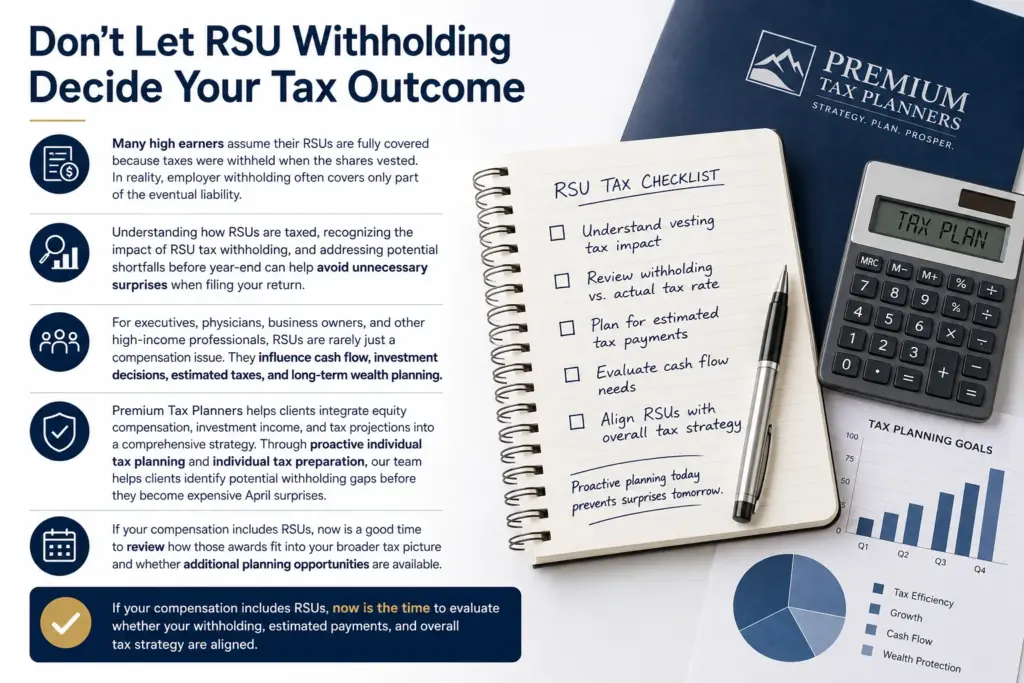
Many high earners assume their RSUs are fully covered because taxes were withheld when the shares vested. In reality, employer withholding often covers only part of the eventual liability.
Understanding how RSUs are taxed, recognizing the impact of RSU tax withholding, and addressing potential shortfalls before year-end can help avoid unnecessary surprises when filing your return.
For executives, physicians, business owners, and other high-income professionals, RSUs are rarely just a compensation issue. They influence cash flow, investment decisions, estimated taxes, and long-term wealth planning.
Premium Tax Planners helps clients integrate equity compensation, investment income, and tax projections into a comprehensive strategy. Through proactive individual tax planning and individual tax preparation, our team helps clients identify potential withholding gaps before they become expensive April surprises.
If your compensation includes RSUs, now is a good time to review how those awards fit into your broader tax picture and whether additional planning opportunities are available.
If your compensation includes RSUs, now is the time to evaluate whether your withholding, estimated payments, and overall tax strategy are aligned.
Request an equity compensation tax review.
FAQs
RSUs are generally taxed when they vest. The fair market value of the shares at vesting becomes taxable compensation income and is typically reported on your W-2.
Many employers apply withholding using the RSU supplemental tax rate, which may be lower than your actual marginal tax rate. This creates an RSU withholding gap that often results in additional taxes due when filing a return.
Generally, no. Because RSUs represent a promise to deliver shares in the future rather than actual property received at grant, they typically do not qualify for an 83(b) election.
One of the most common questions is whether RSUs are taxed twice.
In most situations, no. The fair market value at vesting is taxed as compensation income. Any gain or loss that occurs after vesting is treated separately under capital gains rules when the shares are sold.
Double-trigger RSUs generally require two events before taxation occurs: vesting and a liquidity event such as an IPO or acquisition. The specific tax treatment depends on the plan structure and should be reviewed carefully with a tax advisor.