
The tax landscape for affluent households looked very different just a few years ago. Many of the individual tax provisions created by the Tax Cuts and Jobs Act (TCJA) were scheduled to expire after 2025, creating uncertainty around future tax rates, estate planning, deductions, and business taxation.
The One Big Beautiful Bill Act (OBBBA) changed that trajectory. Signed into law in 2025, the legislation permanently extends many of the tax provisions that high-income taxpayers had expected to sunset while introducing several new limitations and planning considerations.
For physicians, executives, business owners, and other affluent families, understanding these one big beautiful bill tax changes is essential for making informed decisions in 2026 and beyond.
Because the impact of OBBBA varies with income, business structure, estate planning goals, and investment strategy, many high earners benefit from reviewing their tax and advisory strategies before making major financial decisions.
While some provisions create planning opportunities, others quietly reduce the value of deductions for top earners. The result is a tax environment that rewards proactive planning rather than reactive filing.
Key Takeaways
- OBBBA permanently extends many TCJA provisions, providing greater certainty for high-income taxpayers planning beyond 2026.
- Top-bracket earners face a new 35-cent limitation on itemized deductions, reducing the value of certain tax write-offs.
- The expanded $40,000 SALT deduction cap may benefit some taxpayers, but income-based phase-down rules limit the advantage for many high earners.
- The federal estate and gift tax exemption increases to $15 million per individual, creating new long-term wealth transfer opportunities.
- Business owners may benefit from permanent QBI deductions, restored bonus depreciation, and other planning opportunities under OBBBA.
What OBBBA Changed – and What It Made Permanent
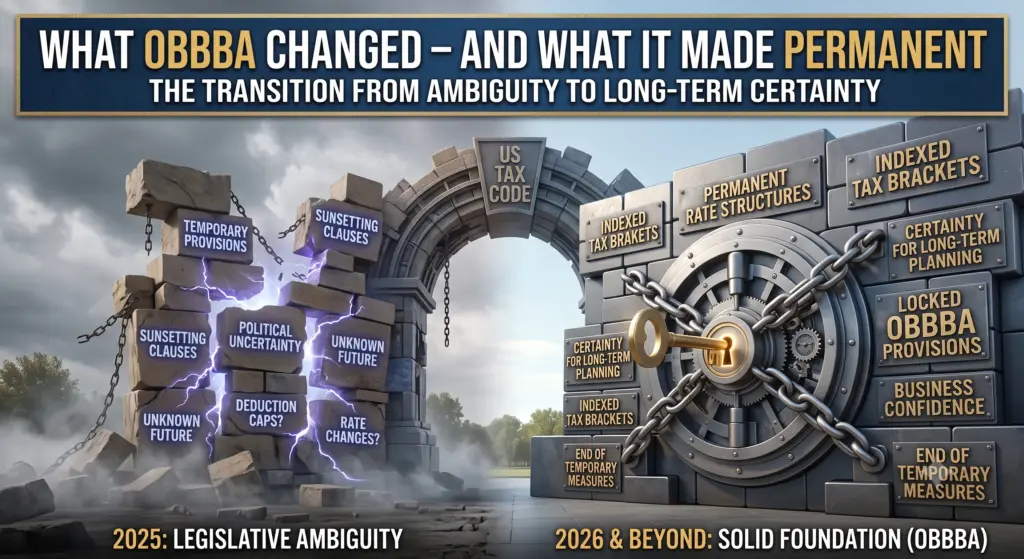
One of the most significant aspects of OBBBA is that it removes much of the uncertainty surrounding individual tax policy.
Rather than allowing key TCJA provisions to expire, Congress chose to make many of them permanent. That decision affects income tax rates, estate tax exemptions, standard deductions, and several other provisions that influence long-term financial planning.
For many households evaluating 2026 tax law changes for wealthy taxpayers, permanence may be just as important as the tax savings themselves. Long-term planning becomes easier when taxpayers are not preparing for a dramatically different tax regime every few years.
TCJA Brackets and Rates Locked in for 2026 and Beyond
Prior to OBBBA, many taxpayers expected higher federal income tax rates beginning in 2026. The legislation permanently preserves the TCJA tax bracket structure, including the current top marginal rate.
For high-income households, this provides greater certainty when evaluating:
- Roth conversion strategies
- Deferred compensation planning
- Capital gain recognition
- Business succession plans
- Multi-year charitable giving strategies
Many discussions around obbba high-income planning focus on tax rates. In reality, the ability to plan around stable tax brackets may be one of the law’s most valuable benefits.
The New 35-Cent Cap on Itemized Deductions for Top-Bracket Earners
One provision that receives less attention concerns the treatment of itemized deductions.
Historically, taxpayers in the highest tax bracket received a deduction benefit equal to their marginal tax rate. OBBBA changes that calculation by limiting the value of itemized deductions for taxpayers in the top bracket to 35 cents on the dollar rather than 37 cents.
While the difference may appear small, it reduces the overall tax benefit associated with deductions for affluent taxpayers.
For many households analyzing one big beautiful bill tax changes, this provision represents one of the less obvious ways the law offsets other tax reductions.
How the Limitation Shrinks the Value of Every Deduction Dollar
The new obbba itemized deduction limit affects the economic value of deductible expenses.
Charitable contributions, mortgage interest, and other qualifying deductions still provide tax benefits. The difference is that those benefits become slightly less valuable for taxpayers subject to the highest marginal rate.
This does not eliminate the value of itemized deductions. It simply changes the math.
For affluent families implementing sophisticated giving strategies or evaluating large-deductible expenditures, understanding the obbba itemized deduction limit should be part of broader advanced tax-planning discussions.
The 2026 SALT Deduction Cap and Its High-Income Phase-Down
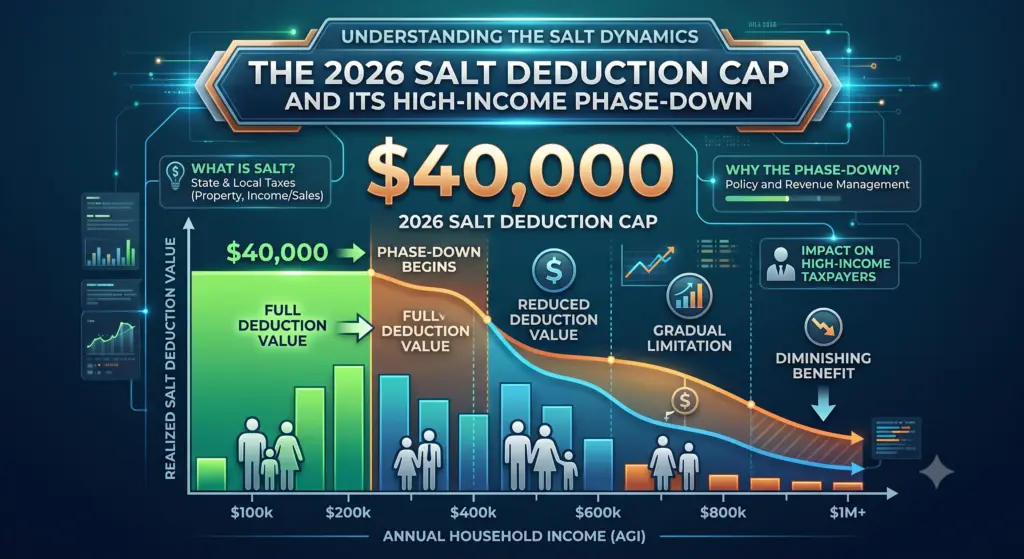
The state and local tax deduction remains one of the most closely watched provisions affecting affluent taxpayers.
OBBBA increases the SALT deduction cap to $40,000 for qualifying taxpayers, creating meaningful opportunities for some households. However, the headline figure does not tell the entire story. The deduction begins phasing down as income rises, limiting its value for many high earners.
This is where many taxpayers misunderstand the practical effect of the legislation.
Why Most Top Earners Won’t See the Full $40,000
The increased deduction cap attracts attention because it represents a substantial increase from the prior $10,000 limit.
However, the obbba salt cap 2026 provisions include income-based restrictions that reduce the benefit for higher earners. As income rises, the allowable deduction begins to phase down, meaning many affluent taxpayers will not receive the full benefit advertised in headlines.
For individuals researching OBBBA high-income planning opportunities, understanding the phase-down mechanics is often more important than understanding the stated cap itself.
What This Means for High-Tax States and Illinois Residents
Taxpayers living in high-tax jurisdictions generally benefit the most from expanded SALT deductions.
However, the obbba salt cap 2026 rules require careful modeling because the deduction amount varies significantly with income levels and filing circumstances.
Illinois residents, business owners, and executives should evaluate how state income taxes, property taxes, and projected earnings interact under the revised rules.
This is particularly relevant for clients seeking specialized North Shore tax planning strategies that account for both federal and state tax exposure.
Estate and Gift Planning After OBBBA: The Permanent $15M Exemption
Among the most significant provisions affecting affluent families is the expansion of the federal estate and gift tax exemption.
Prior law would have reduced the exemption substantially beginning in 2026. OBBBA permanently increases the federal exemption to $15 million per individual and $30 million for married couples, subject to future inflation adjustments.
For many families, this provision removes immediate concerns about federal estate taxation.
The one big beautiful bill estate tax changes also create greater certainty for long-term wealth transfer strategies, trust planning, and intergenerational gifting.
Why North Shore Families Still Face Illinois Estate Tax at $4M
Although the federal exemption increased significantly, state-level estate taxes remain an important consideration.
Illinois continues to impose its own estate tax framework, with thresholds substantially lower than the federal exemption.
As a result, many affluent families who avoid federal estate taxes may still face state-level estate tax exposure.
The one big beautiful bill estate tax provisions reduce one layer of risk, but they do not eliminate the need for thoughtful estate planning.
This is where coordinated estate and trust tax services can help families preserve wealth across generations.
Business-Owner Provisions: QBI, Bonus Depreciation, and Entity Choice

Business owners also receive several meaningful benefits under OBBBA.
The legislation permanently preserves the Qualified Business Income (QBI) deduction while enhancing certain eligibility provisions. It also restores 100% bonus depreciation and expands several business-related tax benefits that were previously scheduled to decline or expire.
For pass-through entities, these changes can influence:
- Entity selection decisions
- Expansion plans
- Equipment purchases
- Succession strategies
- Compensation structures
Many discussions around the 2026 tax law changes for wealthy taxpayers focus on individual planning. Business owners should recognize that entity-level decisions may create equally significant tax consequences.
For entrepreneurs and closely held businesses, integrating these provisions into a broader business tax planning strategy may uncover opportunities that extend well beyond annual tax filings.
Planning Moves to Consider for the 2026 Tax Year
The most effective response to OBBBA is not simply understanding the law. It is understanding how the law affects your specific financial situation.
Tax planning opportunities vary significantly depending on income, business ownership, investment holdings, and estate planning objectives.
Timing Income, Deductions, and Charitable Giving Around the New Rules
The combination of stable tax rates, modified deduction limitations, expanded estate exemptions, and revised SALT rules creates several planning opportunities.
High-income taxpayers may benefit from evaluating:
- The timing of capital gains
- Charitable giving strategies
- Roth conversion opportunities
- Trust funding decisions
- Business income recognition
- Deduction acceleration strategies
The interaction between these provisions often matters more than any individual rule.
For many households, effective tax planning and advisory services focus on coordinating multiple strategies rather than optimizing a single deduction.
An Advisor’s Take: Who OBBBA Helps and Who Quietly Pays More
OBBBA generally creates a favorable environment for affluent taxpayers.
The permanent extension of current tax brackets, expanded estate exemptions, enhanced business incentives, and higher SALT deduction thresholds provide meaningful benefits for many high-income households.
At the same time, some taxpayers may discover that the law does not deliver the benefits they initially expected.
The new deduction limitations, SALT phase-down provisions, and other income-based restrictions reduce the value of certain tax benefits for top earners.
That is why evaluating one big beautiful bill tax changes requires more than reading headlines.
The households most likely to benefit are those that adapt their planning strategies early rather than waiting until tax season.
Take a Strategic Approach to OBBBA Tax Planning
The most important takeaway from OBBBA is that certainty has returned to several areas of tax planning that were previously scheduled to change dramatically.
For high-income professionals, business owners, executives, and affluent families, the legislation creates both opportunities and limitations. Understanding how the changes to the one big beautiful bill tax affect your deductions, estate plan, business structure, and future income can have a meaningful impact on long-term wealth preservation.
Premium Tax Planners helps clients navigate high-income planning decisions, evaluate changes to the 2026 tax law affecting wealthy households, and develop strategies that align tax efficiency with broader financial goals. If you want guidance tailored to your situation,
Schedule a consultation with Premium Tax Planners today.
FAQs
The legislation was signed into law on July 4, 2025, with many provisions affecting 2026 tax planning and future tax years.
The answer depends on the taxpayer’s circumstances. Many high earners benefit from permanent tax rates, expanded estate exemptions, and business incentives, while others may see their deductions reduced due to new limitations.
For taxpayers in the highest tax bracket, certain itemized deductions are effectively limited to a 35% tax benefit rather than the full marginal tax rate.
OBBBA increases the SALT deduction cap but introduces income-based phase-down provisions that reduce the available deduction for higher-income taxpayers.
Yes. The federal estate and gift tax exemption increases to $15 million per individual beginning in 2026 and is indexed for inflation thereafter.