
A property owner who closes on a $2 million apartment building in 2026 can legally deduct hundreds of thousands of dollars from that purchase in the same year, before a single rent check clears. This is known as cost segregation, an IRS-recognized method of reclassifying parts of a building so they depreciate on a much shorter schedule than the standard 27.5- or 39-year life.
Most property owners have heard the term but don’t know when it pays off and when it just creates a paper loss they cannot use.
This guide walks through the mechanics of this tool, the 2026 timing, and the passive loss rules that catch even experienced owners off guard.
Key Takeaways
- Cost segregation reclassifies part of a building’s cost from the standard 27.5- or 39-year schedule into 5-, 7-, and 15-year property.
- With 100% bonus depreciation permanent for property acquired after January 19, 2025, that reclassified portion can be written off entirely in year one.
- The resulting loss is passive under IRC Section 469, so it can only offset W-2 or business income if the owner qualifies as a real estate professional, materially participates in a short-term rental, or has other passive income.
- Owners who already hold a property can still capture the benefit through a look-back study and Form 3115, without amending past returns.
- Some of the deduction is recaptured at sale under Sections 1245 and 1250, though the deferral and a 1031 exchange usually still make the strategy worthwhile.
What Cost Segregation Actually Does
Cost segregation breaks a building’s total cost into individual components rather than treating the whole structure as one asset. Purchase or construction projects usually combine the building shell, interior systems, and outdoor improvements into a single number.
This strategy accelerates depreciation by reassigning each component to its standard tax schedule.
With 100% bonus depreciation permanent for property placed in service after January 19, 2025, combining both approaches yields significant first-year deductions.
It is a key advanced tax planning tool for real estate investors and high earners.
Reclassifying a Building From 39 (or 27.5) Years Into 5, 7, and 15-Year Parts
Under standard depreciation rules, a commercial building depreciates in over 39 years, and a residential rental building depreciates in over 27.5 years, both on a straight-line basis. But not everything inside a building is really for tax purposes.
Carpeting, certain electrical work tied to equipment, decorative fixtures, and specialty plumbing often qualify as 5-year or 7-year personal property. Sidewalks, parking lots, fencing, and landscaping typically qualify as 15-year land improvements.
A cost segregation study usually moves between 20% and 45% of a building’s depreciable basis into these shorter classes, according to the IRS’s own audit guide for this strategy. Land itself is never depreciable and is carved out of every study before any allocation happens.
How Engineering-Based Studies Identify Components
Specialized engineering firms inspect the property and review blueprints, invoices, and appraisals to price components using standard construction data. The IRS considers this detailed engineering approach the most reliable method for cost segregation studies.
The resulting report assigns costs and MACRS recovery periods to each asset with full supporting documentation. Detailed reports protect against IRS scrutiny, whereas rough estimates often trigger audits.
Why is 100% Bonus Depreciation so Powerful in 2026?
Cost segregation depreciation has always let property owners write off buildings faster than the standard schedule. What changed is how much of that faster depreciation you can claim immediately.
In past years, only a portion of the reclassified cost could be deducted in year one, with the rest spread across the shorter recovery period. That shift turns a routine purchase into advanced tax planning instead of a passive investment decision.
OBBBA Made 100% Bonus Permanent for Property Acquired After January 19, 2025
The One, Big, Beautiful Bill Act permanently restored 100% first-year bonus depreciation for qualifying property acquired and placed in service after January 19, 2025, according to guidance the Treasury Department and IRS issued in Notice 2026-11. Without that law, bonus depreciation was on track to drop to 20% in 2026. Instead, it is back to full strength and, for now, permanent.
How Reclassified Components Become an Immediate First-Year Deduction
Bonus depreciation only applies to property with a MACRS recovery period of 20 years or less. That is exactly the category a study creates. The 5-year, 7-year, and 15-year components it identifies all qualify, which means instead of spreading that reclassified portion over several years, an owner can write off the entire amount in the year the property is placed in service. This is the piece that makes cost seg and bonus depreciation work together: the study does the reclassifying, and bonus depreciation does the front-loading.
Read More: Bonus Depreciation Is Back to 100% – What You Can Write Off Now
Example: Turning a Purchase Into a Six-Figure Deduction
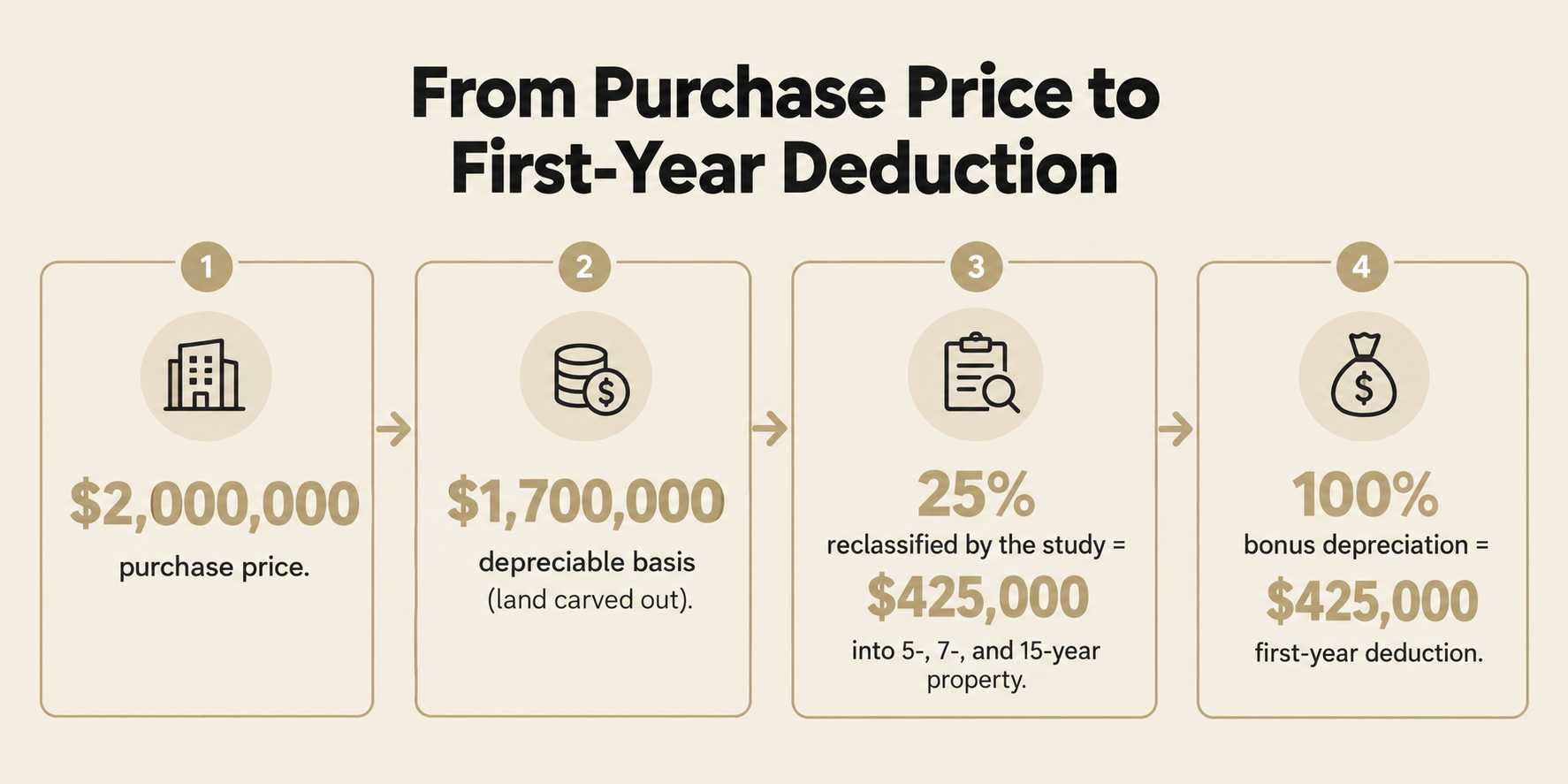
Consider a $2 million commercial building with $1.7 million in depreciable basis (excluding land). A cost segregation study reclassifies 25% ($425,000) as 5-, 7-, and 15-year property.
With 100% bonus depreciation, that full $425,000 is deducted in year one, on top of standard first-year depreciation for the remaining building basis.
For high-bracket owners, this generates substantial upfront tax savings by combining shorter recovery periods with immediate write-offs.
The Catch High Earners Must Understand: Passive Loss Rules
While the upfront deduction is widely promoted, understanding which income streams it can actually offset is crucial before investing.
Why a Cost-Seg Loss Can’t Offset Your W-2 or Business Income by Default
Rental real estate is, by default, a passive activity under IRC Section 469. That means a loss generated by an accelerated-depreciation rental property strategy is a passive loss, and passive losses can generally offset only passive income, according to the IRS’s Publication 925 on passive activity and at-risk rules.
A surgeon, an executive, or a business owner with substantial W-2 wages or active business profit usually cannot use that loss to reduce those income streams. Instead, the loss is suspended and carried forward until it can be used, typically when the property is sold.
The Three Ways to Use It: REPS, the Short-Term Rental Rule, or Passive Income
There are three paths around that limit.
- The first is qualifying as a real estate professional under IRC Section 469(c)(7), which requires more than half your working hours across all trades or businesses to be in real property activities you materially participate in, plus more than 750 hours in those activities for the year, per Publication 925.
- The second is a short-term rental where the average guest stay is seven days or less, and the owner materially participates in running it. Under the passive activity rules, that kind of activity isn’t treated as a rental activity, so it can be treated as nonpassive rather than passive.
- The third path is simpler. If the owner already has other passive income, such as income from another rental or a limited partnership interest, the loss can offset that income directly, no special status required.
Important Note: Tax rules can change and may apply differently based on your circumstances. Consider speaking with a qualified tax professional before making a tax decision.
Already Own the Property? The Look-Back Study
This strategy is not limited to the year of purchase. An owner who has held a property for years without ever doing a study, including one running a broader business tax planning strategy across several properties, has not lost the opportunity.
Catching Up Missed Depreciation With Form 3115, No Amended Returns
A look-back study can be performed on a property placed in service in a prior year. Instead of amending every past tax return to correct the depreciation, the owner files Form 3115, Application for Change in Accounting Method, and claims the entire amount of previously missed depreciation as a single catch-up deduction under Section 481(a) in the current tax year.
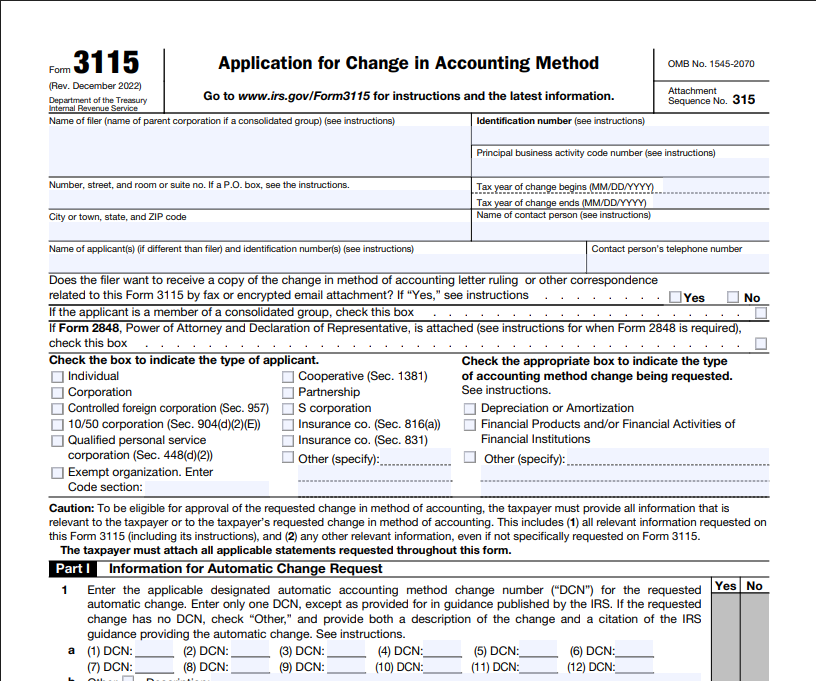
Most look-back changes like this one qualify for automatic consent, which means no user fee and no waiting on IRS approval before filing.
There is one timing limit worth knowing up front: a change in accounting method generally cannot be made in the same year the property is sold, so this strategy needs to be planned before a sale is already on the calendar, not after.
Read More: How the One Big Beautiful Bill Act Changes Tax Planning for High Earners (2026)
The Trade-Off: Depreciation Recapture at Sale
Accelerated depreciation is not free money. It shifts a tax bill from the future into the past, and the tax code collects part of it back when the property sells.
Section 1245 vs. 1250 Recapture, and Why the Deferral Still Usually Wins
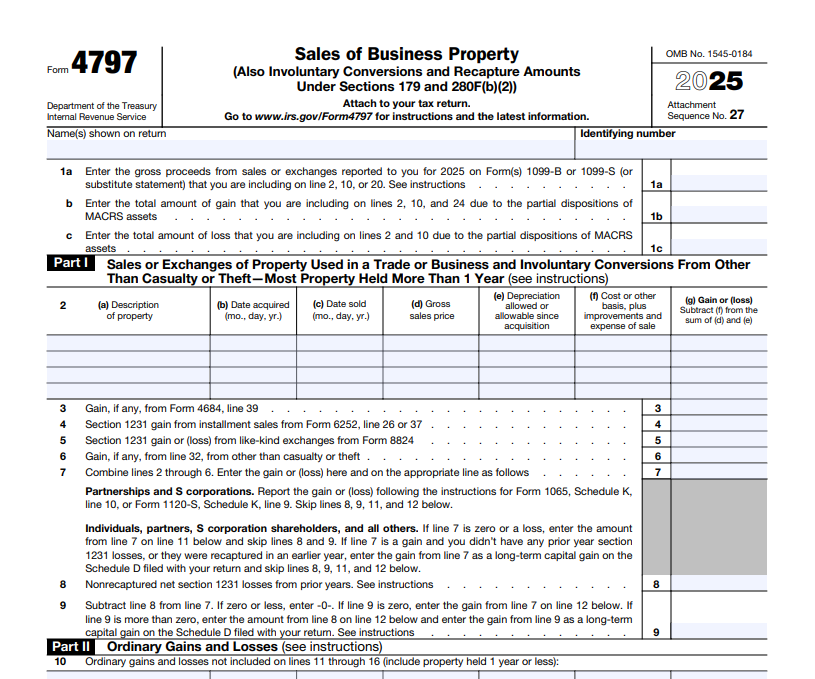
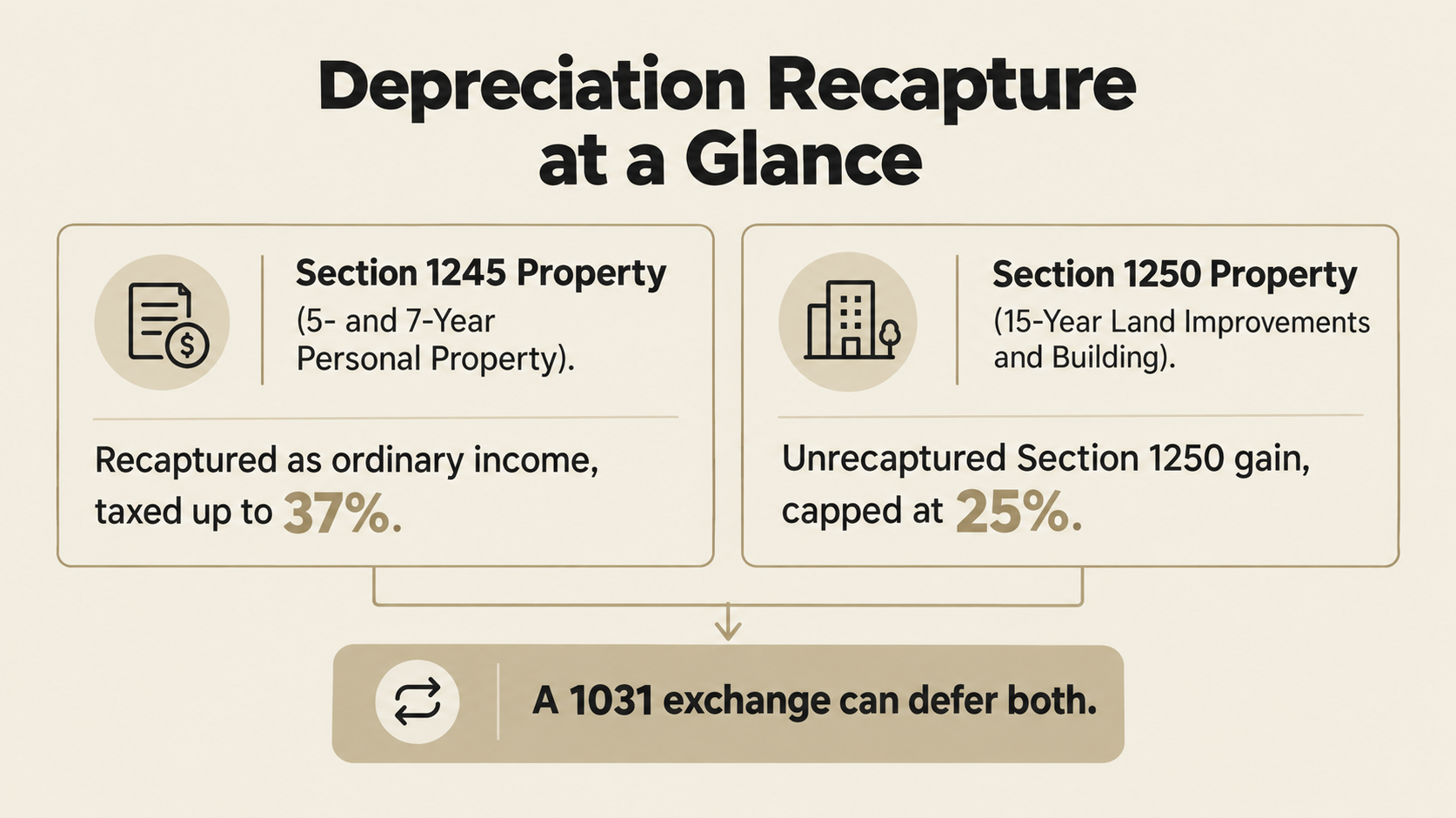
When a property sells, the depreciation claimed on the 5- and 7-year personal property identified by the study is generally recaptured as ordinary income under Section 1245, reported on Form 4797.
The 15-year land improvements and the building’s own depreciation fall under Section 1250 instead, and the portion tied to depreciation is taxed as unrecaptured Section 1250 gain, capped at a maximum rate of 25% under the Schedule D instructions.
Even with recapture on the table, the deferral usually still wins, since money deducted today is worth more than the same amount taxed later.
For the Section 1250 portion specifically, there is also a rate arbitrage: an owner in a high bracket can deduct that income today at rates up to 37%, then have it recaptured years later at a maximum of 25%. That gap is where the real advantage for high earners.
Using a 1031 Exchange to Defer the Recapture
A like-kind exchange under Section 1031 lets an owner sell one investment property and roll the proceeds into another without recognizing gain, including depreciation recapture, at the time of sale.
For an owner who plans to keep reinvesting in real estate rather than cashing out, a properly structured 1031 exchange can push that recapture bill indefinitely into the future, which is exactly why exit timing belongs in ongoing tax planning and advisory work, not a decision made after a study is already ordered.
When a Cost Segregation Study Makes Sense
It is not automatically worth doing on every property, and a good advisor will say so before a client pays for one.
The Basis Threshold, the Cost of a Study, and Doing It Right
An engineered study typically costs between a few thousand and $15,000, depending on property size and complexity, and takes several weeks.
As a rule of thumb, cost segregation works best when depreciable basis exceeds $500,000 so the tax savings outweigh the study cost.
However, basis size is only half the equation. You must also ensure you can actually use the resulting loss under passive activity rules before commissioning a study.
Always hire a firm that conducts an engineering-based analysis. IRS scrutiny comes from poor documentation and rough estimates, not from using cost segregation itself.
An Advisor’s Take: Plan Before You Order the Study
This strategy requires proper planning. Before hiring an engineering firm, review how the tax deduction will actually be used.
Check Passive Loss Rules First
Many owners order a study first, only to realize later that they cannot use the deduction. Without real estate professional status, a short-term rental, or other passive income, the write-off gets suspended rather than lowering current taxes.
Start with high-income tax planning to evaluate property ownership structures, active work hours, and your overall exit timeline.
Plan Before You Order a Cost Segregation Study
Cost segregation can unlock significant tax savings, but the real benefit depends on your income, property, and overall tax strategy. At Premium Tax Planners, we help property owners evaluate opportunities, navigate passive loss rules, and build proactive tax plans tailored to their goals.
Explore the right tax-saving opportunities. Schedule a consultation with Premium Tax Planners and discover how strategic planning can work for you.
FAQs
Is cost segregation worth it for a rental property?
It depends on the property value and whether you can use the loss. It usually pays off for properties with over $500,000 in depreciable basis. You get immediate savings if you qualify as a real estate professional, run a short-term rental, or have other passive income.
Can I do a cost segregation study on a property I’ve owned for years?
Yes, through a look-back study on a property placed in service in a prior year. Instead of amending past returns, you file Form 3115 and claim all the previously missed depreciation as one catch-up deduction in the current year. You generally can’t make this change in the same year you sell the property.
Will cost segregation trigger an IRS audit?
Not on its own. The IRS publishes its own audit guide for this exact strategy, treating it as routine rather than a red flag. Scrutiny comes from studies built on rough percentage estimates instead of genuine engineering-based analysis with supporting documentation. A properly prepared study is built to hold up if it’s ever reviewed.
Can I use the loss against my W-2 income?
Only in specific situations. By default, a loss from cost segregation depreciation on rental property is passive under IRC Section 469 and can’t offset W-2 wages or active business income. Exceptions include qualifying as a real estate professional, materially participating in a short-term rental averaging seven days or less per stay, or having other passive income to absorb the loss.
What happens to the deductions when I sell?
Some benefits are recaptured at sale: 5- and 7-year property depreciation is taxed as ordinary income under Section 1245, while 15-year property and building depreciation fall under Section 1250, capped at 25%. Most owners still benefit overall due to the time value of money, and recapture can be deferred using a 1031 exchange.