
Filing Form 4868 extends your filing deadline to October 15, but it does not extend your payment deadline. If you owed taxes on April 15, 2026, and did not pay in full, interest and penalties have accrued daily on the unpaid balance.
For high-net-worth individuals, delayed filing can quickly result in substantial financial penalties. Complex portfolios, late K-1 forms, and international assets make fall tax filing particularly risk-prone if missed.
This guide explains what the October 15 extension covers, key risks for high earners, and options if you lack documentation or funds to pay in full.
Key Takeaways
- The October 15 tax deadline only extends your filing deadline. Your 2025 tax was due April 15, 2026, and interest has been accruing on any unpaid balance since then.
- High earners feel this more: the same penalty percentages produce much bigger dollar amounts on large balances, especially if you missed the 90%/110% estimated-tax safe harbor.
- Partnership and S-corp K-1s can arrive as late as mid-September, which is the main reason HNWI investors extend into the fall in the first place.
- Filing late costs far more than paying late. Failure-to-file runs 5% a month versus 0.5% for failure-to-pay, with a $525 minimum penalty once a return is more than 60 days late.
- The FBAR and SEP-IRA funding deadlines also land on October 15, and the IRS’s new automatic penalty relief (AEP) may waive penalties for taxpayers with a clean three-year filing history.
October 15 Is a Filing Deadline, Not a Payment Deadline
The October 15 tax deadline is the last stop for anyone who filed Form 4868 back in April. It is a filing deadline. The IRS has never treated it as a payment deadline. Firms that provide individual tax preparation as part of an ongoing planning relationship usually flag this distinction before April, so clients aren’t caught off guard by a larger October bill.
Why your tax was due April 15, and has been accruing interest since
Your 2025 tax bill was due April 15, 2026, regardless of any extension. Filing Form 4868 gave you more time to complete your paperwork. It did nothing to move your payment due date. Under IRS Topic No. 653, interest on any unpaid balance starts on the original due date and runs, compounded daily, until you pay in full.
For the fourth quarter of 2026 (October through December), that rate is 7% a year, set by law at the federal short-term rate plus 3 percentage points, per the IRS’s Q4 2026 interest rate announcement. The rate resets quarterly, but it has held at 7% for several quarters in 2026.
| Example: What a $250,000 Balance Costs in InterestSay you owed $250,000 on April 15, 2026, and didn’t pay any of it until October 15. At a steady 7% annual rate compounded daily, that balance grows by roughly $8,900 in interest alone over six months — before any late-payment penalty. Real numbers shift as the rate changes each quarter, but the balance grows every day it sits unpaid. |
What the extension actually bought you
An IRS extension on October 15 buys you time to gather documents, finish complex schedules, and avoid rushing a return with real consequences if it’s wrong. That’s meaningful when you’re waiting on K-1s or reconciling multiple brokerage statements. It doesn’t buy you a pause on interest, and it doesn’t pause the failure-to-pay penalty if you didn’t pay close to what you owed back in April.
| Quick Tip: If you’re not sure how much of your April payment covered your actual liability, check your IRS account transcript before October 15. It shows what’s posted, what’s still owed, and how much interest has accrued. |
Why the Stakes Are Higher for High Earners
The mechanics of the October 15 tax deadline are the same for every filer. The dollar amounts are not. A five-figure balance and a seven-figure balance face the same penalty percentages, but the gap those percentages produce in real dollars is enormous. That gap is exactly why high-income tax planning matters more as balances grow, and why high earners have the most to lose by treating October 15 as a soft deadline.
Big balances mean big interest: 7%, compounded daily
Daily compounding sounds small until you attach it to a large number. A $50,000 balance and a $1 million balance accrue interest at the identical 7% rate, but the dollar gap between them widens every day the balance sits unpaid. For clients with concentrated stock positions, K-1 income, or a large one-time gain, carrying a balance from April to October can turn into a meaningful five-figure cost on its own, separate from any penalty.
The estimated-tax true-up and the 110% safe harbor
October is also when many high earners discover they didn’t prepay enough during the year. Under IRS Topic No. 306 and the instructions for Form 2210, most taxpayers avoid the underpayment penalty by paying at least the amount shown below, through withholding and estimated payments combined:
| Prior-year AGI | Safe harbor |
|---|---|
| $150,000 or less | Smaller of 90% of current-year tax or 100% of prior-year tax |
| Over $150,000 | Smaller of 90% of current-year tax or 110% of prior-year tax |
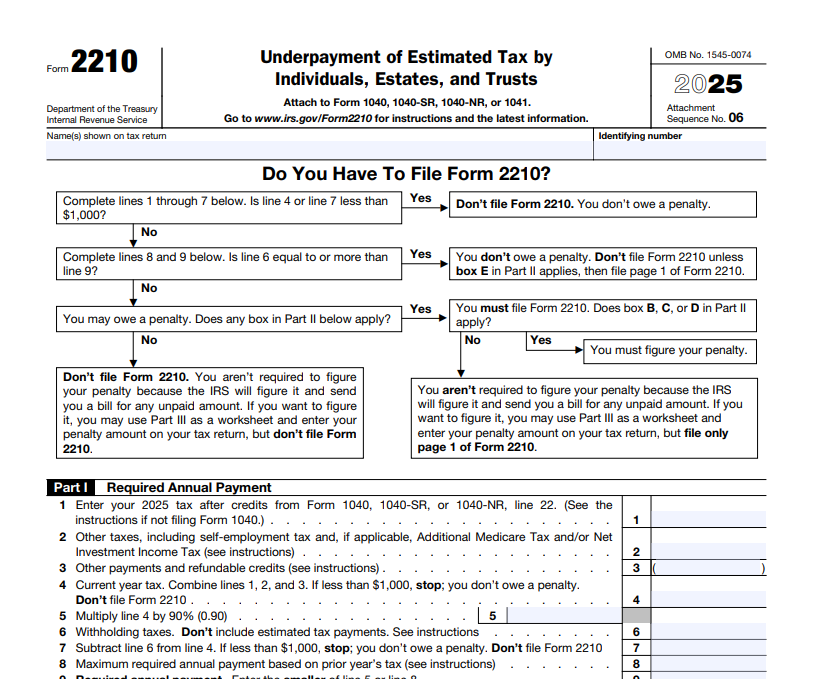
An extension doesn’t touch this rule. Your final quarterly estimate for 2025 income was due January 15, 2026, extension or not. If you fell short of the 90%/110% threshold, the underpayment penalty has been running since the quarter you missed, independent of the October 15 tax deadline. This is exactly the kind of gap high-income tax planning is built to catch before the fall filing crunch.
Read More: Q3 Estimated Taxes: What High Earners Pay (and the 110% Rule)
The Late K-1 Problem That Forces Extensions
Many high earners don’t extend because they’re disorganized. They extend because the paperwork they need doesn’t exist yet in April.
Why partnership and S-corp owners often can’t file until fall
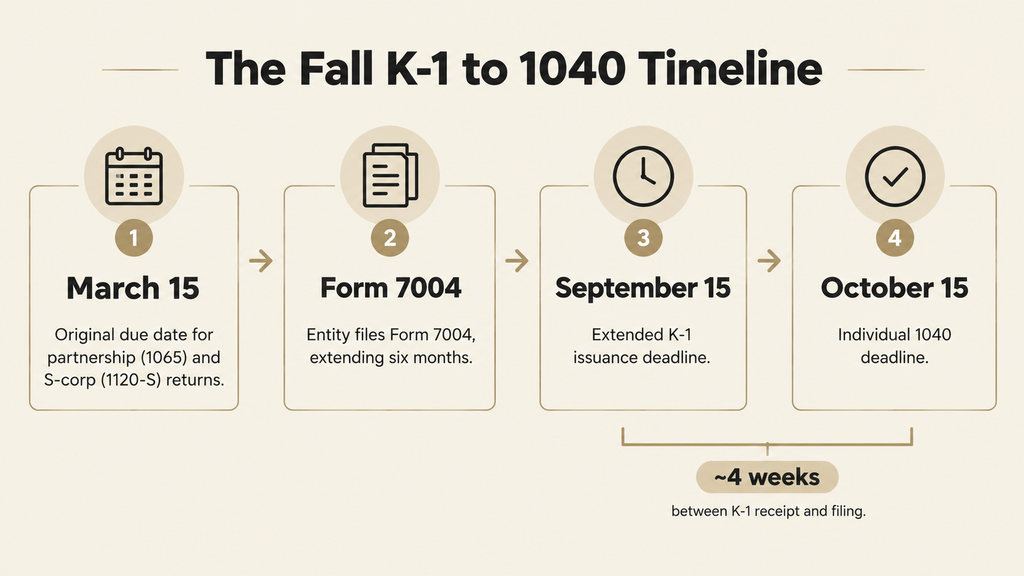
Partnerships and S-corporations file their own returns, and their owners’ K-1s depend on those returns first. If the entity files its own Form 7004 extension, its filing date can move six months, from the original March 15 due date to September 15, under the instructions for Form 7004.
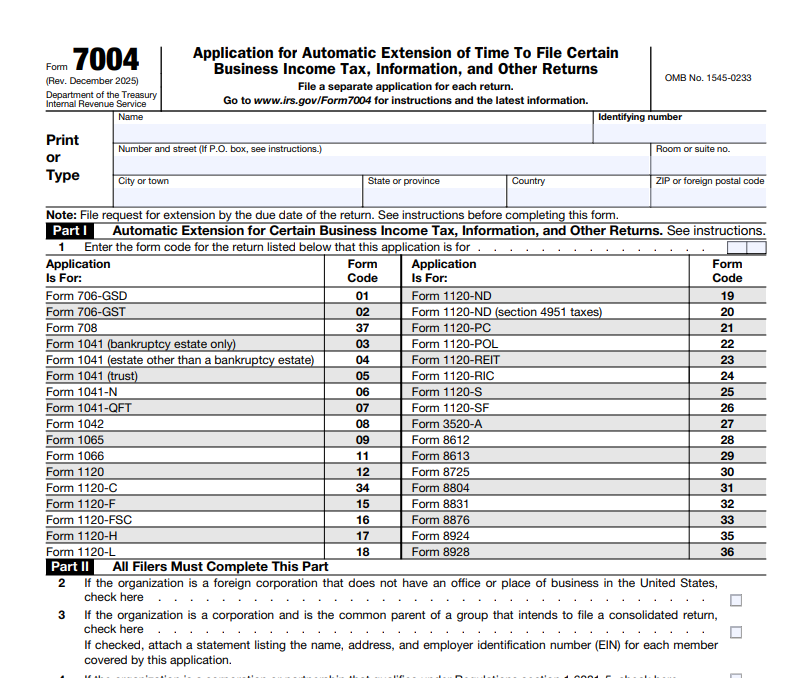
That means an investor in a fund, a private equity vehicle, or a closely held business can be legally unable to file an accurate 1040 until mid-September.
A K-1 landing on September 16 leaves roughly four weeks to fold partnership income, credits, and basis adjustments into a return before October 15. A second or third K-1, or one that needs correcting, shrinks that window further.
This is one of the most common reasons high-net-worth investors extend, and it has nothing to do with procrastination.
| Important Note: Tax rules can change and may apply differently based on your circumstances. Consider speaking with a qualified tax professional before making a tax decision. |
The Penalties You’re Racing to Avoid
Choosing to file taxes after October 15 is different than missing the April payment deadline. The two penalties are calculated differently, and understanding both is the only way to know what missing the October 15 deadline actually costs.
Failure-to-file (5%/month) vs. failure-to-pay (0.5%/month)
The two penalties measure different failures. Failure-to-pay applies when you owe tax you haven’t paid. Failure-to-file applies when you don’t submit a return by its due date, extended or not. Under IRS Topic No. 653, the two rates differ significantly.
| Penalty | Rate | Maximum |
|---|---|---|
| Failure-to-file | 5% of unpaid tax per month or partial month | 25% |
| Failure-to-pay | 0.5% of unpaid tax per month or partial month | 25% |
Failure-to-file costs ten times more per month than failure-to-pay. That’s why preparers push clients to file taxes after October 15 rather than not file at all, even when the balance can’t be paid in full. A late tax return after an extension still costs money, but skipping the return entirely costs far more.
The $525 minimum penalty and how the two penalties interact
If both penalties apply at the same time, the failure-to-file penalty is reduced by the failure-to-pay penalty amount. Instead of paying a combined 5.5%, you pay 5% per month (4.5% for late filing plus 0.5% for late payment) until the failure-to-file penalty reaches its 25% maximum.
Additionally, if your return is more than 60 days late, the minimum penalty is $525 or 100% of the unpaid tax, whichever is less. Even a small balance can grow significantly if you miss the October 15 deadline and file months later.
Don’t Forget the October 15 Deadlines Beyond Your 1040
The October 15 tax deadline doesn’t only apply to your Form 1040. Two other deadlines land on the same date, and both are easy to overlook when the focus is on the main return.
The FBAR and foreign-account reporting for globally diversified HNWIs
If you hold foreign financial accounts such as offshore brokerage or bank accounts that together exceeded $10,000 at any point during 2025, you must file FinCEN Form 114, the FBAR.
It’s due April 15, but Treasury automatically extends it to October 15 with no separate request required. Globally diversified HNWI investors, especially those with international business or family holdings abroad, are the most likely to forget it shares a calendar with their 1040.
Read More: How RSUs Are Taxed, and the Withholding Gap That Surprises High Earners
SEP-IRA and other extended retirement-funding deadlines
Fall filing season is also a funding window. Under IRS Publication 560, employer contributions to a SEP-IRA can generally be made up to the due date of the employer’s return, including extensions, so a self-employed high earner or business owner who extended to October 15 can still fund, or even open, a SEP-IRA for 2025 right up to that date.
| FBAR | SEP-IRA | |
|---|---|---|
| Deadline | April 15, auto-extended to Oct. 15 | Extended return due date (Oct. 15 if extended) |
| Trigger | Foreign accounts exceeded $10,000 at any point in 2025 | Self-employed/business owner funding or opening a plan |
| Action needed | None — extension is automatic | File return and contribute by the due date |
Penalty Relief and the Special Deadlines
Not every late filer pays the full penalty. An IRS extension on October 15 doesn’t erase penalty exposure by itself, but the IRS built in relief for taxpayers with clean histories, and separate rules push some deadlines back entirely.
The IRS’s new automatic penalty relief (AEP) and reasonable cause
Starting in 2026, the IRS introduced Automatic Exemption from Penalty (AEP). This program automatically waives failure-to-file, failure-to-pay, and failure-to-deposit penalties for taxpayers who filed and paid on time for the past three years.
Per the IRS AEP announcement, you don’t need to apply. The IRS grants relief automatically during processing and mails a confirmation notice. AEP replaces the First Time Abate program for returns due on or after January 1, 2027.
If you don’t qualify for AEP, you can still request reasonable-cause relief. You must provide documentation showing a specific reason for missing the deadline, such as illness, a natural disaster, or bad professional advice. Unlike AEP, the IRS reviews these requests case by case.
Disaster-area, military, and taxpayer-abroad postponements
Some taxpayers never have to worry about the October 15 tax deadline, because the IRS automatically moves it for them:
- Federally declared disaster area: automatic filing and payment relief, per the IRS disaster assistance page.
- Combat zone military service: at least 180 days after leaving the zone, per the IRS’s overview of automatic filing extensions.
- Citizens and resident aliens abroad: automatic extension to June 15, with a further extension available on request, per the IRS’s page for citizens and resident aliens abroad.
None of these postponements stop interest from accruing on unpaid tax from April 15 forward.
What to Do If You Still Can’t File, or Can’t Pay
An October 15 deadline missed is not the end of your options. It changes which penalty you face and how quickly you should act.
File anyway, pay what you can, and structure the balance
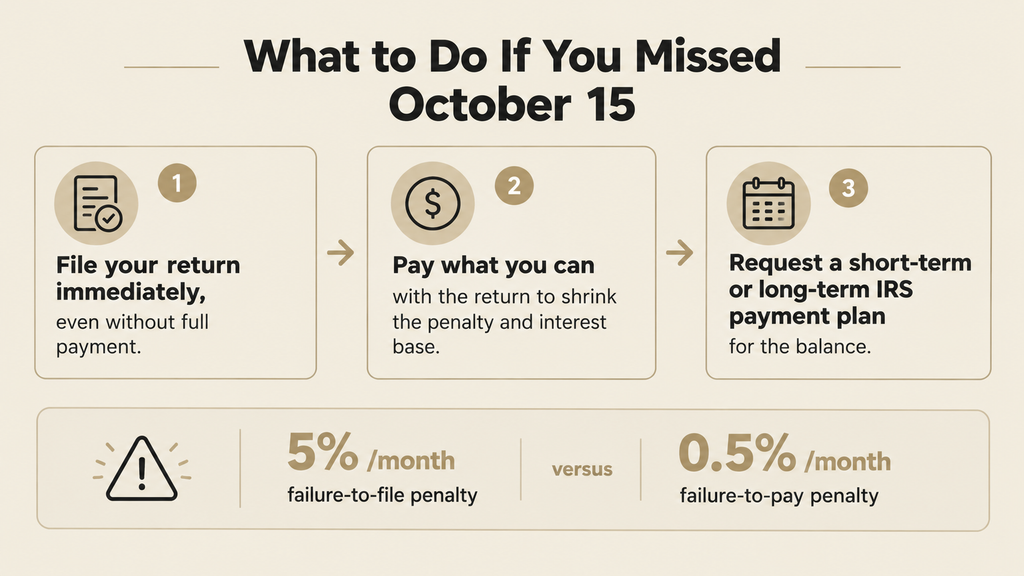
A late tax return after an extension is still far cheaper than no return at all, so act quickly:
- File as soon as you can. Every month you wait adds another 5% failure-to-file charge, plus interest and the failure-to-pay penalty.
- Pay what you can with the return to shrink the balance the remaining penalty and interest apply to.
- For what’s left, look at IRS payment options; a short-term payment plan or long-term installment agreement can stop collection action and cap the failure-to-pay penalty rate, though interest keeps accruing on the unpaid portion.
- If you’re filing late because a K-1 arrived late or a life event got in the way, document that reason. It’s the difference between automatic relief and a penalty you have to fight to remove later.
| An Advisor’s Take: The October 15 Tax Deadline Is a Planning Checkpoint, Not Just a DeadlineTreating October 15 as a finish line misses the point. For high earners, the fall filing season offers the clearest view all year of how your withholding, estimates, and income lined up with what you owed.Using the fall filing to reset next year’s withholding and estimatesOnce your 2025 return is done, you have real numbers: your actual tax, your actual withholding, and your actual estimated payments, all in one place. That’s the moment to check whether you hit the 90%/110% safe harbor, whether withholding on RSU vesting or bonus income covered enough, and whether your quarterly estimates need to change for the rest of 2026. Waiting until next April just repeats the same interest and penalty exposure on a new tax year. |
The Bottom Line
The October 15 tax deadline closes the filing window, but it never controlled your interest or underpayment penalty and kept going for high earners with large balances, late K-1s, or foreign accounts to report.
If you’re facing a missed October 15 deadline, file the return, pay what you can, and get ahead of next year’s estimates before they become next October’s problem.
Premium Tax Planners works with high-net-worth clients on this kind of year-round coordination, from the K-1s that force an extension to the safe harbor math that avoids one, through tax planning and advisory built around your full picture.
Schedule a consultation with Premium Tax Planners to make sure October 15 is the last deadline that surprises you.
FAQs
No. An IRS extension on October 15 only extends your time to file the return itself. Your 2025 tax return was due April 15, 2026, and any unpaid balance has been accruing interest and the failure-to-pay penalty since that date, regardless of your extension.
If you file taxes after October 15, the failure-to-file penalty starts at 5% of your unpaid tax for that month and continues at that rate each month, up to a 25% cap, combined with interest and any failure-to-pay penalty already running. A late tax return after an extension that’s more than 60 days late also triggers a minimum penalty of the lesser of $525 or 100% of the unpaid tax.
If a partnership or S-corp extended its own return, your K-1 may not arrive until mid-September. You generally still need to file your 1040 by October 15 using the best estimate available, or the most accurate numbers your preparer can pull together. Filing accurately and on time beats waiting past the deadline for a document that may not change your bottom line.
Yes, if you’re required to file one. The FBAR is due April 15, but Treasury automatically grants an extension to October 15 with no separate request. It applies if your combined foreign financial accounts exceeded $10,000 at any point in 2025.
File your return by October 15 regardless, and pay as much as you can with it. For the remainder, the IRS offers short-term extensions and installment agreements that stop collection action and limit the failure-to-pay penalty rate, though interest keeps accruing on the unpaid amount until you pay it off.