
Many high earners donate cash while holding appreciated stock in taxable accounts. Giving long-term shares directly to a public charity provides the same financial support to the organization while keeping capital gains off your tax return. This allows you to deduct the stock’s full fair market value while avoiding the capital gains tax from a sale.
This strategy is especially valuable in 2026 under the One Big Beautiful Bill Act (OBBBA). While OBBBA introduces a 0.5% AGI floor and a 35% benefit cap on itemized deductions for top earners, these changes reduce the deduction value without affecting your tax-free capital gains.
This guide details cash versus stock comparisons, the 30% AGI deduction limit, selecting the right shares, and using donor-advised funds to support multiple charities.
Key Takeaways
- Giving long-term appreciated shares directly to a public charity generally avoids the capital gains tax a sale would trigger, and you may deduct fair market value.
- For high earners, the federal tax on a long-term gain can reach 23.8%, made up of the 20% rate and the 3.8% net investment income tax.
- Stock gifts to public charities are limited to 30% of AGI, while cash gifts are limited to 60%. Excess amounts carry forward up to five years.
- Shares held one year or less and shares sitting at a loss are poor candidates. For loss positions, sell, claim the loss, and give the cash.
- A donor-advised fund accepts one block of stock and lets you recommend grants to many charities over time.
Why Donating Appreciated Stock Beats Writing a Check
Donating stock to charity beats a cash gift when you hold shares worth far more than you paid for them. A check comes from money you have already paid tax on, while appreciated shares carry a tax bill that goes away only if you give them. Strong capital gains tax planning starts by listing which holdings carry the largest unrealized gains.
You skip the capital gains tax you’d owe on a sale
Selling appreciated shares creates a taxable gain. A gain on an asset held more than one year is long-term, and the top federal rate is 20%, per IRS Topic No. 409. Higher-income investors may also owe the 3.8% net investment income tax once modified adjusted gross income passes $200,000 for single filers or $250,000 for joint filers, per IRS Topic No. 559.
- Long-term capital gains rate: up to 20%
- Net investment income tax: 3.8% above the income thresholds
- Combined federal rate: up to 23.8%, before any state tax
A direct gift of the shares is not a sale, so no gain is recognized. Gifting stock to avoid capital gains removes that layer of tax before it starts.
You still deduct the full fair market value
Giving long-term shares to a public charity keeps your deduction at full value, even though you skip the sale.
- The deduction is generally the shares’ fair market value on the day the transfer is completed, per IRS Publication 526.
- Your cost basis does not reduce the deduction.
- The stock donation tax deduction matches a cash gift of the same size in amount, and you also avoid tax on the gain.
- That is why an appreciated securities donation suits investors who already give each year.
- The charity receives the same amount either way, and your cash stays available for other needs.
| Quick TipCheck the holding period before you transfer. Shares are long-term only when held more than one year, counted from the day after you bought them. |
The Two Tax Benefits, Side by Side
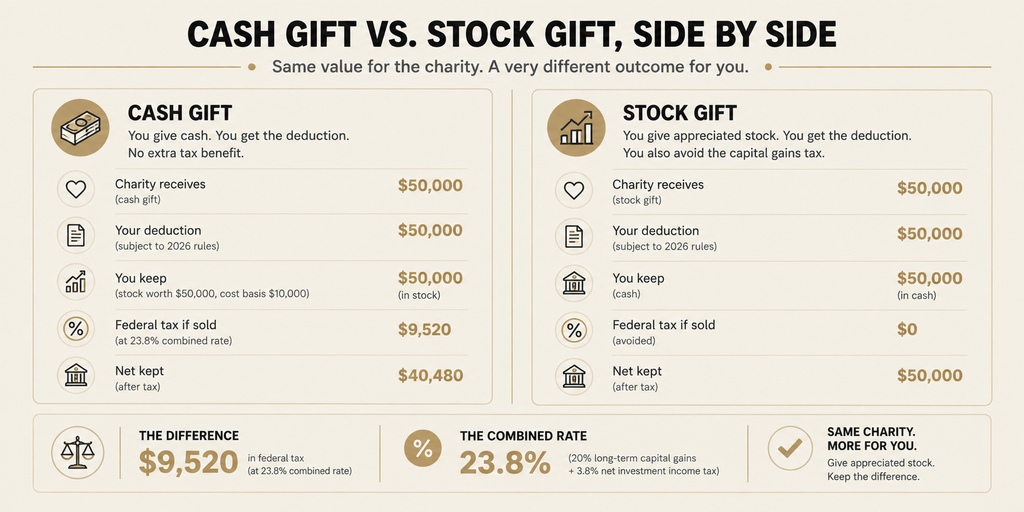
A stock gift delivers two tax benefits: the deduction and the avoided gain. A cash gift delivers only the deduction.
Example: $50,000 in stock vs. $50,000 in cash
Simple Example
- You hold $50,000 of stock bought years ago for $10,000, plus $50,000 in a bank account, and you want to give $50,000.
- Your unrealized gain is $40,000.
- At a combined 23.8% federal rate, tax on a sale would be $9,520.
- These figures are illustrative and ignore state tax.
| Cash gift | Stock gift | |
|---|---|---|
| Charity receives | $50,000 | $50,000 |
| Deduction (before 2026 floor and cap) | $50,000 | $50,000 |
| What you keep afterward | $50,000 of stock with a $10,000 basis | $50,000 in cash |
| Federal tax if you later sold what you kept | $9,520 | $0 |
| Net value kept after tax | $40,480 | $50,000 |
The deduction matches in both columns, so the $9,520 difference comes entirely from the gain you avoid.
OBBBA affects only the deduction side, per Public Law 119-21 (sections 70111 and 70425):
- It caps the tax benefit of itemized deductions at 35% for taxpayers in the 37% bracket.
- It adds a 0.5% of AGI floor on charitable gifts.
- Neither rule touches the avoided gain.
How the 30%-of-AGI limit applies to appreciated-asset gifts
The IRS caps what you can deduct in a year as a share of adjusted gross income (AGI), and the cap depends on what you give and who receives it.
| What you give | Who receives it | Annual limit |
|---|---|---|
| Cash | Public charity | 60% of AGI |
| Long-term appreciated securities | Public charity | 30% of AGI |
| Publicly traded appreciated stock | Private non-operating foundation | 20% of AGI |
Key points on how the limit works:
- Amounts above the limit carry forward for up to five years.
- A donor with $400,000 of AGI could deduct up to $120,000 of appreciated stock in one year, which covers the $50,000 gift above.
- Starting in 2026, the first 0.5% of AGI in itemized gifts produces no deduction, or $2,000 at that income level.
- Larger gifts reach the cap quickly, so the stock donation tax deduction often spreads across more than one return.
Simple Example
- The same donor, with $400,000 of AGI, gives $150,000 of long-term shares to a public charity.
- The 30% limit allows $120,000 in the first year.
- The remaining $30,000 carries forward, within the five-year window and subject to each later year’s limits.
- The capital gain on all $150,000 of shares is still avoided in year one.
The limit applies to the deduction only. It does not create a tax on the gain, because a gift of the shares is not a sale. Donors who expect to exceed the limit often split a large gift across two tax years or pair it with a donor-advised fund.
Which Shares to Give (and Which to Keep)
Not every share in your account suits a charitable gift, and the lot you choose changes how much tax you save. Holding period and whether a position sits at a gain or a loss decide how well a gift works.
Long-term holdings with the largest unrealized gains
The best candidates share three traits:
- They have been held more than one year, so the gain is long-term (IRS Topic No. 409).
- They show a wide gap between current value and what you paid, because that gap is the tax you avoid.
- They are publicly traded. The Instructions for Form 8283 place publicly traded securities in Section A at any value, while non-public securities worth over $5,000 need a qualified appraisal.
Before an appreciated securities donation, take these steps:
- Ask your brokerage for the purchase date and cost basis of each lot, then rank the lots by gain.
- Get the charity’s brokerage transfer details in writing and have your broker move the shares in kind.
- Start early, because the value is set on the date the transfer is completed.
- Keep the written acknowledgment for your records.
Selling first and sending the proceeds defeats the purpose, since the sale is what creates the gain. That is why donating stock to charity works best as an in-kind transfer.
Why you avoid gifting short-term or loss positions
| Position | What you deduct | Better route |
|---|---|---|
| Held one year or less | Generally limited to cost basis | Wait until the holding period passes one year, then give |
| Sitting at a loss | Fair market value, which is below cost | Sell, claim the loss, and give the cash |
| Long-term with a gain | Full fair market value | Give the shares |
For short-term shares, the Form 8283 instructions treat the deduction as fair market value minus the short-term gain, which leaves cost basis. A loss position adds a second problem, because giving it up forfeits the loss. A sale lets you apply the loss against capital gains and up to $3,000 of other income each year, per IRS Topic No. 409, and you can then donate the cash.
Read More: Tax-Loss Harvesting for High Earners: Rules, Wash Sales, and Limits
Using a Donor-Advised Fund to Give Stock Simply
Supporting several charities with appreciated stock takes some setup, and a donor-advised fund (DAF) handles it. You make one transfer of shares, claim one deduction, and then decide over time which charities receive grants and when.
One stock transfer, many charities, one deduction year
A DAF is an account run by a sponsoring public charity. After you contribute, the sponsor holds legal control of the assets, and you keep the right to recommend investments and grants, per the IRS donor-advised fund overview.
- You transfer one block of appreciated shares to the fund.
- You claim one deduction in the year of the contribution.
- You recommend grants to as many charities as you like, on your own timeline.
- You need written acknowledgment that the sponsor has exclusive legal control, per IRS Publication 526.
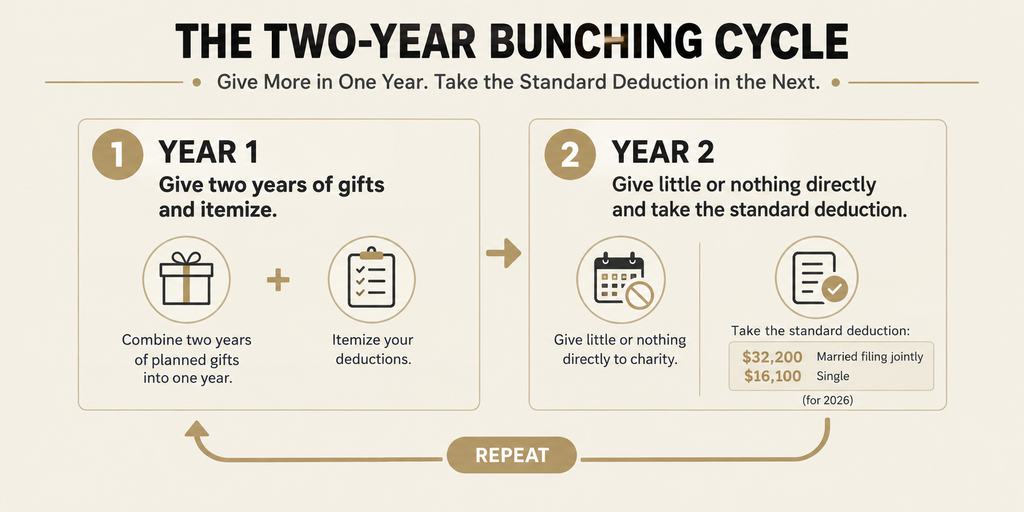
This suits donors who give to several charities, or who want to donate appreciated stock this year before settling on a final list of recipients. Many donors also group several years of giving into one tax year, so the 0.5% floor applies once instead of annually. That bunching is one reason a DAF often appears in advanced tax planning. The five-year carryforward covers any amount above the 30% limit.
A private non-operating foundation is less favorable. Publicly traded stock given to one faces a 20% of AGI limit, and non-public stock may be deductible only at basis.
| Quick TipValue is set by fair market value on the date the transfer is completed. Publicly traded securities are exempt from the qualified appraisal rule, while non-public securities worth over $5,000 generally need one. |
How This Fits Concentrated-Stock and Equity-Comp Planning
Executives often hold one company’s stock as a large share of their net worth, usually built through equity compensation. Gifting shares from that position can serve your giving goals and your risk goals at once.
Trimming an oversized position while doing good
Selling a large block triggers tax on the whole gain. Giving shares reduces the holding without a sale.
- Give the lots with the largest embedded gains.
- Keep higher-basis lots for later sales, since they produce smaller gains.
- Confirm that vested shares have been held more than one year before you give them.
For RSU shares, basis generally equals the value included in your income at vesting, so only the growth since vesting counts as gain. The lots you have held longest after vesting are usually the ones that remove the most gain. Executives can also time gifts to their vesting calendar, which keeps the deduction and the avoided gain in the same tax year.
A gift reduces the position only by the amount given, so it does not fully diversify a concentrated holding on its own. Pair it with a sale plan. A firm that provides tax planning and advisory can coordinate gift timing with vesting dates and the rest of your income.
Read More: How RSUs Are Taxed, and the Withholding Gap That Surprises High Earners
An Advisor’s Take: The Mistakes We See
Most mistakes with stock gifts come from handling the shares in the wrong order, and they are easy to avoid once you know where they occur.
Selling first and donating cash, forfeiting the main benefit
A frequent slip is selling the shares first and then giving the cash. The sale triggers the gain, and the gift deducts only what remains. In the example above, selling first leaves $40,480 after the $9,520 tax, so either the charity receives less or you cover the difference from other funds.
Gifting stock to avoid capital gains works only when the shares move directly to the charity. A review of your holdings under individual tax planning before any trade can prevent this. Other slips we see:
- Gifting shares held one year or less, which limits the deduction to cost basis.
- Gifting a loss position and forfeiting the loss.
- Starting the transfer too close to year-end, since the deduction follows the date the transfer is completed.
The Bottom Line
Donating stock to charity lets you give the same amount, deduct the same fair market value, and avoid tax on the gain. In 2026, OBBBA trims the deduction through the 0.5% floor and the 35% cap, which makes gifting stock to avoid capital gains a larger part of the plan. Start any appreciated securities donation with long-term holdings that carry the largest gains.
At Premium Tax Planners, our expert review under capital gains tax planning keeps the overall position in view.
Schedule a consultation with Premium Tax Planners and map out which shares to give before year-end.
FAQs
Yes, when the shares are long-term and have gained value. Both gifts earn the same fair market value deduction, but donating stock to charity also skips the capital gains tax a sale would trigger. Shares at a loss, or held one year or less, usually favor cash.
Yes. When you donate appreciated stock held more than one year directly to a qualified public charity or donor-advised fund, you do not sell, so you do not recognize the gain. Selling first and then giving the cash does trigger the tax.
The stock donation tax deduction for long-term shares given to a public charity is generally fair market value on the date the transfer is completed. For shares held one year or less, the deduction is generally limited to cost basis. Starting in 2026, itemizers also face a 0.5% of AGI floor and a 35% benefit cap at the top bracket.
An appreciated securities donation to a public charity is limited to 30% of AGI each year, compared with 60% for cash. Excess amounts carry forward up to five years. Publicly traded stock given to a private non-operating foundation faces a 20% limit.
Yes. Donating stock to charity through a donor-advised fund works like a gift to any public charity, and the fund accepts a block of appreciated stock, gives you one deduction in the contribution year, and lets you recommend grants to multiple charities over time. The sponsoring organization holds legal control after your gift, so confirm you receive written acknowledgment.