
The 20% deduction for pass-through business income was once scheduled to disappear after 2025. That did not happen. The One Big Beautiful Bill Act, or OBBBA, made the QBI deduction permanent and changed several rules beginning in 2026.
For business owners, the permanent deduction can remain valuable. The harder question is how much of it you can actually claim when your income is high. Once taxable income crosses the 2026 thresholds, your business type, W-2 wages, and qualified property can change the calculation. Owners of specified service businesses face another restriction that can eventually remove their business income from the deduction entirely.
This guide explains the 2026 thresholds, the rules for service businesses, the W-2 wage and property limits, the new $400 minimum deduction, and the planning issues high-income business owners should review before year-end.
Key Takeaways
- Beginning in 2026, qualifying active business owners may receive a $400 minimum deduction if they meet the statutory requirements.
- W-2 wages and qualified property may limit high-income non-SSTB owners under the Section 199A formula.
- SSTB owners can lose the deduction as taxable income moves through and above the applicable phase-in range.
- For 2026, the main taxable-income thresholds are $201,750 for single filers and $403,500 for married couples filing jointly.
- The QBI deduction is permanent after OBBBA, so eligible pass-through owners can continue using Section 199A after 2025.
What the QBI Deduction Is – and Why It’s Now Permanent
The QBI deduction, also called the Section 199A deduction, generally allows eligible owners of pass-through businesses to deduct up to 20% of qualified business income. It is available to qualifying owners of sole proprietorships, partnerships, S corporations, and certain trusts and estates. C corporation income and wages earned as an employee do not qualify.
For owners using advanced tax planning, the calculation deserves attention because the headline 20% rate is only the starting point. Income level and business type can change the final deduction.
The 20% Deduction on Pass-Through Income, Explained
Qualified business income generally means the net qualified income, gains, deductions, and losses from a qualified U.S. trade or business. Certain items are excluded, including capital gains and losses, most investment interest, employee wages, reasonable compensation received by an S corporation shareholder, and certain guaranteed payments to partners.
If an eligible business owner has $200,000 of QBI and no limitation applies, 20% would equal $40,000. The actual deduction can still be limited because Section 199A generally caps it based on taxable income minus net capital gain. Other limitations can also apply once taxable income rises above the applicable threshold.
The deduction reduces taxable income. It does not mean that 20% of the business owner’s revenue disappears from the tax return. You first have to determine what income actually counts as QBI and then apply the relevant limits.
How OBBBA Removed the 2025 Sunset for Good
The original Section 199A rules were temporary and had been scheduled to end after 2025. OBBBA made the deduction permanent. The law also widened the income range over which certain limitations phase in and created a minimum deduction for qualifying active business owners beginning in 2026.
This permanence gives owners more reason to consider the Section 199A deduction when making long-term decisions about entity structure, compensation, retirement contributions, and taxable income.
Read More: Roth Conversions for High Earners: When Paying Tax Now Wins
How the 2026 QBI Income Thresholds Affect Your Deduction
The QBI phase-out thresholds for 2026 rules are especially important for high-income taxpayers because the calculation changes once taxable income exceeds the applicable threshold.
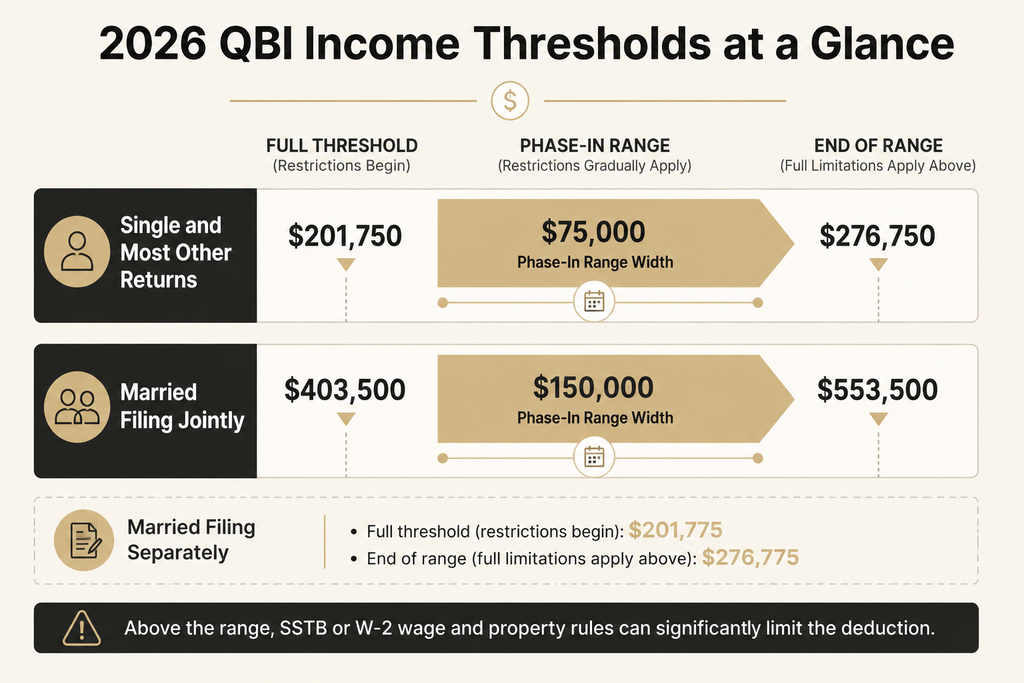
| Filing Status | Full-Deduction Threshold | Phase-In Range | Top of Phase-In Range |
| Married Filing Jointly | $403,500 | $150,000 | $553,500 |
| Married Filing Separately | $201,775 | $75,000 | $276,775 |
| Single and Most Other Returns | $201,750 | $75,000 | $276,750 |
These amounts determine when the SSTB restrictions and W-2 wage and qualified-property limits begin to affect the qualified business income deduction. The figures are confirmed in the IRS 2026 inflation-adjustment guidance.
The Full Deduction Below $201,750 Single / $403,500 Joint
For a single taxpayer with taxable income at or below $201,750, or a married couple filing jointly with taxable income at or below $403,500, the wage, property, and SSTB restrictions generally do not reduce the QBI component in the same way they can above the threshold.
This does not automatically mean the taxpayer receives a deduction equal to exactly 20% of business profit. The general taxable-income limitation and rules defining QBI still apply.
For high earners close to these limits, relatively small changes in taxable income may affect how much of the deduction survives.
This is one reason tax planning and advisory should look at the full personal and business tax picture together.
The Phase-In Range – Now $75,000 Single / $150,000 Joint Wide
OBBBA widened the phase-in range beginning in 2026. The range is now $75,000 for single and other non-joint filers and $150,000 for married couples filing jointly.
For a single filer, the range runs from $201,750 through $276,750. For a married couple filing jointly, it runs from $403,500 through $553,500. For married filing separately, the range runs from $201,775 through $276,775.
Inside this range, restrictions are gradually applied. Once taxable income moves above the range, the full high-income rules can apply.
The SSTB Trap for High-Earning Professionals
A major issue with the QBI deduction for high earners is whether the business is a specified service trade or business, commonly called an SSTB.
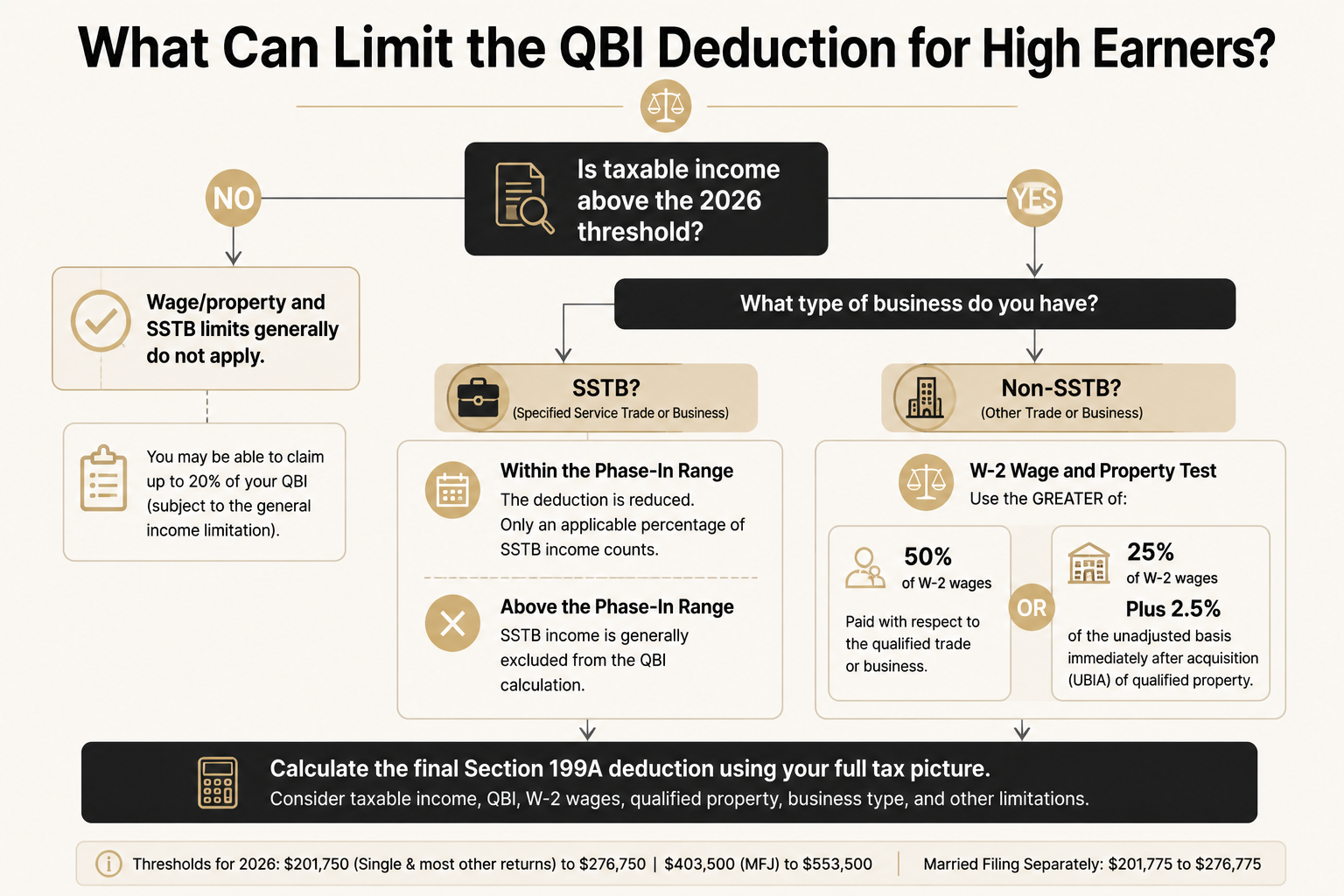
An SSTB can generate eligible QBI when the owner’s taxable income is low enough. As income moves through the phase-in range, the amount counted is reduced. Above the applicable range, SSTB income is generally excluded from QBI.
What Counts as a Specified Service Business
The SSTB rules can apply to businesses in the following fields:
- Health and medical services
- Law, accounting, and actuarial science
- Consulting and financial services
- Performing arts and athletics
- Brokerage and investment-management services
- Trading or dealing in securities, partnership interests, or commodities
The rules can also cover certain businesses where the principal asset is the reputation or skill of one or more employees or owners under specific Section 199A regulations. The SSTB definition is detailed, so a business should not assume it falls inside or outside the rule based only on its job title or industry label.
Why Doctors, Lawyers, and Consultants Lose the Deduction Above the Range
Consider a physician who owns a medical practice. Health services generally fall within the SSTB rules. If the owner’s taxable income exceeds the top of the applicable 2026 phase-in range, QBI from that SSTB generally cannot be used to calculate the deduction.
For a married couple filing jointly, that upper amount is $553,500 in 2026. For most non-joint filers, it is $276,750. Inside the phase-in range, the result is more gradual because only an applicable percentage of SSTB items is considered.
This creates a different planning problem for a high-earning consultant or physician than it does for the owner of a qualifying non-SSTB business.
The W-2 Wage and Property Limit for Everyone Else
Owners of businesses that are not SSTBs can still qualify for the qualified business income deduction at higher incomes. However, once taxable income is high enough, the W-2 wage and qualified property limitation becomes important.
This is where the QBI deduction for high earners often becomes a business-level calculation rather than a simple 20% formula.
The Greater of 50% of W-2 Wages, or 25% plus 2.5% of Property
For taxpayers subject to the full limitation, the QBI component for a qualified trade or business can be limited based on the greater of:
- 50% of the W-2 wages paid with respect to the qualified trade or business; or
- 25% of those W-2 wages plus 2.5% of the UBIA of qualified property.
UBIA means the unadjusted basis immediately after acquisition. In simple terms, it generally refers to the original tax basis of qualifying depreciable property before depreciation adjustments.
Qualified property generally applies to businesses with eligible depreciable tangible property used in the trade or business. The exact UBIA rules are technical, so the amount should be calculated from the business’s actual tax records.
How the Limit Drives Entity and Payroll Decisions
The wage limitation means compensation planning can affect the Section 199A deduction. An S corporation owner, for example, has to consider several connected issues because reasonable compensation paid to the owner is not QBI, while W-2 wages can matter when calculating the wage limitation.
Simply increasing payroll does not guarantee a larger overall tax benefit. More wages can change payroll taxes, business deductions, QBI, and the wage limitation at the same time.
Business tax planning can coordinate compensation with entity structure and the owner’s personal taxable income instead of treating each decision separately.
The New $400 Minimum Deduction
OBBBA added another change for 2026. A minimum QBI deduction for certain taxpayers with active qualified business income. The minimum is designed for qualifying owners whose normal Section 199A calculation would otherwise produce a smaller deduction.
What the OBBBA Floor Means for Smaller Pass-Through Owners
Beginning in 2026, an applicable taxpayer can receive the greater of the normally calculated deduction or $400.
To qualify for this rule in 2026, the taxpayer must have at least $1,000 of aggregate QBI from active qualified trades or businesses. An active qualified trade or business is one in which the taxpayer materially participates under the applicable tax rules.
The $400 minimum and $1,000 QBI requirement are scheduled to be adjusted for inflation for tax years beginning after 2026. This rule does not mean that anyone reporting $1,000 of business income automatically receives $400. You still must meet the statutory requirements for active qualified business income.
Read More: How the One Big Beautiful Bill Act Changes Tax Planning for High Earners (2026)
QBI Planning Considerations for High-Income Business Owners
No single strategy determines the QBI deduction for high earners. Before year-end, review the factors that can affect the calculation:
- Whether the business is an SSTB or a non-SSTB
- The owner’s projected taxable income
- W-2 wages paid by the business
- The UBIA of qualified business property
- Reasonable compensation paid to an S corporation owner
- Retirement-plan contributions and other available deductions
- The timing of income and deductible business expenses
Owners near a 2026 threshold may have more planning flexibility before the tax year closes. Each change should be evaluated for its full income-tax and payroll-tax effect.
Managing Taxable Income, Wages, and Retirement Contributions
Taxable income is central to the QBI phase-out thresholds for 2026. That means planning should consider legitimate deductions and the timing of income where the taxpayer has flexibility.
Retirement plan contributions can be part of the analysis. However, the interaction requires care because deductions for qualified retirement plan contributions attributable to the trade or business can also affect QBI.
Wage planning is another factor for owners above the threshold. A non-SSTB may need sufficient W-2 wages or qualified property to support its deduction under the high-income limitation.
| Quick Tip If your projected taxable income is close to a 2026 QBI threshold, estimate the deduction before year-end. Waiting until the return is prepared can leave fewer options for changing income, deductions, compensation, or retirement contributions. |
Where It Stops: Taxes the QBI Deduction Does Not Reduce
The qualified business income deduction reduces federal taxable income when you qualify. However, it does not reduce every tax connected with business or investment income.
| Tax Calculation | Does the QBI Deduction Reduce It? | What Business Owners Should Know |
| Regular Federal Income Tax | Yes | The deduction reduces qualifying taxable income. |
| Self-Employment Tax | No | It does not reduce net earnings used to calculate self-employment tax. |
| Net Investment Income Tax | No | NIIT is calculated separately under its own rules. |
| Payroll Taxes on W-2 Wages | No | The deduction does not reduce Social Security or Medicare taxes on wages. |
A substantial Section 199A deduction may therefore reduce regular federal income tax while leaving self-employment tax, NIIT, or payroll taxes unchanged.
An Advisor’s Take: Planning Around the Thresholds
The QBI phase-out thresholds and 2026 rules make Section 199A a year-round planning issue for many high-income business owners.
Your current taxable income may determine whether an SSTB receives a meaningful deduction or loses access to it. For a non-SSTB, wages and qualified property can determine how much of the deduction remains available once the owner’s income rises.
Coordinating QBI with Entity Choice and Compensation in 2026
Entity choice can change how business income reaches your return. Compensation decisions can affect QBI and W-2 wage limitations. Retirement contributions and other deductions may affect taxable income. These moving parts make the QBI deduction difficult to plan in isolation.
For an S corporation owner, reasonable compensation is excluded from QBI. For a partner, certain guaranteed payments for services are also excluded.
A useful planning process starts with projected business profit and personal taxable income. From there, the owner and advisor can test the Section 199A result under the actual entity structure, compensation arrangement, retirement contributions, and other relevant deductions.
Premium Tax Planners can review these factors as part of ongoing tax planning and advisory. If your income, compensation, or business structure may change during 2026, schedule a consultation before you finalize year-end decisions.
| Important Note Tax rules can apply differently based on your business structure, income, participation, and other facts. Consider speaking with a qualified tax professional before making tax or compensation decisions. |
FAQs
What Are the 2026 QBI Income Thresholds?
The 2026 threshold is $201,750 for most non-joint returns, $201,775 for married filing separately, and $403,500 for joint returns. The QBI phase-out thresholds 2026 determine when SSTB and wage-and-property restrictions begin applying.
Is the 20% QBI Deduction Permanent Now?
Yes. OBBBA made the deduction permanent and expanded the phase-in ranges beginning in 2026. However, eligibility requirements and income-based limitations can still reduce the amount below 20%.
Why Can’t My Service Business Claim the Deduction?
Your business may be an SSTB, such as a health, law, accounting, consulting, or financial-services business. The deduction may be reduced within the phase-in range, while SSTB income is generally excluded from the qualified business income deduction above that range.
What Is the New $400 Minimum QBI Deduction?
Beginning in 2026, qualifying taxpayers with at least $1,000 of QBI from active qualified businesses may receive a $400 minimum deduction. Material-participation and other statutory requirements still apply.
Does the QBI Deduction Lower My Self-Employment Tax?
No. The QBI deduction may reduce federal taxable income, but it does not reduce net earnings used to calculate self-employment tax. The Section 199A deduction and self-employment tax are calculated separately.