
When a high-earning couple buys a $1.2 million rental and ends the year with a $60,000 depreciation loss, standard rules prevent that loss from offsetting their W-2 income. Real Estate Professional Status (REPS), governed by Internal Revenue Code Section 469(c)(7), changes this. Under IRC Section 469(c)(7), qualifying taxpayers can overcome the presumption that all rental activities are passive per se. With proper planning, REPS turns that $60,000 loss into an immediate tax deduction against salary or business profits.
This guide explains how REPS works, its qualification tests, key audit requirements, and how advanced tax planning helps you qualify.
Key Takeaways
- Rental losses are passive by default under IRC 469, so they can only offset other passive income until you qualify as a real estate professional.
- The $25,000 special allowance phases out completely once your modified AGI reaches $150,000, so it rarely helps high earners.
- Real estate professional status removes the passive label from your rental losses, but you must also materially participate in each rental before the loss becomes usable.
- Only one spouse needs to meet the 750-hour and more-than-half tests, which makes REPS realistic even when the other spouse keeps a demanding W-2 job.
- Pairing REPS with a cost segregation study, and filing the aggregation election on time, is what turns this strategy into real, defensible tax savings.
Why Rental Losses Are Usually Trapped
Most rental property owners never get to use their losses in the year they happen, which surprises people who assume a rental loss works like any other business loss. This is the problem real estate professional status was written to solve.
The passive activity rules under IRC 469
Under Internal Revenue Code Section 469, rental real estate is automatically a passive activity, no matter how much time you spend managing it. According to IRS Publication 925:
- Rental losses can only offset income from other passive activities, not wages, business profit, or investment income
- Without enough passive income to absorb it, the loss is suspended and carried forward
- It stays suspended until you have passive income to use it against, or until you sell the property
For most W-2 employees and business owners, that loss just sits there year after year, even while the property is cash-flow negative and generating a real tax loss on paper.
Why the $25,000 special allowance disappears for high earners
If you or your spouse actively participate in a rental, a lower bar than material participation met by things like approving tenants and setting rental terms, you can deduct up to $25,000 of rental losses against other income each year. Publication 925 shows how fast that allowance disappears:
| Modified AGI | Special Allowance Available |
| $100,000 or less | Up to $25,000 |
| $125,000 | Up to $12,500 |
| $150,000 or more | $0 |
A couple earning a combined salary above $150,000 gets no benefit, regardless of how large their rental losses are. This gap is what pushes high-income rental owners toward real estate professional status instead.
What Real Estate Professional Status Changes
REPS does not create a new deduction. It changes the category a rental activity sits in, which is what makes the loss usable. Deducting rental losses with REPS is only half the job, a point we’ll return to, and it’s why business tax planning advisors treat REPS as a structural decision, not a line item claimed at filing time.
How REPS makes rental losses non-passive – and usable against other income
Once you qualify as a real estate professional under IRC 469(c)(7) and materially participate in a rental, that rental is no longer automatically passive. The loss becomes non-passive, so it can offset wages, business income, or other income the year it occurs, with no dollar cap and no phase-out like the $25,000 allowance.
A qualifying real estate professional with $150,000 of rental losses and $600,000 of salary can, in principle, use the full loss that same year.
The cost-segregation combination that creates six-figure deductions
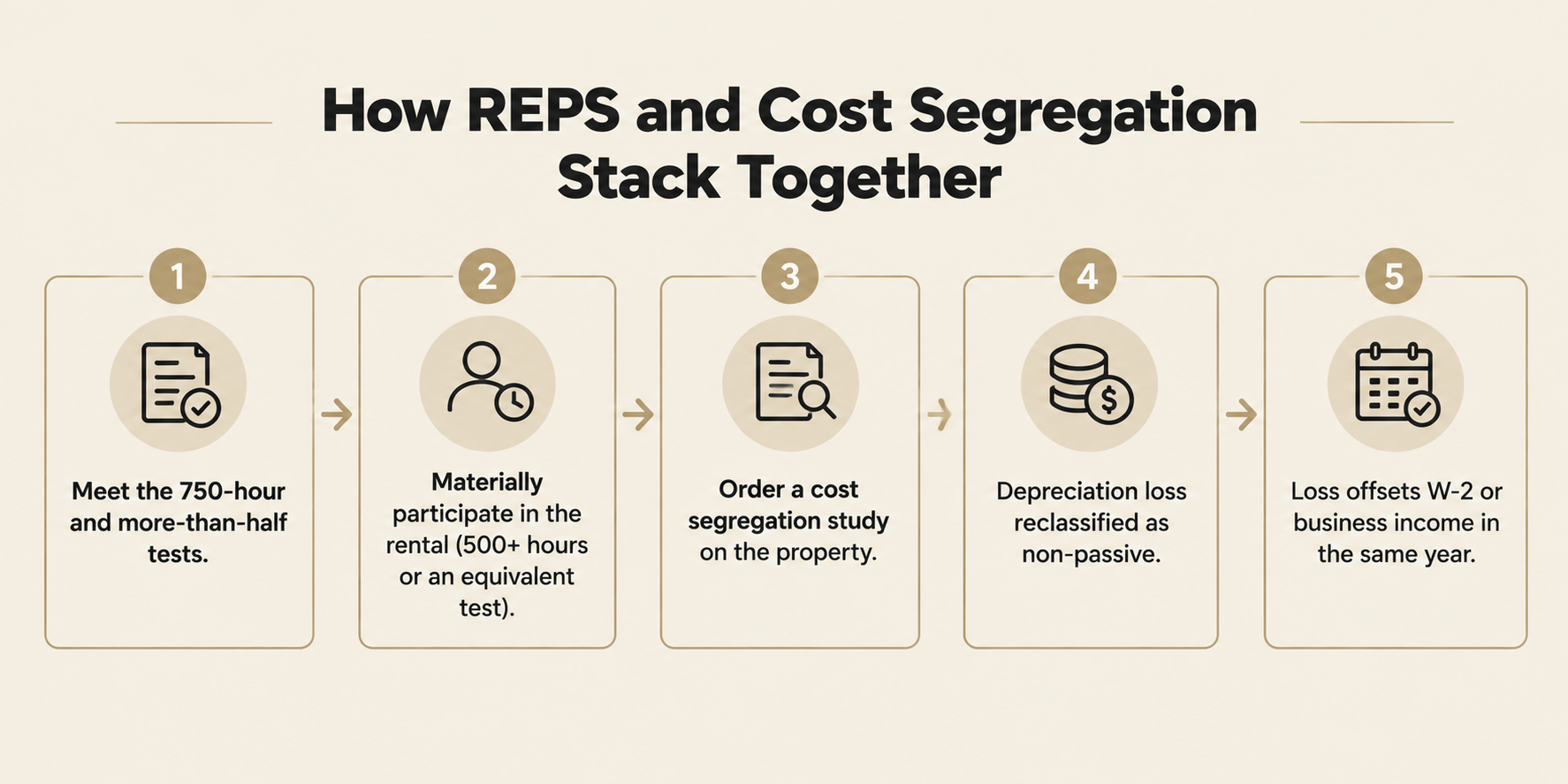
Pairing REPS with a cost segregation study is what produces the six-figure deductions people hear about. A cost segregation study reclassifies parts of a building into shorter depreciation categories, accelerating the loss in the year the property is placed in service. On its own, that accelerated loss is still passive. Combined with REPS, it isn’t.
How the Combination Works
- Buy the property and materially participate in it
- Order a cost segregation study the same year
- The accelerated first-year loss becomes non-passive under REPS
- It can directly offset W-2 income or business profit — no dollar cap, no phase-out
The Two Tests to Qualify (IRC 469(c)(7))
To qualify as a real estate professional, you must pass two separate tests in the same tax year, and you must meet both every year you want the benefit. There is no grandfathering. A good year in 2025 does not carry over to 2026.
| Test | What it Requires | Where People Get Tripped Up |
| More-Than-Half Test | Over 50% of your personal service hours across every trade or business must be in real property trades or businesses you materially participate in. | A full-time job outside real estate makes this nearly impossible to clear. |
| 750-Hour Test | You must perform more than 750 hours of service in real property trades or businesses you materially participate in. | Employee hours don’t count unless you own more than 5% of the employer. |
More than half of your personal services in real property trades
This test is proportional to everything else you do. Under Publication 925, more than half of your personal service hours for the year must be in real property trades or businesses; development, construction, acquisition, rental, management, leasing, and brokerage all count.
Work 2,000 hours in an unrelated field, and you’d need over 2,000 hours in real property activities to clear 50%, which is rarely realistic alongside a full-time job elsewhere.
More than 750 hours – and why a full-time W-2 job makes this hard
The second test requires over 750 hours of personal service in real property trades or businesses in which you materially participate. Hours worked as an employee do not count unless you own more than 5% of the employer.
Reaching 750 hours is challenging alongside a full-time outside job. IRS auditors check W-2 records, and working 2,000+ hours in another field makes passing the more-than-half test very difficult.
Consequently, REPS is most feasible for self-employed individuals, part-time workers, or spouses who manage rental portfolios full-time.
Read More: Bonus Depreciation Is Back to 100% – What You Can Write Off Now
The Step Everyone Forgets: Material Participation
This is where a lot of REPS claims fall apart. Qualifying as a real estate professional and materially participating in each rental are two different milestones, and good business tax planning treats them that way from the start.
REPS alone isn’t enough – you must materially participate in the rentals
Qualifying for REPS removes the automatic passive label, but you must still materially participate in each property to deduct its losses.
You can meet material participation by satisfying any of these key tests:
- Logging 500+ hours in the property activity during the year
- Performing substantially all the work done on the property
- Working 100+ hours and at least as much as any other individual
Hours must come from hands-on management or operations. Investor tasks (like reviewing finances from a distance) and commuting time do not count.
The aggregation election that tests your whole portfolio at once
If you own several rentals, the default rules evaluate material participation for each property separately. This makes it hard to qualify if your hours are spread across multiple locations instead of concentrated on a single property.
To solve this, you can make an aggregation election under Treasury Regulation 1.469-9(g). This election allows real estate professionals to treat all rental properties as a single activity, combining their hours across the entire portfolio.
To make the election, attach a statement to your timely filed original return that includes:
- Declare that you are a qualifying taxpayer for the year
- State that you are making the election under IRC 469(c)(7)(A)
- Confirmation that it is included with your original return
Once filed, the regulation confirms this election applies to the current tax year and all future qualifying years. It can only be revoked if your circumstances change significantly.
Many taxpayers who meet the hour requirements still fail audits simply because they forgot to file this required election.
| Quick Tip: If you own more than one rental and plan to rely on REPS, file the aggregation election in your first qualifying year. It is far easier to file on time than to argue later that you should have. |
The Spouse Advantage
REPS does not require you to give up a stable income to qualify. Because the rules treat each spouse’s qualifying hours differently from their participation hours, a married couple can often structure who does what so the household still gets the tax benefit without either spouse leaving a career.
One spouse can qualify while the other keeps the high-income W-2 job
One spouse must meet the 750-hour test and the more-than-half test individually. You cannot add your hours to your spouse’s hours to clear either threshold together.
Material participation in the underlying rentals works differently. Under IRC 469(h)(5), confirmed in Publication 925, a married couple filing jointly can combine both spouses’ hours in a rental when testing real estate professional material participation, even though the two REPS qualification tests cannot be combined.
In practice, one spouse, often the one who is self-employed or has stepped back from a W-2 job, can independently clear the REPS 750-hour requirement and the more-than-half test, while the other keeps a demanding high-income tax-planning career and still contributes hours toward material participation. The household gets the full benefit because the return is joint.
| Simple Example: A physician earns $450,000 a year at a hospital. Her husband left his job two years ago to manage their four rental properties full time, logging more than 900 hours annually on leasing, repairs, and tenant issues. He individually clears both REPS tests. Because they file jointly, the properties’ losses, including the loss from a cost segregation study on their newest purchase, can offset her salary. |
Documentation: Where REPS Claims Are Won or Lost
Qualifying for REPS and materially participating in your rentals mean nothing to the IRS without proof.
Examiners scrutinize REPS claims more closely than almost any other passive activity issue, and the difference between a deduction that survives audit and one that gets reversed usually comes down to how well you tracked your hours.
Contemporaneous time logs and the hours that don’t count
The IRS does not require a specific format for proof of hours worked. The estimate still has to be credible, and vague, after-the-fact reconstructions are where most REPS audits go badly. A log kept throughout the year, even a simple spreadsheet noting the date, property, activity, and hours, holds up far better than a summary written in April.
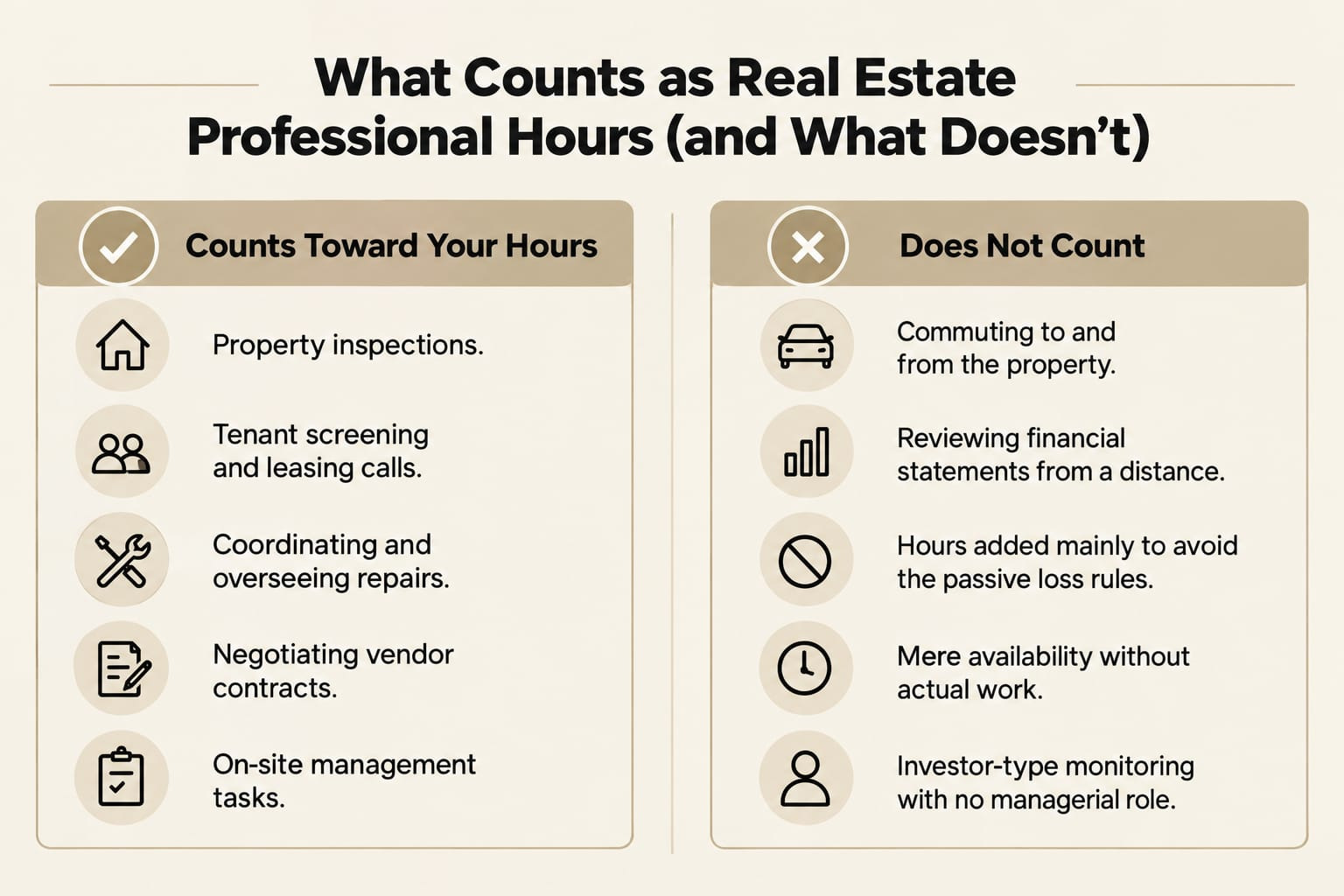
Not every hour you spend on a property counts toward your total, and the distinction is where most REPS claims run into trouble:
Counts toward your hours:
- Property inspections and walkthroughs
- Tenant screening and leasing calls
- Coordinating and overseeing repairs
- Negotiating vendor contracts
- On-site management tasks
Doesn’t count:
- Commuting to and from the property
- Reviewing financial statements from a distance
- Hours logged mainly to avoid the passive loss rules
- Mere availability without actual work
- Investor-type monitoring with no managerial role
Examiners are trained to look for these gaps, so a log that clearly separates real, hands-on work protects both the REPS 750-hour requirement and your material participation numbers. This discipline is central to tax planning and advisory work built around real estate.
| Important Note: Tax rules can change and may apply differently based on your circumstances. Consider speaking with a qualified tax professional before making a tax decision. |
Read More: How the One Big Beautiful Bill Act Changes Tax Planning for High Earners (2026)
| An Advisor’s Take: Qualify on Purpose, Not by AccidentMost REPS mistakes come down to timing rather than the rules themselves. By the time a return reaches an advisor’s desk, the tax year is already closed, and there is no way to go back and log more hours or file an election that had to be timely. Qualifying for REPS well is a planning decision made before year-end, not a filing-season scramble. Planning the hours, the election, and the studies before year-endReal estate professional status is measured fresh each tax year, so you have to plan for it, not discover it at filing time. Waiting until March to tally last year’s hours is too late to log more time, file a timely election, or order a cost segregation study before placing the property in service.Before year-end, that typically means:Start tracking hours on January 1, not the following MarchDecide early which spouse will pursue REPS qualificationFile the aggregation election with a timely, original return if you own multiple propertiesTime property acquisitions and cost segregation studies so the loss lands in a usable yearThis is the coordination tax planning and advisory work is built for. |
Conclusion
Rental losses don’t have to go to waste. Real Estate Professional Status (REPS) lets high earners offset salary with rental losses, provided you meet the annual hour tests, document material participation for each property, and file the aggregation election on time.
If a spouse in your household qualifies for the 750-hour test, or you have unused rental losses, Premium Tax Planners can help you build an advanced tax plan before year-end.
Schedule a consultation with Premium Tax Planners to see how REPS can lower your tax bill.
FAQs
It is possible but difficult. The more-than-half test requires more than half your working hours to come from real property, so a full-time job elsewhere makes that hard to meet. The REPS 750-hour requirement is rarely the obstacle; the more-than-half test usually is. Qualifying as a real estate professional is far more common for the self-employed.
No. Real estate professional status only removes the passive label from your work. You still have to separately show real estate professional material participation in each rental, usually more than 500 hours, before that property’s losses become usable. Many taxpayers meet the REPS tests but skip this step.
The 750-hour test and the more-than-half test must be met by one spouse alone. But once that spouse qualifies, real estate professional material participation on the properties can be shown using both spouses’ combined hours on a joint return, which is what makes deducting rental losses with REPS realistic for a two-income household.
A formal daily log is not strictly required. Your hours toward the REPS 750-hour requirement still need a credible, contemporaneous record. A simple running log noting the date, property, task, and time spent holds up far better than a reconstruction at tax time. Investor-type hours and commuting don’t count.
A cost segregation study accelerates depreciation on parts of a property, creating a large deduction the year it’s performed. On its own, that deduction is still passive. Once you qualify as a real estate professional and materially participate in that property, the loss becomes non-passive, which is how deducting rental losses with REPS and a cost segregation study work together.