
Running an S-corp lets you split income into salary and distributions, so only your salary incurs payroll tax. While this is a great tax strategy, the IRS requires you to pay yourself a reasonable salary before taking any distributions.
This guide explains how the IRS defines reasonable salary, why the “60/40 rule” is a myth, and how to set a defensible number for your business tax planning.
Key Takeaways
- Only your S-corp salary is subject to the 15.3% combined Social Security and Medicare tax. Distributions are not.
- The IRS requires a reasonable salary before you take any distributions. There is no shortcut around this.
- The “60/40 rule” is not found in any statute, regulation, or IRS publication. Your salary must reflect what an unrelated employer would pay for your role.
- Paying yourself too little invited the reclassification and back taxes seen in Watson v. United States. Paying yourself too much can shrink your 20% QBI deduction.
- A written compensation agreement backed by real market wage data is what protects your number if the IRS ever asks.
The Tax Break That Makes This Question Matter
S-corp owners spend time setting a reasonable S-corp salary because of payroll tax. Understanding the split between wages and profit distributions is the first step toward smart advanced tax planning for your business.
Why only your salary, not your distributions, pays payroll tax
When you work for your S-corp, you are both the owner and an employee. The wages your corporation pays you are reported on a W-2 and are subject to FICA tax: 6.2% for Social Security and 1.45% for Medicare, matched by the corporation for a combined 15.3%.
Profit distributions are your share of the company’s earnings as a shareholder, not wages, so they are not subject to FICA or self-employment tax.
A sole proprietor pays self-employment tax on nearly all business profit. An S-corp owner only pays payroll tax on the salary portion, as long as it meets the reasonable compensation for S-corp shareholder-employees standard.
A quick example of the FICA savings
Simple Example:
Say your S-corp nets $150,000 after expenses, and a fair salary for your role is $70,000.
- Salary of $70,000 is subject to 15.3% combined FICA tax, or about $10,710.
- The remaining $80,000 taken as a distribution is not subject to FICA tax at all.
Compare that to a sole proprietorship earning the same $150,000, where self-employment tax applies to nearly the full amount. That gap is why so many profitable businesses elect S-corp status.
| Salary | Distributions | |
| Reported on | W-2 | Schedule K-1 |
| Subject to 15.3% FICA tax | Yes | No |
| Required before distributions | N/A | Only after a reasonable salary is paid |
The IRS Rule: A “Reasonable” Salary Comes First
The payroll tax savings only work if you follow the rule that comes with them. Before you take a single distribution, you need a reasonable S-corp salary in place.
Why shareholder-employees must be paid before taking distributions
If a shareholder who performs services for the corporation receives cash or property, the corporation must first treat an appropriate and reasonable amount of that payment as wages.
Courts have repeatedly ruled that an S-corp cannot avoid employment taxes by labeling wages as distributions. What matters is whether the payment was really compensation for work performed.
This is the core of every S-corp payroll requirements discussion: salary comes first, distributions come after.
The 60/40 rule is a myth. There is no magic percentage
You may have heard that you should pay yourself 60% of profit as salary and take the remaining 40% as distributions. This idea shows up constantly in small business forums, but it has no legal basis. It does not appear in the tax code, Treasury regulations, any IRS revenue ruling, or any IRS publication.
Some tax professionals observe that S-corp owners in service businesses often land somewhere in a 40% to 70% range of net profit paid as salary. That is what tends to happen in practice, not a legal safe harbor. The IRS judges your salary against what someone else would be paid for your specific job. Relying on a fixed ratio instead of specific facts leads to trouble.
Read More: How the One Big Beautiful Bill Act Changes Tax Planning for High Earners (2026)
How the IRS Actually Judges “Reasonable”
Without a fixed percentage, here’s how to find a defensible number. The IRS considers your full role rather than a formula.
The facts-and-circumstances factors under Treasury Regulation 1.162-7
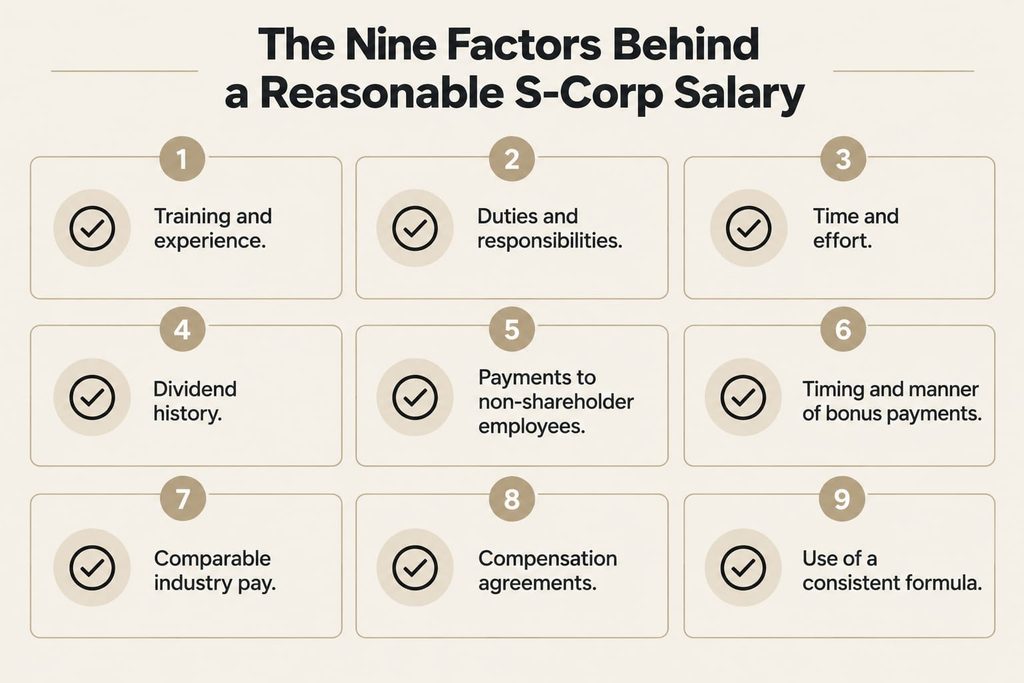
Under Treasury Regulation 1.162-7(b)(3), reasonable compensation is “such amount as would ordinarily be paid for like services by like enterprises under like circumstances”. IRS Fact Sheet FS-2008-25 breaks this into the factors examiners weigh for reasonable compensation for S-corp officers.
- Training and experience
- Duties and responsibilities
- Time and effort devoted to the business
- Dividend history compared to salary history
- Payments to non-shareholder employees for comparable work
- Timing and manner of bonuses to key people
- What comparable businesses pay for similar work
- Compensation agreements already in place
- Use of a consistent pay formula
| Quick Tip: No single factor decides your number. An examiner weighs them together, so strong training and duties can offset a thinner history of formal agreements. |
Building the number from real market wage data
Start with comparable market wage data for your role, industry, and location. Tools like the Bureau of Labor Statistics OEWS program provide defensible salary ranges.
If you work full-time, your salary should match what a local business would pay an employee with similar qualifications for the same work.
Ask yourself: what would it cost to hire someone else to do your job? Answering this with real wage data ensures your S-corp salary is defensible.
What Happens When Owners Get It Wrong
The stakes here are not theoretical. Two court cases show exactly what happens on either end of the spectrum when an owner ignores the rule.
The Watson case: reclassified distributions and back payroll taxes
David E. Watson, P.C. v. United States, the leading case here, was decided by the Eighth Circuit in 2012. Watson, a CPA, paid himself a $24,000 salary while his S-corp distributed roughly $200,000 a year.
The numbers tell the story:
| Item | Amount |
| Salary Watson actually paid himself | $24,000 |
| Distributions taken | About $200,000 |
| Reasonable compensation set by the court | $91,044 |
| Distributions reclassified as wages | $67,044 |
The court used comparable industry wage surveys to determine what an accounting firm would pay someone with Watson’s training and workload, then reclassified $67,044 of his distributions as wages and added back payroll taxes, penalties, and interest.
The zero-salary trap
Watson’s opinion pointed back to an earlier case, Radtke v. United States, where an S-corp owner paid himself no salary and took his entire income as distributions. The court reclassified the full amount as wages, since the payments were clearly compensation for the work he performed. A $0 salary is one of the clearest audit triggers an S-corp owner can create.
| Important Note: Tax rules can change and may apply differently based on your circumstances. Consider speaking with a qualified tax professional before making a tax decision. |
The Number Can Be Too High, Too
Most warnings about your S-corp reasonable salary focus on paying too little. But for higher earners, an excessive salary carries its own cost.
How your salary interacts with the 20% QBI deduction
The qualified business income (QBI) deduction allows eligible owners to deduct up to 20% of qualified income. In 2026, for taxable income above $201,750 (single) or $403,500 (joint), W-2 wages limit the deduction.
Because the One Big Beautiful Bill Act made this permanent, balancing wages and QBI remains a key planning goal.
Above those income limits, setting salary too low reduces your QBI deduction, while setting it too high wastes money on unnecessary payroll taxes. In high-income tax planning, aim for a reasonable, defensible salary rather than the lowest possible number.
| Takeaway: A reasonable salary works as an audit shield, and for owners above the QBI thresholds, it also determines how much of your pass-through deduction you get to keep. |
How to Set and Document Your Salary
Once you understand what counts as reasonable compensation for S-corp shareholder-employees, the next step is putting a process behind it to defend later. Getting S-corp salary vs. distributions right starts with real evidence.
Comparable data, a written agreement, and a compensation study
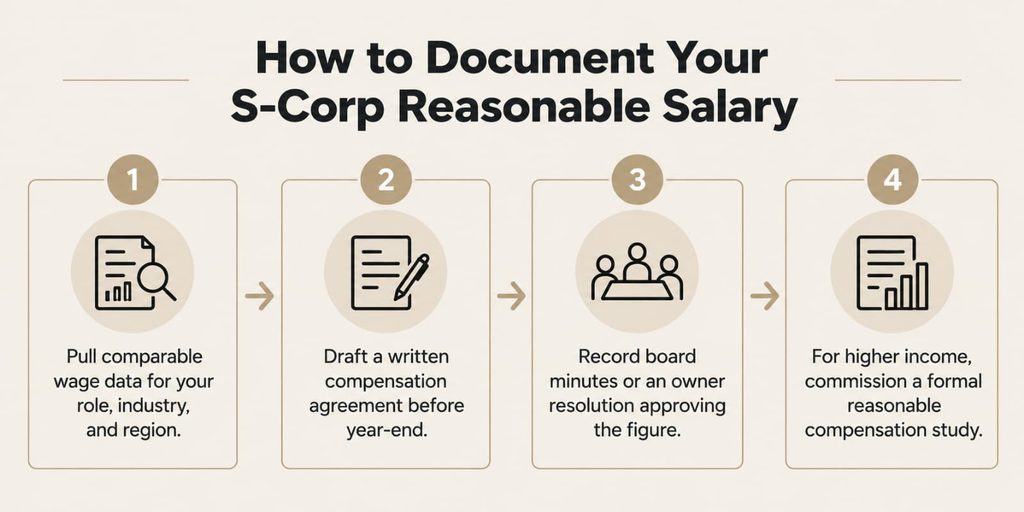
A defensible S-corp reasonable salary is built the same way each year, using real evidence rather than a guess. Meeting S-corp payroll requirements starts with documentation like this:
- Comparable wage data, such as Bureau of Labor Statistics wage figures for your job title, industry, and region
- A written compensation agreement approved before the tax year, spelling out your role, duties, and pay
- Board minutes or an owner resolution recording how the salary figure was chosen
- A formal reasonable compensation study, which is worth commissioning once income and complexity grow, since a third-party study carries more weight than a number an owner picked alone
This does not need to be complicated for a small, straightforward business, and it makes how much to pay yourself from an S-corp far less of a guess.
The more income and distributions involved, the more this documentation matters, which is why it belongs in ongoing tax planning and advisory work, not a once-a-year afterthought.
Read More: Q3 Estimated Taxes: What High Earners Pay (and the 110% Rule)
An Advisor’s Take: Revisit the Number as Profit Grows
Setting your S-corp reasonable salary once is not the end of the process. It is worth revisiting every year as part of ongoing advanced tax planning, especially as your business changes.
Why last year’s salary isn’t automatically right this year
A reasonable salary reflects your role and the market at the time it is set. A few signs it’s time to revisit the number:
- Your S-corp’s profit doubles, or shifts significantly
- You take on more responsibility than in prior years
- You hire staff who now handle work you used to do
Any one of these can mean last year’s number no longer holds up. Owners who get the most value from splitting salary and distributions treat the number as an annual decision. Reviewing it before year-end, alongside the rest of your business tax planning, keeps your S-corp payroll requirements current and your savings intact.
Conclusion
Splitting income between salary and distributions is one of the real advantages of running an S-corp, but it only works if the salary side is reasonable. The IRS does not accept a fixed percentage, a $0 paycheck, or a number chosen to minimize tax.
Get the S-corp reasonable salary question right, and you keep the payroll tax savings that made the S-corp election worth it, while still supporting a strong QBI deduction as part of your high-income tax planning, if you’re a higher earner. If you get it wrong, you risk back taxes, penalties, or a smaller deduction than you should have.
At Premium Tax Planners, the team works with S-corp owners to set a defensible number and document it properly as part of a broader tax planning and advisory relationship.
Schedule a consultation with Premium Tax Planners and talk through your numbers before your next tax year closes.
FAQs
No. The “60/40 rule” isn’t in any statute, regulation, or IRS publication. Your S-corp reasonable salary depends on what an unrelated employer would pay someone else to do your job, based on training, duties, time spent, and comparable wages, not a fixed formula.
The IRS can reclassify distributions as wages, adding back payroll taxes, penalties, and interest. In Watson v. United States, a CPA’s $24,000 salary was raised to $91,044, with the difference taxed as wages. Underpaying is a common trigger for an S-corp payroll requirements audit.
It’s risky if you’re actively working in the business. Courts have reclassified entire distributions as wages when an owner who clearly performed services took no salary. A slow year may support a lower salary, but rarely zero.
Only above certain income levels. For 2026, the QBI deduction is limited by W-2 wages once taxable income passes $201,750 (single) or $403,500 (married filing jointly). Below that, chasing a bigger deduction usually costs more in payroll tax than it gains.
Not always, but it helps as income and distributions grow. A written compensation agreement and comparable wage data are the baseline; a formal study adds independent support if the IRS ever questions your number.