
Choosing between an S-corp and a C-corp used to be simple: pick an S-corp to avoid double taxation. The One Big Beautiful Bill Act (OBBBA) of July 2025 complicated that choice.
Starting in 2026, the law makes the 20% qualified business income (QBI) deduction permanent, keeping effective S-corp tax rates lower than C-corp rates on distributed profits.
However, OBBBA also expanded tax breaks for qualified small business stock (QSBS), making C-corps more attractive to high earners.
This guide covers the S-corp vs. C-corp decision, breaks down the 2026 tax math, and explains how business tax planning applies to different owners.
Key Takeaways
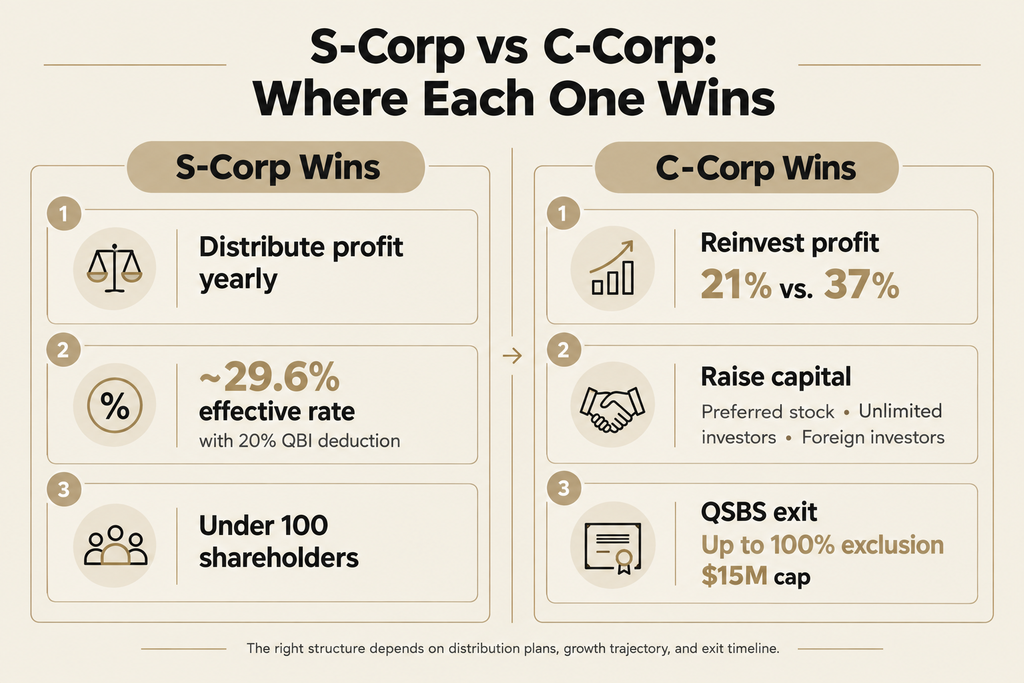
- A C-corp pays a flat 21% rate, but C-corp double taxation can push distributed profit to a combined rate near 40%.
- The permanent 20% QBI deduction keeps many S-corp owners’ effective top rate near 29.6% starting in 2026.
- OBBBA’s expanded QSBS exclusion (up to 100% of gain, $15 million cap) only applies to C-corp stock, never S-corp stock.
- Reinvested C-corp profit can beat S-corp taxation because 21% is lower than the top individual rate of 37%.
- Model S-corp vs. C-corp against your distribution plans, growth trajectory, and exit timeline.
The Core S-Corp vs C-Corp Difference: One Layer of Tax vs. Two
The starting point for any S-corp vs C-corp decision is how many times the government taxes your profit. An S-corp is a pass-through entity, so the government taxes its income once, on the owners’ personal returns. A C-corp is a separate taxpaying entity, so its income can be taxed twice: once at the corporate level and again when profit reaches shareholders as a dividend.
That difference drives most of the high income tax planning conversations we have with business owners, but OBBBA added enough new variables that the answer is no longer automatic.
S-corp pass-through taxation and the 20% QBI deduction
An S-corp pays no federal income tax directly. Profits and losses pass through to the owners’ personal returns, taxed at individual rates up to 37%.
Eligible S-corp owners can also take the 20% Qualified Business Income (QBI) deduction under Section 199A, deducting 20% of pass-through earnings.
For top-bracket earners, this QBI deduction reduces the effective top rate on S-corp profit to roughly 29.6%.
The C-Corp’s Flat 21% Rate and Its Double Taxation
A C-corp pays a flat 21% federal tax on profits under Section 11, unchanged by OBBBA.
Distributing after-tax profit as dividends leads to double taxation. Shareholders pay up to 20% on qualified dividends plus the 3.8% net investment income tax.
The table below summarizes the core S-corp vs C-corp tax differences before we run the numbers on real dollars.
S-Corp vs C-Corp at a Glance
| Feature | S-Corp | C-Corp |
|---|---|---|
| Entity-level federal tax | None (pass-through) | Flat 21% |
| Tax on distributed profit | Individual rate, reduced by 20% QBI deduction | 21% at the entity, then 0/15/20% plus 3.8% NIIT |
| Effective top rate on distributed profit (2026) | About 29.6% | About 39.8% |
| QSBS eligibility | Never | Yes, with OBBBA’s expanded exclusion |
| Shareholder limit | 100 | Unlimited |
Running the Numbers on Distributed Profit
Below is what happens to $100 of profit under each structure, assuming the owner is in the top brackets and distributes the money right away.
Why fully distributed C-corp earnings can be taxed at nearly 40%
On $100 of profit, the corporation pays 21% in federal tax, leaving $79. If that $79 is distributed as a dividend to a top-bracket shareholder, it faces a 20% qualified dividend rate plus the 3.8% net investment income tax, a combined 23.8% on the distributed amount.
| Step | Amount |
|---|---|
| Starting profit | $100.00 |
| Corporate tax at 21% | -$21.00 |
| Profit after corporate tax | $79.00 |
| Shareholder tax at 23.8% (dividend rate plus NIIT) | -$18.80 |
| Amount the owner keeps | $60.20 |
| Combined effective federal rate | About 39.8% |
This is C-corp double taxation in real dollars, and it still accurately reflects a business that pays out most of what it earns each year.
How the S-corp’s QBI deduction lowers the effective rate
Run the same $100 through an S-corp. No entity-level tax, so the full $100 passes through. With the full 20% QBI deduction, only $80 is taxable. Taxed at 37%, the bill is about $29.60, leaving the owner with roughly $70.40.
That is close to $10 more per $100 of profit than the C-corp scenario, which is why S-corp vs C-corp taxes have favored the S-corp for owners who take distributions. The gap narrows below the top bracket, but the pattern holds: an S-corp usually keeps more money in the owner’s pocket when profit is distributed the same year it is earned.
| Important Note: Tax rules can change and may apply differently based on your circumstances. Consider speaking with a qualified tax professional before making a tax decision. |
Read More: How the One Big Beautiful Bill Act Changes Tax Planning for High Earners (2026)
When the C-Corp’s 21% Rate Actually Wins
The math above assumes the owner takes every dollar out right away. Change that assumption, and two situations can flip the S-corp vs C-corp comparison in the C-corp’s favor.
Reinvesting profits instead of distributing them
If a business reinvests profit instead of distributing it, the C-corp’s 21% rate beats the top individual rate of 37% outright. A company that plows earnings back into equipment, hiring, or research pays 21% inside the corporation and owes no second layer of tax until the money is eventually distributed, which may be years away.
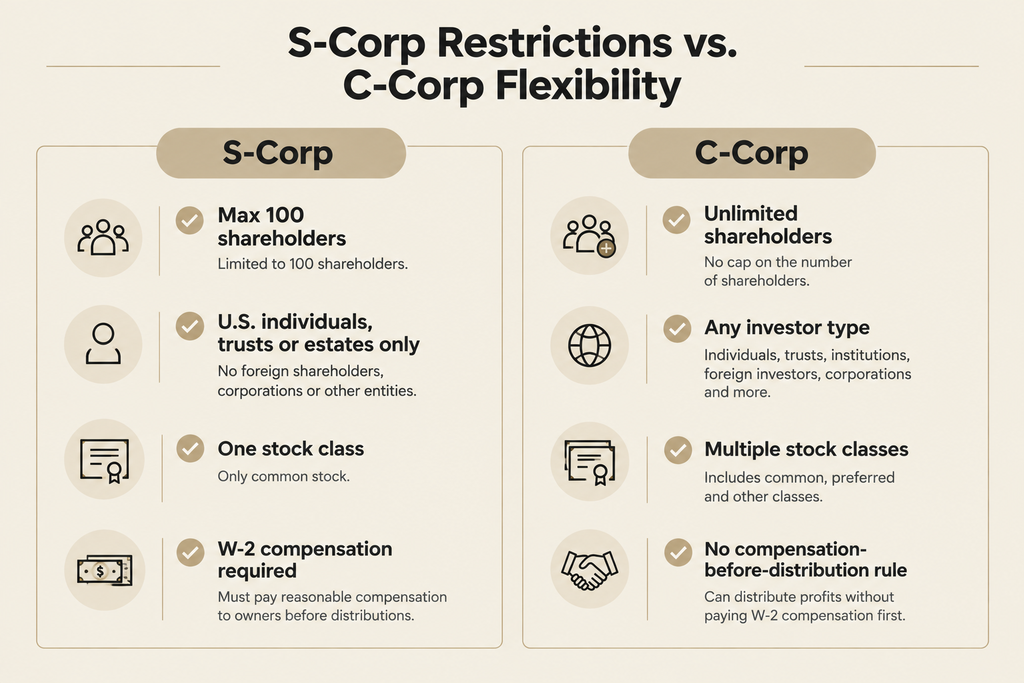
C-corps also have structural advantages for raising institutional capital. They can issue preferred stock, sell shares to an unlimited number of investors, and accept foreign or corporate shareholders, none of which an S-corp is allowed to do.
The QSBS advantage OBBBA just expanded
The second reason to reconsider a C-corp is qualified small business stock, or QSBS, a break under Section 1202 that lets founders and early investors exclude a portion of their gain when they sell qualifying stock. OBBBA significantly expanded this benefit for stock acquired after July 4, 2025.
The catch, and it is a big one for entity choice for high earners after OBBBA, is that only C-corp stock can ever qualify for QSBS. An S-corp cannot offer this benefit to its owners under any circumstance. For a founder with a realistic path to a sale, that single fact can outweigh the annual tax math above.
The QSBS Change That Can Flip the Decision
QSBS is the single biggest reason OBBBA changed the S-corp vs C-corp conversation. It can be worth millions to a founder who eventually sells the company.
The new 50/75/100% exclusion tiers and the $15M cap
Before OBBBA, QSBS let eligible shareholders exclude gain only after a five-year hold, capped at $10 million or 10 times basis, whichever was greater. For stock acquired after July 4, 2025, Section 1202 of the Internal Revenue Code uses a tiered exclusion instead:
- 3-year hold: 50% of the gain is excluded
- 4-year hold: 75% of the gain is excluded
- 5-year hold or more: 100% of the gain is excluded
The per-issuer cap rose from $10 million to $15 million, with inflation adjustments starting after 2026, and the corporation’s gross-asset ceiling rose from $50 million to $75 million. More companies now qualify, larger gains can be excluded, and a founder no longer has to wait a full five years for meaningful relief.
Why only C-corp stock qualifies
QSBS only applies to original-issue stock in a domestic C-corp. S-corp stock, partnership interests, and LLC membership units do not qualify, regardless of how long you hold them. The IRS confirms this scope in its overview of the OBBBA business provisions.
Converting an existing S-corp to a C-corp later does not make its previously issued stock eligible. QSBS treatment only applies to stock issued after the corporation becomes a C-corp, so a founder who wants this benefit generally needs to set up as a C-corp from the start. This is exactly the kind of decision our advanced tax planning team models before a client incorporates, not after.
What the New Tax Law Kept for Pass-Throughs
OBBBA not only added new C-corp advantages to the S-corp vs. C-corp taxes equation. It also locked in the pass-through side’s biggest benefit and left a valuable state tax workaround untouched.
The permanent 20% QBI deduction and the SALT-cap workaround (PTET)
Before OBBBA, the 20% QBI deduction was scheduled to expire after 2025. OBBBA made it permanent for tax years beginning after December 31, 2025, and widened two key 2026 thresholds:
| Single filers | Married filing jointly | |
|---|---|---|
| SSTB phase-in range (widened by OBBBA) | $75,000 | $150,000 |
| QBI phase-in threshold (2026) | $201,750 | $403,500 |
Pass-through owners also kept the pass-through entity tax, or PTET, a workaround many states created after the $10,000 cap on state and local tax (SALT) deductions took effect.
Under PTET, an S-corp or partnership can elect to pay state income tax at the entity level, and the IRS has confirmed that payment doesn’t count against the owners’ individual SALT cap. C-corps don’t need this workaround because they already deduct state taxes as an ordinary business expense.
Read More: Bonus Depreciation Is Back to 100%: What You Can Write Off Now
The Other Factors That Decide It
Tax rate is not the only variable. A handful of operational rules can push a business toward an S-corp or C-corp regardless of the tax math, and any serious business tax-planning process must account for them.
Reasonable compensation, fringe benefits, and ownership restrictions
S-corp owners who work in the business must pay themselves reasonable W-2 compensation before taking distributions. The IRS is explicit that an owner-employee cannot skip a salary and take everything as a distribution to avoid payroll tax. Getting this wrong is a common audit trigger for S-corp owners.
S-corps also carry ownership restrictions a C-corp does not:
- No more than 100 shareholders
- Only U.S. individuals and certain trusts or estates can own shares, per IRS eligibility rules
- Only one class of stock is allowed, which rules out preferred shares for investors
- No partnerships, corporations, or nonresident alien shareholders
These restrictions rule out most venture capital financing, since institutional investors typically want preferred stock and many funds are structured as partnerships that cannot legally hold S-corp shares.
Fringe benefits differ too:
- A C-corp can generally deduct the full cost of certain employee benefits, such as health insurance, for owner-employees
- An S-corp owner who holds more than 2% of the company must include the value of many of those benefits in taxable wages
These questions come up constantly in our high-income tax planning reviews with owner-employees.
An Advisor’s Take: Entity Choice Isn’t Set-and-Forget
After running these numbers for enough business owners, one lesson holds up: the right structure depends on where the business is headed, not just where it is today. This is where tax planning and advisory work earns its keep.
Why the right answer changes with your growth and exit plan
Two patterns show up again and again:
- Stick with the S-corp if you distribute most profit yearly and aren’t raising outside capital. The permanent QBI deduction keeps doing its job.
- Consider a C-corp if you’re planning to raise venture funding or build toward a sale five-plus years out, mainly for QSBS and the ability to reinvest at a flat 21% rate.
Switching later isn’t free, though. Converting a C-corp to an S-corp can trigger the built-in gains tax on appreciated assets sold within five years of the conversion, and it requires tracking accumulated earnings and profits from the C-corp years, as the IRS instructions for Form 1120-S explain.
Going the other direction doesn’t retroactively qualify previously issued stock for QSBS. Because of these one-way doors, choosing S-corp or C-corp is a modeling exercise built around your specific growth and exit plan, not a rule of thumb.
Conclusion
The S-corp vs C-corp decision after OBBBA is not as simple as it used to be, and it shouldn’t be treated as a formality you handle once and forget. An S-corp still wins for most owners who distribute profit every year, thanks to a permanent QBI deduction that keeps the effective top rate well below the C-corp’s combined rate.
A C-corp now has a real case too, for founders reinvesting earnings or building toward a sale where the expanded QSBS exclusion applies. The right call depends on your income, your distribution habits, and your exit timeline, which is exactly why entity choice for high earners after OBBBA deserves a full model instead of a guess.
At Premium Tax Planners, the team builds that model around your actual numbers as part of a broader advanced tax planning engagement, checking the S-corp vs. C-corp math every time your business grows, adds investors, or moves toward a sale.
Schedule a consultation with Premium Tax Planners and walk through the numbers with our team.
FAQs
Not automatically. The C-corp’s 21% rate wins mainly when profit stays in the business or the owner is building toward a QSBS-eligible sale. For owners who distribute profit every year, the S-corp vs. C-corp comparison still favors the S-corp, since dividend tax can push the C-corp’s combined rate close to 40%.
Double taxation means the same profit gets taxed twice: once at the corporate level, again when it reaches the shareholder. A C-corp pays a flat 21% on its profit, then the shareholder pays another 0%, 15%, or 20% on dividends, plus 3.8% net investment income tax for high earners. That’s C-corp double taxation.
No. QSBS only applies to original-issue stock in a domestic C-corp under Section 1202. S-corp stock, partnership interests, and LLC membership units never qualify, no matter how long you hold them. It’s one of the clearest differences in the S-corp vs. C-corp comparison after OBBBA.
No. The 20% QBI deduction under Section 199A only applies to pass-through owners: S-corps, partnerships, and sole proprietorships. C-corps don’t qualify, since they already pay a flat 21% corporate rate instead of passing income through to an individual return.
Yes, but model the consequences first. Converting a C-corp to an S-corp can trigger the built-in gains tax on appreciated assets sold within five years, plus tracking accumulated earnings and profits from the C-corp years. Going from an S-corp to a C-corp is simpler, but it won’t retroactively qualify old stock for QSBS.