
A tax extension can give you more time when your return is complicated or important documents are still arriving. For high earners, business owners, and investors, those extra months can be especially useful.
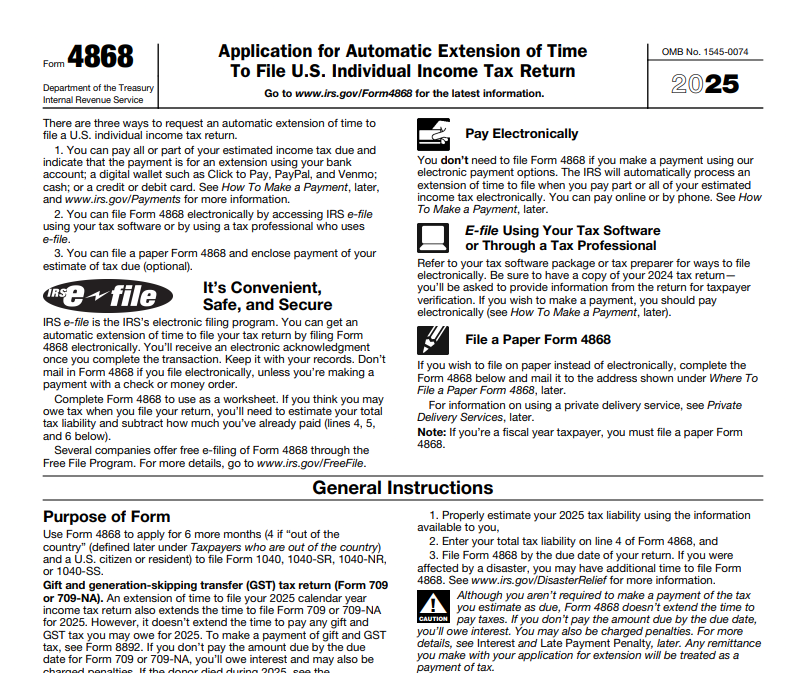
For a 2025 individual return, Form 4868 generally extends the filing deadline from April 15 to October 15, 2026. However, your tax balance is still generally due April 15. Missing that distinction can lead to a tax extension penalty and interest.
This guide explains how to file a tax extension, what it protects you from, and how to reduce avoidable penalties.
Key Takeaways
- Form 4868 generally extends a 2025 individual return from April 15 to October 15, 2026.
- Your extension gives you more time to file. Your tax balance generally remains due April 15.
- The federal failure-to-file penalty is generally 5% per month, while the failure-to-pay penalty generally starts at 0.5% per month.
- Estimated-tax safe harbors can help protect you from an underpayment penalty, but they do not automatically postpone the April 15 payment deadline for a balance shown on your return.
- Illinois automatically provides a six-month filing extension, but Illinois tax is still due April 15.
What a Tax Extension Really Does: Understanding the Tax Extension Penalty
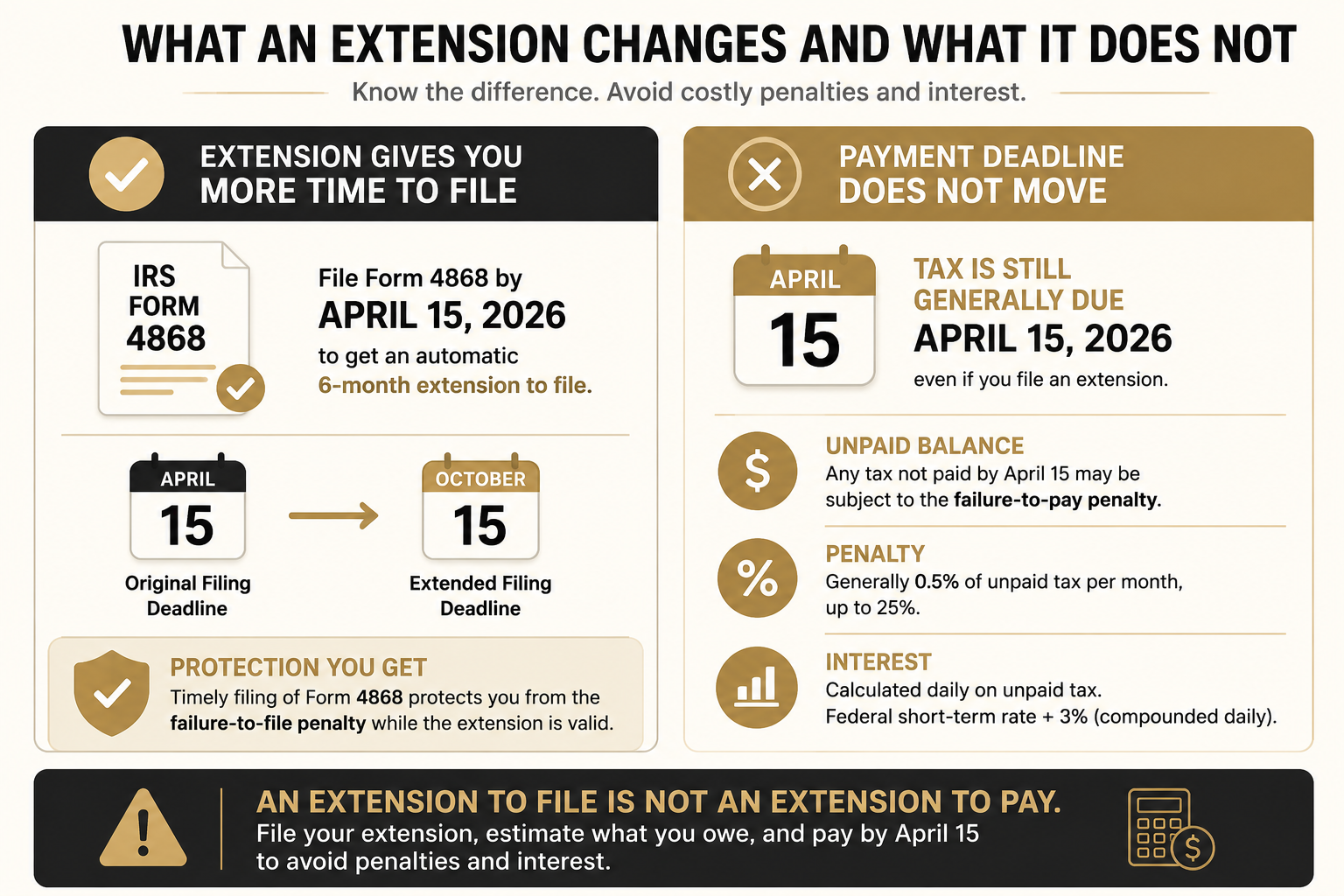
An extension gives you additional time to complete and file an accurate return. A valid Form 4868 extension can also protect you from the much larger failure-to-file penalty while the extension remains in effect.
This can be particularly helpful when your finances involve investment activity, K-1s, business interests, or other information that may take longer to finalize. A broader tax planning and advisory approach can help you separate the filing deadline from the payment decisions that still need attention.
Form 4868 Buys Six Months to File – Until October 15
For most calendar-year individual taxpayers, the federal return for 2025 was due April 15, 2026. Filing Form 4868 by that date generally moves the filing deadline to October 15, 2026.
The Form 4868 extension applies to filing the return. You can still file at any point before October 15 if your information becomes available earlier.
You can request the extension in several ways, including IRS electronic filing options or by filing Form 4868. If you are researching how to file a tax extension, the IRS also allows taxpayers to request an extension electronically through its Free File options.
The Extension Is Automatic, With No Explanation Required
Form 4868 makes the federal filing extension relatively simple:
- No explanation is generally required. You do not need to tell the IRS why you need more time.
- The extension protects your filing deadline. A timely extension can prevent the failure-to-file penalty during the valid extension period.
- Payment rules still apply. Tax that should have been paid by April 15 may still be subject to penalties and interest.
So, does a tax extension avoid penalties? It can prevent certain filing penalties, but it does not automatically protect you from charges related to late payment.
Read More: Q3 Estimated Taxes: What High Earners Pay (and the 110% Rule)
The Mistake That Costs High Earners Thousands
A large tax extension penalty problem often begins when someone assumes that October 15 becomes the new deadline for both filing and paying.
For taxpayers with a large balance, that misunderstanding can mean months of accumulating charges. This is especially relevant when income comes from several sources or a business creates a large pass-through tax liability. Coordinating the personal and entity sides through business tax planning can help identify the expected balance before April.
An Extension to File Is Not an Extension to Pay
The IRS states that an extension provides additional time to file, rather than additional time to pay. For a 2025 return, federal income tax generally remained due April 15, 2026.
Suppose you request an extension and eventually determine that you owe $40,000. If too little of that liability was paid by April 15, filing the return on October 15 does not make the April balance timely.
Why Your Balance Is Still Due on April 15
Federal income tax works largely as a pay-as-you-go system. Taxes are normally paid during the year through withholding and, when necessary, estimated tax payments.
By April 15, you may still be waiting for final tax documents or completing a complicated return. The IRS nevertheless expects you to make a reasonable estimate of the tax owed and pay the balance by the original due date.
The Two Penalties – and Why One Is Ten Times Worse
Understanding the failure-to-file vs. failure-to-pay penalty can make the value of an extension much clearer.
Both penalties can apply to unpaid federal tax, but they begin at very different monthly rates. Filing the extension can therefore prevent a much larger tax extension penalty from building while you finish the return.
| Penalty | General Federal Rate | Maximum | What Triggers It |
| Failure-to-file | 5% of unpaid tax per month or part of a month | 25% | Filing after the deadline without a valid extension |
| Failure-to-pay | 0.5% of unpaid tax per month or part of a month | 25% | Leaving tax unpaid after the payment deadline |
| Interest | Federal short-term rate + 3%, compounded daily | No fixed 25% cap | Unpaid federal tax |
The failure-to-file vs. failure-to-pay penalty comparison shows why filing an extension can matter so much. The starting monthly failure-to-file rate is ten times the standard failure-to-pay rate.
Failure-to-File: 5% of the Unpaid Tax per Month
The failure-to-file penalty is generally 5% of unpaid tax per month, up to 25%. If both filing and payment penalties apply in the same month, the combined amount is generally 5%.
For returns required to be filed in 2026 that are more than 60 days late, the minimum penalty is generally the lesser of $525 or 100% of the unpaid tax.
Failure-to-Pay: 0.5% per Month, Plus Daily Interest
The failure-to-pay penalty generally starts at 0.5% of unpaid tax per month, up to 25%. Interest also accrues daily. For the third quarter of 2026, the individual underpayment interest rate is 7%.
A valid extension can protect you from the larger filing penalty, while paying as much as possible reduces the balance subject to payment-related charges.
The Safe Harbors That Keep You Penalty-Free
Safe harbor rules are especially useful for high earners whose income changes significantly from one year to another. They deal with the separate underpayment-of-estimated-tax penalty.
This distinction matters. Meeting a safe harbor can protect you from an estimated-tax underpayment penalty. It does not automatically make an unpaid April 15 return balance timely for purposes of the failure-to-pay penalty.
Pay 90% of This Year – or 100% of Last Year (110% Over $150K AGI)
Generally, you can avoid the federal underpayment-of-estimated-tax penalty if you owe less than $1,000 after subtracting withholding and refundable credits.
Another general safe harbor is based on your required annual payment. This is usually the smaller of:
- 90% of the tax for the current year, or
- 100% of the tax shown on the prior-year return.
For higher-income taxpayers, the prior-year percentage generally increases from 100% to 110% if prior-year adjusted gross income exceeded $150,000, or $75,000 for married taxpayers filing separately. Special rules apply in some situations.
This is an area where individual tax planning can be valuable because the amount required depends on your actual income, withholding, estimated payments, and prior-year tax.
| Safe Harbor | General Requirement |
| Small balance test | You owe less than $1,000 after subtracting withholding and refundable credits |
| Current-year test | You paid at least 90% of the tax due for the current year |
| Prior-year test | You paid at least 100% of the tax shown on your prior-year return |
| Higher-income prior-year test | Generally 110% of prior-year tax if prior-year AGI exceeded $150,000, or $75,000 if married filing separately |
Special rules apply in some situations. This is an area where individual tax planning can be valuable because the amount required depends on your actual income, withholding, estimated payments, and prior-year tax.
How the Safe Harbor Protects You Even If You Owe Big in the Fall
If your income rises sharply from a business distribution, investment gain, bonus, or another event, you may still avoid the estimated-tax underpayment penalty if you satisfied an applicable safe harbor through timely withholding and estimated payments.
Timing still matters. A large payment made later may not correct an earlier quarterly underpayment because the IRS calculates the penalty by required installment.
This is why it depends on the type of charge involved. Filing penalties, payment penalties, estimated-tax penalties, and interest are separate issues.
| Quick Tip If you expect your income to change significantly during the year, review your estimated payments before tax season. Waiting until you request an extension may be too late to correct an earlier estimated-tax underpayment completely. |
How to Estimate and Pay When You’re Not Ready to File
You may know that you owe tax without having enough information to complete the entire return. In that situation, the goal is to prepare the best reasonable estimate you can before the deadline.
A Form 4868 extension asks for an estimate of your total tax liability, payments already made, balance due, and the amount you are paying.
Making a Good-Faith Payment With Your Extension
Start by gathering the tax information you already have. This may include:
- W-2 income and federal tax withholding
- Estimated tax payments already made
- Investment sales, dividends, and interest
- Business or self-employment income
- Available K-1 information
- Retirement account distributions
- Other known taxable income
Then estimate your total tax and subtract the payments already made. This gives you a reasonable starting point for deciding how much to pay with your extension.
If you cannot pay the entire expected balance, paying what you can by April 15 can still reduce the unpaid amount on which penalties and interest may be calculated.
| Important Note Tax rules can apply differently depending on your income, payment history, filing status, and other circumstances. Consider speaking with a qualified tax professional when estimating a large extension payment. |
Read More: How RSUs Are Taxed – and the Withholding Gap That Surprises High Earners
The Illinois Extension You Also Need to Handle
For taxpayers in Illinois, there is a second set of deadlines to consider. Premium Tax Planners is based in Northfield and serves clients throughout the Chicago area, Illinois, the North Shore, and nationwide, so federal and Illinois deadlines can both be part of the planning process.
Illinois Grants the Extension Automatically – but You Still Pay by April 15
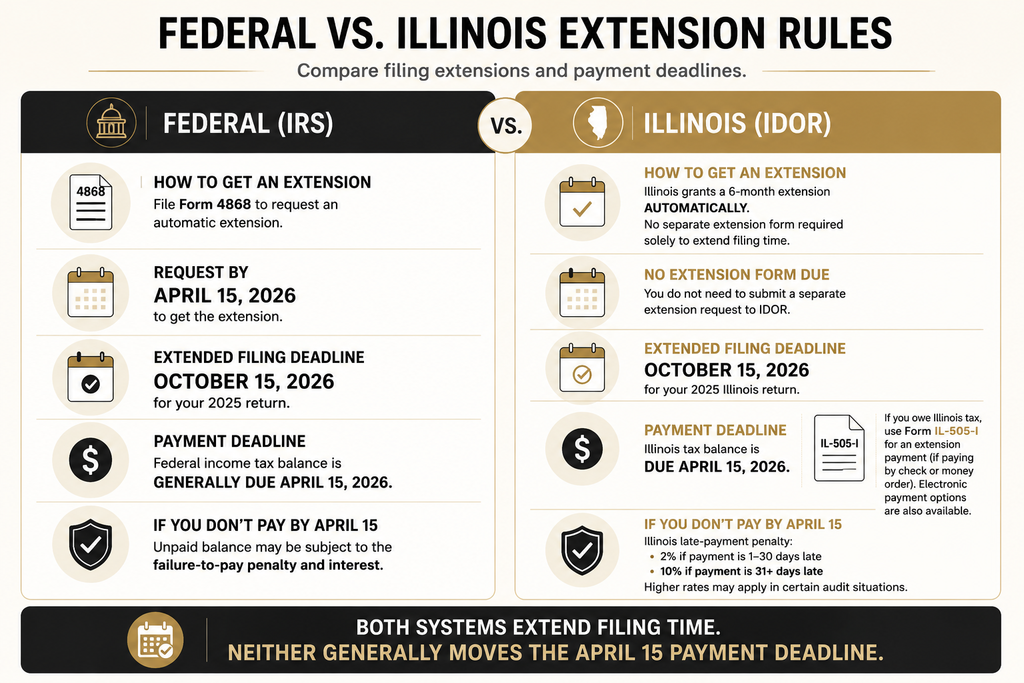
Illinois grants an automatic six-month extension to file an individual income tax return.
For a 2025 Illinois individual return:
- Regular filing deadline: April 15, 2026
- Extended filing deadline: October 15, 2026
- Separate extension request: Generally not required solely to receive the six-month filing extension
- Tax payment deadline: April 15, 2026
- Extension payment: Form IL-505-I may be used when paying by check or money order, while electronic payment options are also available
- Late-payment penalty: 2% when payment is 1 to 30 days late and 10% when it is 31 or more days late, with higher rates possible in certain audit situations
For local taxpayers, North Shore tax planning should therefore account for both the federal payment and the Illinois amount before April 15.
If You’ve Already Missed a Deadline
Missing April 15 does not mean you should wait until October to take action. Filing and paying as soon as possible can prevent additional monthly charges from continuing to build.
The tax extension penalty consequences depend on what was missed. Someone who timely requested an extension but did not pay enough has a different situation from someone who neither filed a return nor obtained a valid extension.
First-Time Penalty Abatement and How to Request It
In July 2026, the IRS began replacing First-Time Abate with the Automatic Exemption from Penalty (AEP) for eligible original returns beginning with tax year 2025 and certain 2026 quarterly returns.
Eligible taxpayers generally need a three-year history of timely filing and payment. When the requirements are met, relief from certain failure-to-file and failure-to-pay penalties is applied automatically.
Not every penalty qualifies, and reasonable-cause relief may still be available in some cases. This change is important when reviewing the failure-to-file vs. failure-to-pay penalty, since older guidance may still refer to requesting First Time Abate.
An Advisor’s Take: Using the Extra Six Months Well
A filing extension can be useful when it gives you enough time to complete a complicated return accurately. It should also create a clear plan for what happens between April and October.
For high-income taxpayers, tax planning and advisory during this period may include reviewing finalized K-1s, reconciling investment activity, confirming business income, checking prior payments, and preparing for the next estimated-tax deadline.
When an Extension Is a Planning Tool, Not a Last Resort
- Estimate your total tax liability: Using the information currently available.
- Make the appropriate payment by April 15: Instead of waiting until the return is completed.
- File the extension on time: so you have until October 15 to complete the individual return.
- Use the additional months carefully to collect missing documents, finalize calculations, and prepare an accurate return.
For business owners, the personal return may depend on information from partnerships or S-corporations. Calendar-year partnerships and S corporations generally use Form 7004 to request their own extensions, with extended returns generally due September 15. A calendar-year C corporation generally has an extended Form 1120 deadline of October 15.
Those business deadlines can affect when information becomes available for an owner’s individual return.
The tax extension penalty should therefore be considered before the extension is filed. Knowing what must be filed, what must be paid, and which safe harbor applies can prevent an extension from becoming an expensive six-month delay.
Conclusion
A timely Form 4868 extension gives you until October 15 to file, but your federal tax balance generally remains due April 15. Understanding this difference is key to avoiding an unnecessary tax extension penalty.
If you expect to owe a large amount, estimate your liability, review the applicable safe harbor, and make the appropriate payment before the deadline.
Premium Tax Planners helps high-income individuals and business owners plan for these obligations through tax planning. Schedule a consultation to review your extension payment, estimated-tax position, and filing strategy.
FAQs
Does Filing an Extension Stop Penalties?
A valid extension can protect you from the federal failure-to-file penalty through the extended deadline. However, it does not stop the failure-to-pay penalty or interest on unpaid tax. So, does a tax extension avoid penalties? It can prevent certain filing penalties, but payment-related charges may still apply.
How Much Do I Have to Pay by April 15?
Your federal tax balance is generally due by April 15, even with an extension. Estimated-tax safe harbors may protect you from an underpayment penalty if you meet the applicable 90%, 100%, or 110% payment requirements.
What’s the Penalty if I File Late and Owe?
The failure-to-file penalty is generally 5% of unpaid tax per month, up to 25%, while the failure-to-pay penalty generally starts at 0.5% per month. A return required in 2026 that is more than 60 days late may also face a minimum penalty of the lesser of $525 or 100% of the unpaid tax.
Do I Need a Separate Extension for Illinois?
Generally, no. Illinois automatically provides a six-month filing extension. However, Illinois tax is still due by April 15. If you owe tax, you may need to make an extension payment using Form IL-505-I or an approved electronic payment method.
Can I Get Penalties Removed if I Have a Clean Record?
Possibly. The IRS began replacing First Time Abate with the Automatic Exemption from Penalty in 2026. Eligible taxpayers with a qualifying three-year history of timely filing and payment may receive automatic relief from certain penalties.