
Many high-income W-2 employees believe meaningful tax planning is only for business owners, but that’s not the case. Effective planning extends well beyond standard paycheck withholding. High-income tax planning can help identify strategies like retirement accounts, investments, charitable giving, equity, and real estate to actively influence your tax liability. With key 2026 updates, including new retirement limits, Roth catch-up requirements, and changes to charitable and depreciation rules, proactive, year-round coordination is essential to identify the right opportunities before deadlines pass.
Key Takeaways
- High earners still have several ways to reduce W2 taxable income, even when most compensation comes through payroll.
- The 2026 employee 401(k) deferral limit is $24,500, with higher limits for eligible catch-up contributions.
- Roth income limits do not prevent strategies such as a backdoor Roth or, when the employer plan allows it, a mega-backdoor Roth.
- Charitable giving, equity compensation, and short-term rentals can create additional planning opportunities when their rules are followed carefully.
- The value of high-income W-2 tax strategies often depends on timing and sequencing decisions during the year.
Why High Earners Feel Stuck With W2 Tax Planning
W2 tax planning can feel restrictive because your employer controls payroll and reports your wages directly to the IRS. Yet individual tax planning can still address decisions surrounding retirement contributions, investments, compensation, charitable gifts, and other parts of your financial life. The key is knowing which decisions remain within your control.
Withholding Is Automatic, but That Isn’t the Same as Planning
Federal income tax withholding is simply a way of prepaying tax during the year. It does not determine your final tax liability.
Your actual bill depends on your total income, deductions, credits, investments, filing status, and other tax items. A large bonus, stock vest, investment gain, or second source of household income can create a gap between withholding and the final amount owed.
For this reason, tax planning for W2 employees should include periodic withholding reviews, especially after major compensation or investment events.
Why W-2 Income Carries Some of the Highest Effective Tax Rates
Wages are generally taxed as ordinary income. High earners may also face the 0.9% Additional Medicare Tax once applicable wages and compensation exceed $200,000 for single filers or $250,000 for married couples filing jointly.
Investment income creates another layer. The 3.8% Net Investment Income Tax can apply when modified adjusted gross income exceeds $200,000 for single or head-of-household filers or $250,000 for married couples filing jointly.
Start With the Retirement Accounts You Already Have
Workplace benefits are often the simplest starting point for W2 tax reduction strategies because they are already available through your employer.
Maxing the 2026 401(k): $24,500, Plus Catch-Up Contributions
For 2026, employees can defer up to $24,500 into a 401(k), 403(b), or governmental 457 plan.
Traditional pre-tax contributions can reduce W2 taxable income for federal income tax purposes in the contribution year. Roth contributions do not provide that current income tax reduction.
| 2026 Contribution | Limit |
| 401(k), 403(b), or governmental 457 employee deferral | $24,500 |
| Catch-up contribution, ages 50–59 | $8,000 |
| Maximum with catch-up, ages 50–59 | $32,500 |
| Catch-up contribution, ages 60–63 | $11,250 |
| Maximum with catch-up, ages 60–63 | $35,750 |
| Overall defined-contribution plan limit | $72,000, plus eligible catch-up contributions |
Read More: Annual Gifting in 2026 ($19,000): A Simple Way to Shrink Your Taxable Estate
The New 2026 Rule: High Earners Must Make Catch-Up Contributions as Roth
A major SECURE 2.0 change takes effect in 2026. If your prior-year wages from the employer sponsoring your plan exceeded $150,000, your catch-up contributions generally must be made as Roth contributions when the plan offers catch-ups and has a Roth feature.
That means the catch-up dollars are contributed after tax and do not lower your current taxable income. The rule makes early W2 tax planning more valuable. Someone who previously counted on a pre-tax catch-up contribution may need to adjust other parts of the plan once those catch-up dollars must go to Roth.
The HSA as a Stealth Retirement Account
If you are eligible for a health savings account, an HSA can combine current tax benefits with long-term investing.
For 2026, the HSA contribution limit is $4,400 for self-only coverage and $8,750 for family coverage. Eligible people age 55 or older can contribute an additional $1,000.
An HSA offers three federal tax advantages when the rules are met:
- Contributions: Eligible contributions may be tax-deductible or made pre-tax through payroll.
- Investment growth: Money invested inside the HSA can grow tax-deferred.
- Qualified withdrawals: Withdrawals used for qualified medical expenses can be tax-free.
You do not have to spend the account each year. Some high earners pay current medical costs separately, keep the receipts, and allow HSA investments to grow for future qualified medical expenses. This can make the HSA part of a broader retirement tax planning strategy.

The Roth Strategies Income Limits Can’t Block
High income can prevent you from contributing directly to a Roth IRA. It does not automatically prevent money from reaching a Roth account through other permitted methods.
The Backdoor Roth When You Earn Too Much to Contribute Directly
For 2026, the IRA contribution limit is $7,500, plus a $1,100 catch-up contribution for people age 50 or older.
- Direct Roth contributions are income-restricted (phase-out starts at $153,000 for singles, $242,000 for married couples filing jointly).
- Roth conversions have no income limits.
- The ‘Backdoor Roth’ strategy: Make a non-deductible traditional IRA contribution, then convert that amount to a Roth.
Important Note: If you hold existing pre-tax IRA balances (Traditional, SEP, or SIMPLE), pro-rata rules may make a conversion partially taxable; review all your IRA balances before taking action.
The Mega-Backdoor Roth: After-Tax 401(k) Contributions Up to $72,000
The mega-backdoor Roth can allow some employees to move considerably more money into Roth accounts.
For 2026, the overall defined-contribution plan limit is $72,000, excluding eligible catch-up contributions. This total includes regular employee deferrals, employer contributions, and qualifying after-tax contributions.
After regular employee deferrals and employer contributions, remaining room under the $72,000 limit may be available for after-tax contributions that are then converted to Roth.
This strategy depends completely on the employer plan. The plan must allow the necessary after-tax contributions and Roth conversion mechanism. Review the plan documents before assuming this W-2 tax-planning strategy is available.
Deferring Income You Don’t Need Yet
Some highly compensated employees have another option through their employer: nonqualified deferred compensation.
Nonqualified Deferred Compensation (NQDC) and the Timing Decision
A nonqualified deferred compensation plan can allow an employee to defer salary or a bonus into a future year under Section 409A rules. This may help if you expect your taxable income to fall later, such as after retirement.
The election generally must be made in advance and is irrevocable, so NQDC works best as part of advanced tax planning rather than as a year-end reaction to a tax bill.
The Trade-Off: Tax Deferral Against Your Employer’s Credit Risk
Deferred NQDC generally remains an unsecured obligation of your employer. If the company experiences serious financial trouble, the money may be exposed to its creditors.
The decision should therefore consider the potential tax deferral alongside your employer’s financial health, future income, retirement timing, and cash-flow needs.
Turning Charitable Giving Into a Tax Strategy
For people who already give to charity, the timing and type of contribution can affect the tax result.
The 2026 Rules That Change the Math: The 0.5% Floor and the 35% Cap
Beginning in 2026, an itemizer can generally deduct charitable contributions only to the extent they exceed 0.5% of adjusted gross income.
Consider someone with $500,000 of AGI who gives $15,000. The first $2,500 falls under the 0.5% floor, leaving $12,500 before considering other applicable charitable deduction rules.
OBBBA also limits the tax benefit of itemized deductions for taxpayers in the 37% bracket. In practical terms, deductions affected by the rule can produce a maximum 35-cent federal income tax benefit per deductible dollar rather than 37 cents.
The 60%-of-AGI limit for certain cash gifts to public charities was also made permanent.
These changes make charitable giving an important part of high-income W-2 tax strategies, particularly when you make substantial gifts.
Bunching Several Years of Gifts Through a Donor-Advised Fund
The 0.5% floor makes contribution timing more important. Instead of giving the same amount each year, you may bunch several years of planned gifts into one year, often through a donor-advised fund.
You receive the applicable deduction when contributing to the fund and can recommend grants over time. Bunching may help you clear the 0.5% floor once on a larger gift instead of applying it to smaller annual gifts.
Donating Appreciated Stock Instead of Cash
If you have appreciated publicly traded stock held for more than one year, donating shares directly may allow you to deduct fair market value while avoiding the capital gain from selling first, when applicable requirements are met. Contributions of appreciated property to public charities are generally subject to a 30%-of-AGI limit.
For high earners with concentrated investments, charitable planning and portfolio planning can therefore work together.
Equity Compensation: Where W-2 Earners Leave the Most on the Table
Stock compensation can create some of the most important W2 tax reduction strategies because tax consequences can occur at vesting, exercise, and sale.
RSUs, and the Withholding Gap That Creates a Surprise Bill
Restricted stock units, or RSUs, are generally treated as ordinary wage income when they vest and the shares are delivered.
The problem is withholding.
Employers can generally use a 22% federal supplemental wage withholding rate on supplemental wages up to the applicable threshold. A high earner may face a 35% or 37% marginal federal income tax rate.
Good W2 tax planning includes estimating this gap before a large vest and considering whether additional withholding or estimated tax payments are needed.
ISOs, NSOs, and the Timing Decisions That Control the Tax
Incentive stock options, or ISOs, can create alternative minimum tax exposure when exercised and held. The spread between the exercise price and fair market value may create an AMT adjustment.
Nonqualified stock options, or NSOs, generally create ordinary compensation income when exercised based on the spread between the exercise price and the stock’s fair market value.
Exercise timing, sale timing, existing capital gains and losses, and AMT exposure can all affect the outcome.
For someone receiving a large portion of compensation in company stock, high income tax planning should ideally happen before an exercise or sale rather than after the transaction has already fixed the tax result.
Read More: How RSUs Are Taxed – and the Withholding Gap That Surprises High Earners
The Real Estate Move That Offsets W-2 Income
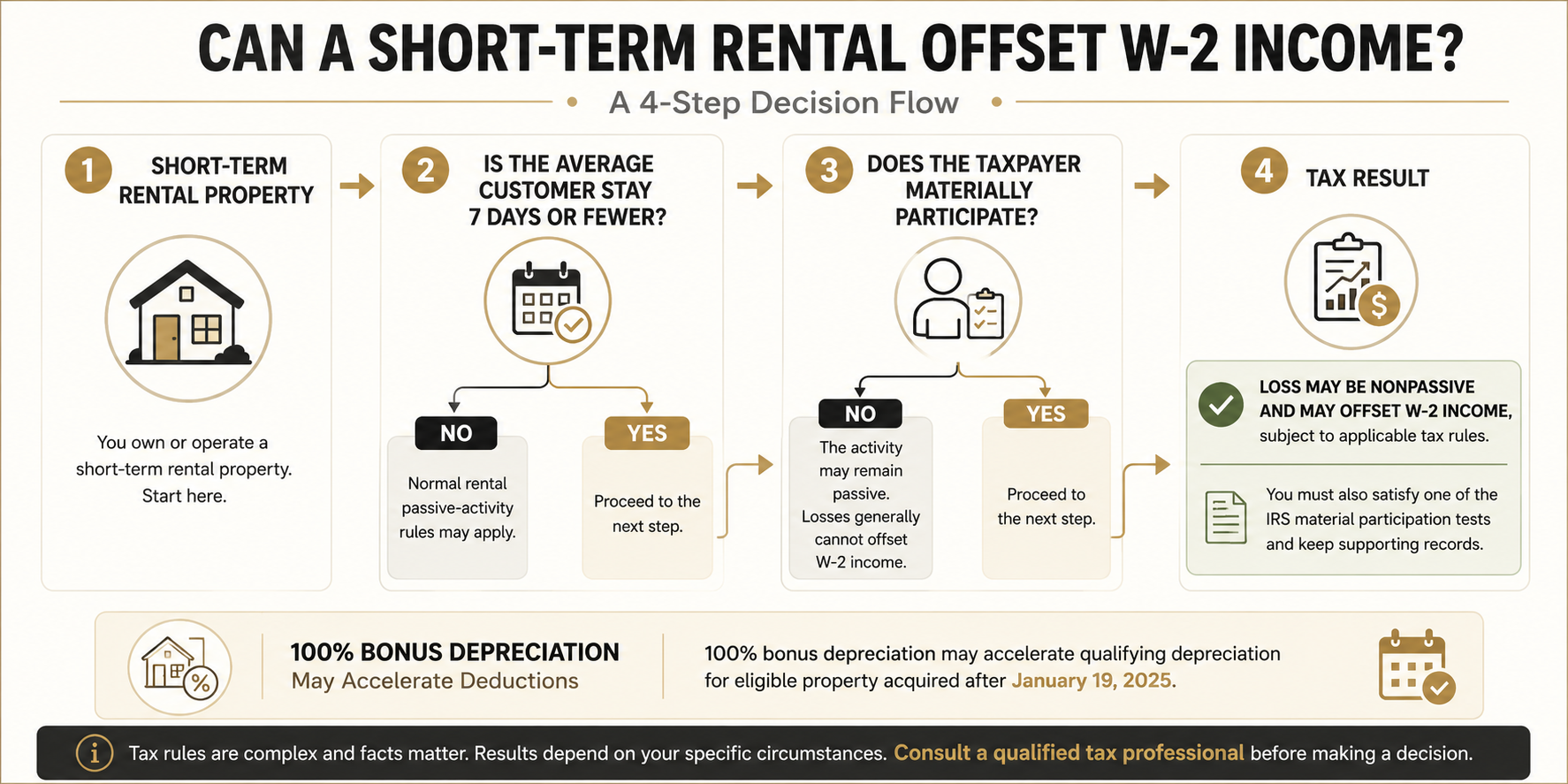
Real estate losses are commonly passive, which means they generally cannot offset salary. A properly structured short-term rental can be treated differently.
The Short-Term Rental Loophole and the 7-Day Rule
Under Section 469 rules, an activity involving property is generally not treated as a rental activity when the average customer stay is seven days or fewer. If you also materially participate, qualifying losses may be nonpassive and offset W-2 wages.
You do not need to meet the separate 750-hour real estate professional test, but you must satisfy an applicable material participation test and maintain supporting records.
For the right taxpayer, this can be one of the more advanced high-income W-2 tax strategies. Buying a short-term rental solely for a deduction, however, can create financial and tax risks that should be evaluated before the property is purchased.
How 100% Bonus Depreciation Creates a First-Year Paper Loss
OBBBA permanently restored 100% bonus depreciation for certain qualifying property acquired after January 19, 2025.
A cost segregation study may identify portions of a rental property that qualify for shorter depreciation periods and potentially bonus depreciation. Depending on the property, this can accelerate a substantial amount of depreciation into the first year.
If the short-term rental qualifies as a nonpassive activity and the owner materially participates, those deductions may help reduce W2 taxable income.
The deduction depends on the property, cost segregation results, placed-in-service date, and your circumstances, so it should be modeled before purchase.
| Important Note Tax rules can apply differently based on your income, investments, employer plans, property, and other circumstances. Consider speaking with a qualified tax professional before making a tax decision. |
The Investment-Side Levers
Your salary may be fixed, but the way you manage taxable investments can still influence your total tax bill.
Tax-Loss Harvesting, Asset Location, and the 3.8% Investment Tax
Tax-loss harvesting uses investment losses to offset realized capital gains. If losses exceed gains, up to $3,000 of net capital loss can generally offset ordinary income each year, with remaining losses carried forward. Wash-sale rules must be considered when replacing an investment.
Asset location considers which investments are held in taxable versus tax-advantaged accounts based partly on how their income is taxed.
This becomes especially relevant because the 3.8% Net Investment Income Tax can apply once modified adjusted gross income exceeds $200,000 for single filers or $250,000 for married couples filing jointly.
Investment planning may not change the salary shown on your W-2, but it can improve the broader result of tax planning for W2 employees.
| Strategy | Main Tax Planning Goal | Key Limitation |
| Traditional 401(k) | Reduce current taxable income | Annual contribution limits apply |
| HSA | Current tax benefit plus tax-advantaged growth | Requires HSA eligibility |
| Backdoor Roth | Move retirement savings into Roth | Pro-rata rules can create taxable income |
| Mega-backdoor Roth | Increase potential Roth savings | Employer plan must allow the strategy |
| NQDC | Defer compensation to a future year | Money is exposed to employer credit risk |
| Charitable bunching | Concentrate deductions into selected years | Deduction rules and AGI limits apply |
| Short-term rental | Potentially offset W-2 income with qualifying nonpassive losses | Material participation and other rules must be met |
| Tax-loss harvesting | Offset realized capital gains | Wash-sale rules must be considered |
An Advisor’s Take: Sequencing Beats Any Single Move
A list of strategies is useful. The larger planning opportunity often comes from deciding which moves to use, how much to allocate to each one, and when to complete them.
Why the Order and Timing of These Strategies Is Where the Savings Are
Consider how quickly these decisions begin to overlap. For example, your planning decisions can interact in several ways:
- 401(k) contributions can lower current taxable income, while Roth catch-up rules can change the calculation.
- NQDC can shift compensation into a future year.
- Charitable giving may work differently when several years of gifts are bunched.
- ISO exercises can increase AMT exposure.
- Real estate and investment losses can affect the tax impact of other income.
A year-round W2 tax planning process considers these decisions together, using your expected salary, bonuses, equity, investments, retirement contributions, charitable plans, and major purchases.
This is also where advanced tax planning differs from tax preparation. Preparation records transactions that already occurred. Planning gives you time to evaluate transactions before deadlines or taxable events arrive.
For high earners asking how to lower taxes on W2 income, the answer is rarely one deduction. It is usually a coordinated sequence of available choices.
Conclusion
Receiving most of your income through a W-2 does not remove tax planning from the table. The strongest W2 tax planning approach considers every decision together because your income, investments, retirement goals, charitable giving, and real estate plans can affect one another.
Premium Tax Planners works with high-income individuals who want to move beyond filing a return and build a year-round strategy.
Schedule a consultation with Premium Tax Planners to build a tax strategy around your income, investments, compensation, and long-term financial goals.
FAQs
Can a W-2 employee really lower their tax bill?
Yes. Tax planning for W2 employees can include pre-tax retirement contributions, HSAs, charitable giving, investment planning, deferred compensation, equity strategies, and qualifying real estate activities. The right options depend on your income, employer benefits, investments, and circumstances.
What’s the fastest way to reduce my taxable income this year?
For many employees, increasing eligible pre-tax retirement contributions is one of the most direct W-2 tax-reduction strategies. An eligible HSA contribution may also provide a current tax benefit. Your available options depend on contribution limits, eligibility, and how much time remains in the year.
How do high earners contribute to a Roth if they’re over the income limit?
A backdoor Roth allows eligible high earners to make a nondeductible traditional IRA contribution and convert it to Roth. Existing pre-tax IRA balances can affect the tax result. Some employer plans also allow a mega-backdoor Roth through after-tax contributions and Roth conversions.
Can I use real estate to offset my W-2 salary?
Potentially. If a short-term rental meets the applicable rules and you materially participate, qualifying losses may be nonpassive and offset W-2 income. Bonus depreciation can also accelerate certain deductions. The participation and depreciation rules should be reviewed carefully.
When should I bring in a tax advisor instead of doing it myself?
Consider professional guidance when several strategies interact, especially with bonuses, equity compensation, investment income, NQDC, charitable giving, or real estate. Year-round high-income tax planning can help coordinate these decisions before important transactions and deadlines.