
Capital losses offset capital gains dollar for dollar, with no annual cap. Only the net loss left after your gains are used up is limited to 3,000 a year against ordinary income (1,500 if married filing separately). For a high earner with a large gain, that difference is why year-end tax loss harvesting deserves attention before December 31.
A business sale, vested RSU shares, or a concentrated stock exit can push one year’s gain into the top federal brackets and trigger the 3.8% net investment income tax. Selling losing investments before year-end shrinks that gain, making year-end tax-loss harvesting a planning task for any large 2026 gain.
This post is the 2026 year-end companion to our guide on tax-loss harvesting rules. It covers timing, wash sales, staying invested, and loss ordering.
Key Takeaways
- Capital losses offset capital gains dollar for dollar, with no annual cap.
- Only the net loss beyond your gains is limited to $3,000 a year against ordinary income, and the rest carries forward.
- A sale generally must settle by December 31, 2026, to count, so place trades by December 30.
- The wash sale rule applies to all your accounts, including your spouse’s accounts and IRAs.
- Harvested losses also reduce income subject to the 3.8% net investment income tax.
When a Big Gain Makes Year-End Tax Loss Harvesting Worth It
Year-end tax loss harvesting is worth the effort when your realized gain is large because losses reduce that gain before any tax rate applies. Good capital gains tax planning for 2026 starts with a clear total of what you have already realized.
Once you have that number, tax loss harvesting for big gains comes down to sizing: how much loss do you need to sell before December 31 to bring the gain to a level you can accept?
Business sales, RSU vesting, and concentrated-position exits
Three events commonly produce a large realized gain in a single year:
- A business sale. The gain on a sold ownership interest is often taxed as a capital gain.
- RSU vesting. Vesting itself creates wages, and capital losses reduce wages only up to the $3,000 limit. The capital gain appears when you sell vested shares for more than their value at vest.
- A concentrated-position exit. Selling a large holding that has appreciated for years can produce a gain with a low cost basis behind it.
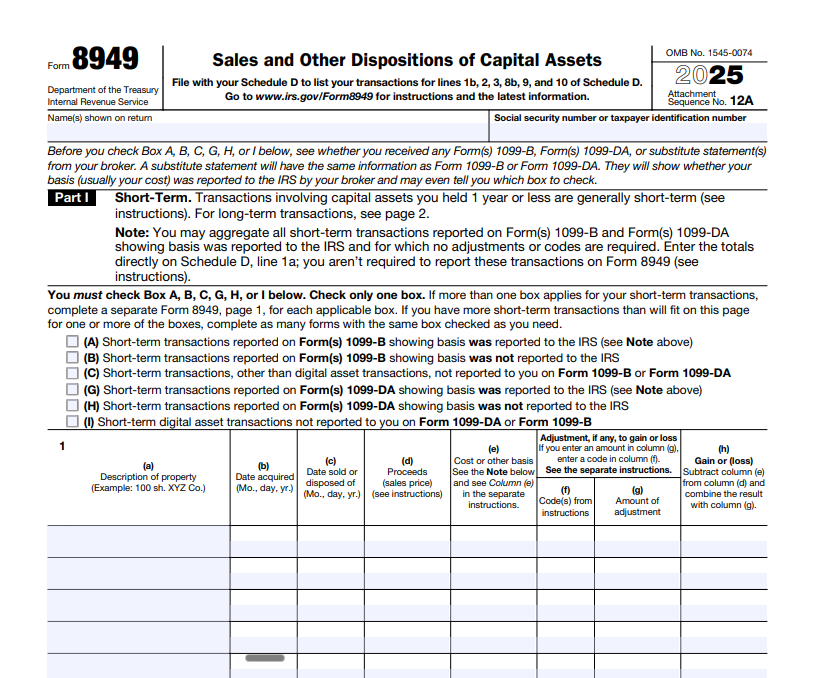
Each sale is reported on Form 8949 and Schedule D, which is where your losses and gains meet.
Offsetting gains dollar-for-dollar vs. the $3,000 ordinary limit
You can offset capital gains with losses without a cap. Only the net loss beyond your gains is subject to the $3,000 limit on ordinary income ($1,500 if married filing separately), and the excess carries forward with no expiration.
The table below shows where each dollar goes when you harvest more loss than you have gains.
| Simple Example: $100,000 of harvested losses in a year with $60,000 of gains | |
| Where the loss goes | Amount |
| Offsets your gains in full | $60,000 |
| Deducted against ordinary income | $3,000 |
| Carried forward to future years | $37,000 |
Read More: How RSUs Are Taxed, and the Withholding Gap That Surprises High Earners
The Year-End Timing Playbook
Timing decides whether a harvested loss lands in 2026 or slips into 2027, and the window for a large gain is shorter than most people expect. This section covers the settlement deadline for 2026 trades and how harvesting fits with the 3.8% net investment income tax, so you can sequence your sales before the year closes.
Why the work happens before December 31, not after
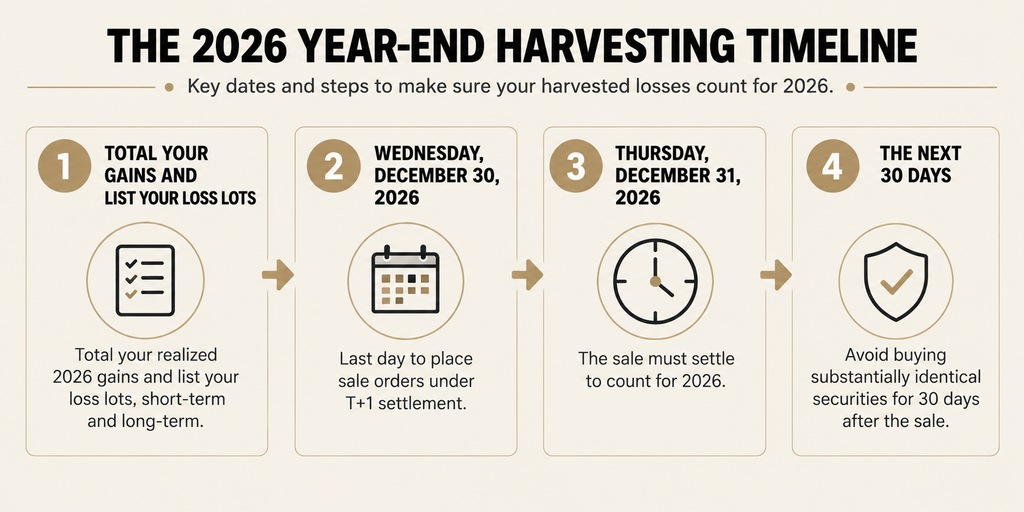
A loss counts for 2026 only if the sale closes in 2026, and a sale generally must settle by December 31, 2026, to qualify. The SEC moved most securities to next-business-day (T+1) settlement in 2024, so an order placed on Wednesday, December 30 settles on Thursday, December 31.
Waiting for January closes the door on a 2026 loss. Starting in the fall gives year-end tax loss harvesting room for advanced tax planning steps such as choosing which lots to sell, comparing short-term and long-term losses, and lining up replacement holdings. Tax loss harvesting big gains also takes lot-level data, so pull your cost basis and holding periods early.
| Quick TipA trade placed on Thursday, December 31 settles the next business day, which falls in 2027. Check your custodian’s year-end cutoff and aim to place 2026 sale orders by December 30. |
Coordinating with the 3.8% net investment income tax
The net investment income tax adds 3.8% on the lesser of your net investment income or the amount your modified adjusted gross income (MAGI) exceeds a threshold. Net gains from selling stocks, bonds, and mutual funds count as net investment income.
The threshold depends on your filing status:
| Filing status | MAGI threshold |
| Single or head of household | $200,000 |
| Married filing jointly or qualifying surviving spouse | $250,000 |
| Married filing separately | $125,000 |
Net investment income tax harvesting works because a harvested loss lowers your net gain, which lowers both parts of that formula. Long-term gains face a top combined federal rate of 23.8%, so each dollar of long-term gain you erase can save up to that amount.
| Simple ExampleYou sell a concentrated position for a $400,000 long-term gain and harvest $150,000 in losses, reducing your gain to $250,000. If the 20% rate and the 3.8% tax both apply, the harvest saves about $35,700 ($150,000 x 23.8%). |
Staying in the Market While You Harvest
Selling a losing position does not mean sitting in cash for a month. The right replacement lets you lock in the loss and keep your market exposure, as long as you avoid the wash sale trap.
The wash sale rule and the 30-day window on both sides of the trade
The wash sale rule disallows a loss when you buy the same or a substantially identical security within 30 days before or after the sale, a 61-day window that includes the sale date. The disallowed loss is added to the cost basis of the replacement shares, so you recover it only when you sell them.
- The window runs both ways, so shares you bought three weeks before the sale count, just like shares you buy after it.
- The rule applies across all of your accounts, as the Advisor’s Take below explains.
- It applies only to losses. Selling at a gain and repurchasing right away raises no wash sale issue.
Our guide to tax-loss harvesting rules covers the mechanics in full.
| Quick TipThe IRS treats cryptocurrency as property for tax purposes, so wash sales don’t currently apply. Congress could change that, so confirm the current rule before you sell. |
Substitute funds and direct indexing
To stay invested through the 61 days, you have two main options:
- Substitute fund: Sell the losing fund and buy a similar fund that is not substantially identical, such as a different S&P 500 fund. The IRS weighs all the facts and circumstances, so confirm the pair with your advisor first.
- Direct indexing: Own the individual stocks that make up an index in your own account, sell the ones at a loss, and let the rest keep tracking the index. Each sold stock is replaced with a different company, which keeps the swap outside the wash sale rule.
| Important NoteTax rules can change and may apply differently based on your circumstances. Consider speaking with a qualified tax professional before making a tax decision. |
Short-Term vs. Long-Term: Getting the Ordering Right
Two losses of the same size can save different amounts of tax, depending on which gain they offset. Short-term and long-term gains face different rates, so the order of netting matters as much as the total you harvest.
How losses net against each gain type
When you offset capital gains with losses, netting follows this order:
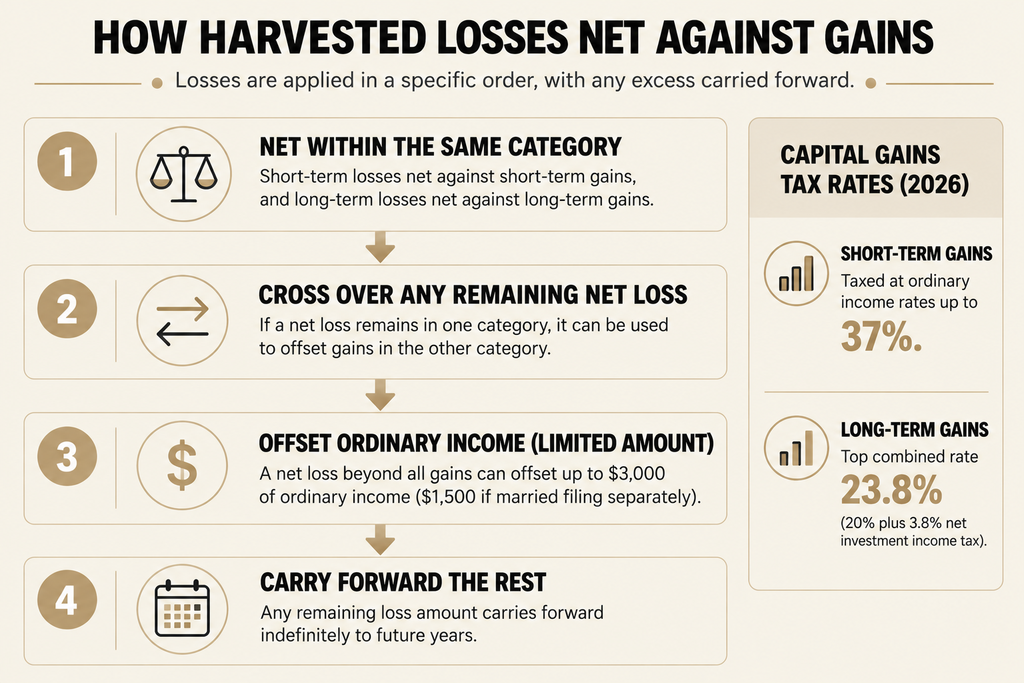
- Short-term losses offset short-term gains, and long-term losses offset long-term gains.
- A net loss in one category then offsets the net gain in the other.
The category matters because the rates differ:
- Short-term gains: ordinary rates, up to 37%.
- Long-term gains: up to 23.8% combined with the net investment income tax.
A short-term loss against a short-term gain saves more than a long-term loss against a long-term gain, so harvesting short-term losses first is often the better move. Net investment income tax harvesting follows the same logic, and tax-loss harvesting for big gains works best when you know which category your gain falls into.
Carrying unused losses into future years
A net loss beyond your gains and the $3,000 deduction carries forward indefinitely:
- It offsets future capital gains plus up to $3,000 of ordinary income each year until the balance is used up.
- It keeps its short-term or long-term character.
- The Capital Loss Carryover Worksheet in IRS Publication 550 figures the amount.
Tracking that balance is part of individual tax planning, since a large carryover can absorb a future gain.
How Harvesting Fits a Liquidity-Event Year
A liquidity event puts income, tax, and investment decisions into one year. Year-end tax loss harvesting lets you offset capital gains with losses before the year closes, and your 2026 estimated payments should reflect the lower gain, since a taxable capital gain can require them. Capital gains tax planning keeps the sale, the harvest, and the payments on one schedule.
Read More: Q3 Estimated Taxes: What High Earners Pay (and the 110% Rule)
Pairing with charitable gifts of appreciated stock
Gifts of appreciated stock can work alongside harvesting. IRS Topic No. 506 says you generally can deduct the fair market value of donated property if you itemize on Schedule A, and IRS Publication 526 lists the limits.
Donated shares are not sold, so they add nothing to your realized gain. Gifting your highest-gain shares while harvesting losses on the rest attacks the same gain from two sides, making tax-loss harvesting against big gains one piece of the plan.
An Advisor’s Take: The Traps at Year-End
A harvested loss can disappear when a trade in another account lands inside the 61-day window, and year-end tax loss harvesting plans tend to miss those accounts.
Harvesting across a spouse’s or IRA accounts and disqualifying the loss
The wash sale rule follows your spouse as well as you. If your spouse buys the same fund in a separate account during the window, your loss can be disallowed.
IRAs carry a heavier penalty. Under Revenue Ruling 2008-5, buying the same security in your IRA or Roth IRA disallows the loss and gives you no basis increase, so the loss is gone permanently.
Before December 31, check:
- Your spouse’s brokerage and IRA accounts
- Your own IRA, Roth IRA, and accounts at other firms
- Automatic purchases and dividend reinvestment in the sold security
A plan built around advanced tax planning lists all household accounts before the first sale is placed.
The Bottom Line
A large 2026 gain leaves a short window for tax loss harvesting big gains. You can offset capital gains with losses dollar for dollar if the sale settles by December 31, and year-end tax loss harvesting works best when you size the loss to the gain, pick replacements that avoid a wash sale, and count net investment income tax harvesting in the result.
Premium Tax Planners works with high earners on liquidity-event years. List your realized gains and loss lots, then review them with our advisor before the December 30 trade date.
Schedule a consultation with Premium Tax Planners and build your 2026 trade list before the December 31 settlement deadline.
FAQs
Harvested losses offset capital gains dollar for dollar with no annual limit, so you can offset capital gains with losses until your net gain reaches zero. Only the net loss beyond your gains is capped at $3,000 against ordinary income ($1,500 if married filing separately), and the rest carries forward.
To count for 2026, a sale generally must settle by December 31, 2026. Under T+1 settlement, that means placing the trade by Wednesday, December 30. Year end tax loss harvesting that waits for the last day risks settling in 2027, so confirm your custodian’s cutoff early.
Yes. The rule covers all of your accounts, including a spouse’s accounts and IRAs. A purchase of the same or a substantially identical security within 30 days before or after the sale can disallow the loss, and an IRA purchase can disallow it permanently.
Yes. Capital gains count as net investment income, so harvested losses lower the income the tax applies to and also lower your MAGI. Net investment income tax harvesting matters once MAGI exceeds the threshold, which is $200,000 for single filers and $250,000 for married filing jointly, per IRS Topic No. 559.
Buy a similar fund that is not substantially identical, such as a different S&P 500 fund, or use direct indexing, where you hold individual stocks in place of one fund. Avoid the original security for 30 days before and after the sale across all accounts you and your spouse control.