
A W-2 employee who works from a home office, buys software out of pocket, and pays a preparer can deduct none of those costs on a 2026 federal return. Tax reform suspended those write-offs in 2018, and the One Big Beautiful Bill Act (OBBBA) made the suspension permanent in 2025.
Payroll contributions to a 401(k) or HSA lower your taxable wages, several above-the-line deductions still apply, and four new deductions for tips, overtime, car loan interest, and seniors run from 2025 through 2028. Planning beyond those basics is covered in our guide to tax strategies for high-income W-2 earners.
This guide starts with one question: what can W-2 employees deduct in 2026? It covers what no longer exists and which loopholes work.
Key Takeaways
- Home office, mileage, unreimbursed job expenses, union dues, and tax prep fees are no longer deductible for W-2 employees on the federal return, and the 2025 law made that permanent.
- The standard deduction ($16,100 single, $32,200 joint, $24,150 head of household in 2026) is the starting point for most employees.
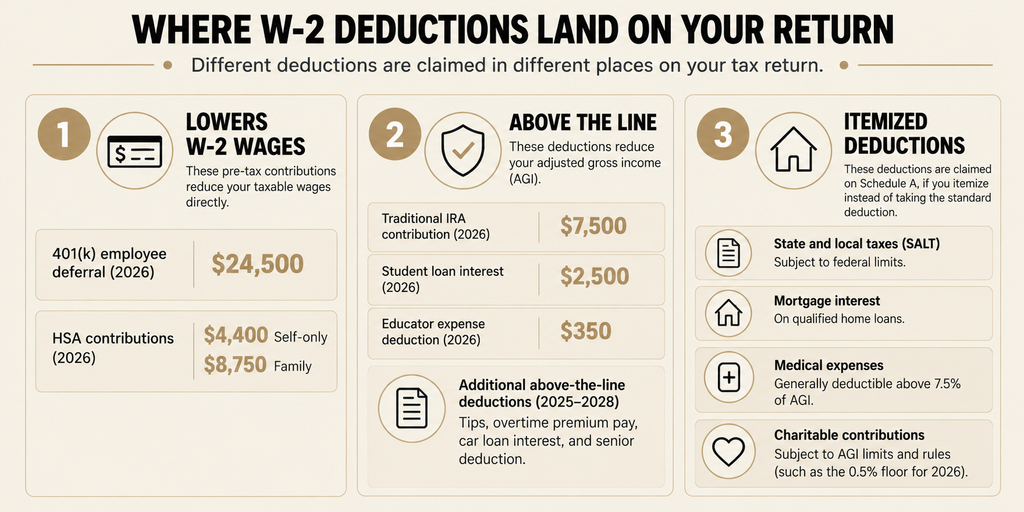
- Pre-tax 401(k) contributions (up to 24,500) and HSA contributions (4,400 self-only, $8,750 family) reduce your taxable W-2 wages directly.
- Four deductions for tips, overtime premium pay, car loan interest, and seniors apply for 2025 through 2028 on top of the standard deduction. The overtime deduction covers only the premium portion of pay.
- The loopholes that work (mega-backdoor Roth, short-term rentals, charitable
Why W-2 Employees Have Fewer Deductions Than They Think
The list of tax deductions for W-2 employees is shorter. Employees report wages on Form W-2, so the business-expense deductions that self-employed taxpayers use mostly do not apply.
The write-offs that disappeared permanently after tax reform
Before 2018, employees could deduct unreimbursed job expenses, union dues, tax preparation fees, and investment advisory fees as miscellaneous itemized deductions, but only the portion above 2% of adjusted gross income. The 2017 tax reform suspended those deductions through 2025. Section 70110 of the OBBBA removed the end date, so the suspension of deductions subject to the 2% floor now has no sunset.
Federal rules apply to the federal return only. Some states set their own rules, so check your state tax agency before assuming the federal answer carries over.
Why the standard deduction is usually your starting point
The standard deduction lowers taxable income by a flat amount and needs no receipts. The table lists the 2026 amounts from IRS Revenue Procedure 2025-32.
| Filing status | 2026 standard deduction |
|---|---|
| Single or married filing separately | $16,100 |
| Married filing jointly | $32,200 |
| Head of household | $24,150 |
Itemizing helps only when your deductible expenses add up to more than your amount. Most employees therefore start with the standard deduction and look for additional tax deductions for W-2 employees in the categories below. Tax write-offs for W-2 employees that rely on receipts, such as job supplies, no longer count toward that total.
The Deductions That Lower Your Taxable Wages
Pre-tax payroll contributions are the closest thing to a built-in write-off, because they reduce taxable wages before you file. Among the tax deductions for W-2 employees, these run through your employer’s payroll system, so you set them up once, and they repeat each paycheck. Employees comparing W-2 tax deductions will find this group the easiest to use.
401(k) and HSA contributions come straight off your W-2 wages
Pre-tax 401(k) and payroll HSA contributions reduce the taxable wages reported in Box 1 of your Form W-2, according to the IRS instructions for Forms W-2 and W-3. Roth 401(k) contributions use after-tax dollars, so they leave Box 1 unchanged.
The table shows the 2026 limits from IRS Notice 2025-67 and Revenue Procedure 2025-19.
| Contribution | 2026 limit |
|---|---|
| 401(k), 403(b), and 457 employee deferral | $24,500 |
| Catch-up contribution, age 50 and older | $8,000 |
| HSA, self-only coverage | $4,400 |
| HSA, family coverage | $8,750 |
| HSA catch-up, age 55 and older | $1,000 |
The 2026 HSA triple tax advantage
An HSA delivers three tax benefits. Contributions are deductible going in, growth is tax-free, and withdrawals for qualified medical costs are tax-free.
You need a qualifying high-deductible health plan to contribute, and since January 1, 2026, bronze and catastrophic marketplace plans also count. That change makes more employees eligible than in prior years.
| Quick Tip: Check your latest pay stub for pre-tax lines labeled 401(k), HSA, or cafeteria plan. These are the W-2 tax deductions you already have, and the stub shows how much room remains under each 2026 limit. |
Above-the-Line Deductions You Can Take Without Itemizing
Above-the-line deductions reduce your adjusted gross income, and you can claim them with the standard deduction.
IRA contributions, student loan interest, and educator expenses
The table compares three deductions that many employees can claim. The IRA and student loan figures come from IRS Notice 2025-67 and Revenue Procedure 2025-32. The IRA phase-out applies only when you or your spouse has a workplace retirement plan.
| Deduction | 2026 limit | Phase-out range (single / joint) |
|---|---|---|
| Traditional IRA | $7,500 | $81,000 to $91,000 / $129,000 to $149,000 |
| Student loan interest | $2,500 | $85,000 to $100,000 / $175,000 to $205,000 |
| Educator expenses | $350 | None |
Beginning in 2026, educators can also deduct classroom costs above the $350 amount as an itemized deduction without the 2% floor. Together, these deductions let a teacher with a workplace plan cut taxable income without itemizing.
Read More: How the One Big Beautiful Bill Act Changes Tax Planning for High Earners (2026)
New for 2026: tips, overtime, car loan interest, and the senior deduction
Four OBBBA deductions apply for tax years 2025 through 2028. You claim them on Schedule 1-A, and the IRS confirms you can take them in addition to the standard deduction. The table summarizes the limits from the IRS overview.
| Deduction | Maximum | Phase-out begins (single / joint) |
|---|---|---|
| Tips | $25,000 per return | $150,000 / $300,000 |
| Overtime premium pay | $12,500 single, $25,000 joint | $150,000 / $300,000 |
| Car loan interest, U.S.-assembled vehicle | $10,000 | $100,000 / $200,000 |
| Senior deduction, age 65 and older | $6,000 per person | $75,000 / $150,000 |
The headline no tax on overtime W-2 workers see online suggests all overtime pay is exempt. The deduction covers only the premium portion, such as the extra half in time-and-a-half pay. It lowers income tax on your return, and payroll taxes still apply to your full overtime pay.
| Simple Example: A single filer earns $6,000 in overtime premium pay in 2026, with modified adjusted gross income below $150,000. The no-tax-on-overtime W-2 deduction removes $6,000 from taxable income. At a 22% marginal rate, that lowers federal income tax by about $1,320. |
Itemized Deductions That Still Matter
Itemizing pays off when deductible expenses exceed the standard deduction. Employees who own a home, live in a high-tax state, or give generously are the most likely to clear that bar, so what W-2 employees can deduct beyond the standard amount depends on those three factors. Higher earners can compare these results with their high-income tax planning goals.
SALT, mortgage interest, and medical expenses
The cap on the state and local tax (SALT) deduction rose from $10,000 to about $40,400 for 2026, and it phases down for incomes above roughly $505,000. Mortgage interest remains deductible on up to $750,000 of acquisition debt. Medical expenses count only after they exceed 7.5% of adjusted gross income.
Charitable giving after the 2026 floor and cap
Three charitable changes took effect for 2026:
- Non-itemizers can deduct up to $1,000 of cash gifts ($2,000 for joint filers).
- Itemizers can deduct charitable gifts only above a 0.5% floor of adjusted gross income.
- Taxpayers in the 37% bracket see itemized deductions valued at no more than 35 cents per dollar.
Gifts to donor-advised funds do not qualify for the non-itemizer deduction. That detail matters for the bunching strategy later in this guide.
The Write-Offs That No Longer Exist for Employees
Many videos still describe write-offs employees can no longer claim. Tax write-offs for W-2 employees that depend on job expenses were removed from the federal return, and the table below compares the common claims with the current rule.
Home office, mileage, and unreimbursed job expenses
Employees cannot deduct a home office, even when they work remotely full time. The home office deduction is limited to the self-employed. Work mileage and unreimbursed job costs fall under the miscellaneous deductions that Section 70110 eliminated.
| Expense | Deductible by a W-2 employee on the federal return? |
|---|---|
| Home office, including full-time remote work | No |
| Work mileage that your employer does not reimburse | No |
| Tools, supplies, and software you buy for your job | No |
| Union dues | No |
| Tax preparation and investment advisory fees | No |
Why a side business or 1099 income changes the answer
Self-employment income is reported on Schedule C, separate from your W-2 job. A genuine side business can deduct its ordinary and necessary expenses, and a home office used regularly and exclusively for that business may qualify. Your W-2 job still doesn’t allow a deduction, and the business expenses must be business-related.
Read More: How Business Owners Can Still Write Off a Home Office
The ‘Loopholes’ That Actually Work for W-2 Employees
Searches for tax loopholes for W-2 employees return plenty of recycled advice, and many results describe tricks the tax code doesn’t allow.
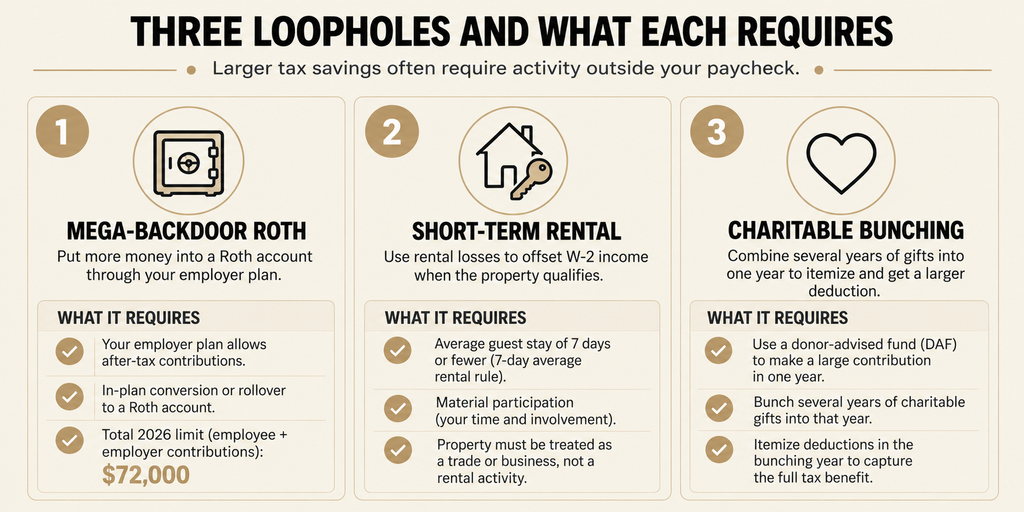
The strategies that work share one trait: they need activity outside your paycheck, such as extra plan contributions, a rental business, or planned giving. A review of your high-income tax planning options helps before you try any of them.
The mega-backdoor Roth
Some 401(k) plans accept after-tax contributions beyond the $24,500 deferral limit. The 2026 limit on total additions to a defined contribution plan is $72,000, excluding catch-up contributions. If your plan also permits in-plan Roth conversions or in-service withdrawals, you can move those after-tax dollars into Roth form.
Your plan document determines whether this is available, and the strategy builds tax-free growth instead of a current deduction, making it a core topic in retirement tax planning.
Short-term rentals and the real-estate route to offsetting W-2 income
A property whose average guest stay is seven days or less is not treated as a rental activity under the passive activity rules. If you also materially participate, its losses can be non-passive and may offset W-2 income.
Cost segregation and 100% bonus depreciation can enlarge first-year losses. Material participation requires meeting one of the IRS tests with documented hours, so the paperwork carries as much weight as the property.
Charitable bunching through a donor-advised fund
Bunching combines several years of gifts into one year, so itemized deductions exceed the standard deduction, then takes the standard deduction in the other years.
A donor-advised fund lets you claim the deduction in the year you fund it and send grants to charities later. With the new 0.5% floor applying each year, concentrating gifts also reduces how often the floor cuts your deduction.
An Advisor’s Take: Deductions Are the Floor, Not the Plan
Each deduction in this guide has a cap, a phase-out, or a filing rule. After you use the ones that apply to you, further savings depend on how your income is arranged.
Why structure and timing carry more savings than line-item write-offs
A deduction lowers the income tax you have already earned. Larger shifts come from choosing which year income lands in, which account holds it, and how a household’s income fits together.
Planners who offer individual tax planning can model those choices together, from splitting a bonus across years to timing charitable gifts. Tax loopholes for W-2 employees that hold up under review are structural moves of this kind, and the deeper playbook sits in our guide to tax strategies for high-income W-2 earners.
Important Note: Tax rules can change and may apply differently based on your circumstances. Consider speaking with a qualified tax professional before making a tax decision.
Conclusion
Tax deductions for W-2 employees run through payroll accounts, a short list of above-the-line items, and the itemized deductions that survived reform. Home office and mileage write-offs no longer apply on the federal return, but the 2025 to 2028 deductions for tips, overtime, car loan interest, and seniors add real value for eligible workers. The no-tax-on-overtime W-2 deduction covers only the premium portion of pay.
Premium Tax Planners helps employees match these tools to their income and timing. We review where your next dollar of savings sits and real tax loopholes for W-2 employees.
Schedule a consultation with us and map out which payroll, above-the-line, and loophole strategies fit your 2026 return.
FAQs
What can W-2 employees deduct in 2026? A W-2 employee can take the standard deduction, pre-tax 401(k) and HSA contributions, IRA contributions, student loan interest, educator expenses, and the 2025 to 2028 tips, overtime, car loan interest, and senior deductions. Itemizers can add SALT, mortgage interest, medical costs above 7.5% of adjusted gross income, and charitable gifts.
No. Among tax write-offs for W-2 employees, the home office is gone: employees cannot deduct one on the federal return, even with a full-time remote job. The deduction is limited to the self-employed. A separate side business may deduct a home office on Schedule C if you use the space regularly and exclusively for that business.
Yes, but each one needs activity outside your paycheck. The mega-backdoor Roth, short-term rental losses, and charitable bunching through a donor-advised fund all work within specific rules. Each depends on plan support or documentation, so confirm eligibility before acting.
Not entirely. The no-tax-on-overtime W-2 deduction covers only the premium portion of overtime pay, up to $12,500 for single filers and $25,000 for joint filers. It phases out above $150,000 and $300,000 of modified adjusted gross income, and payroll taxes still apply to all overtime pay.
Yes. Pre-tax contributions made through payroll reduce the wages in Box 1 of your W-2. Roth 401(k) contributions do not, because they use after-tax dollars. Your pay stub shows which type of contribution you are making.